
Review · WALKING TOURS
Dupont Circle and Embassy Row Architectural Walking Tour
Washington’s grandest residential street becomes much more interesting when you learn who once lived behind its stone facades. This two-hour Dupont Circle and Embassy Row walk takes you from a fountain designed by the team behind the Lincoln Memorial to mansions now used as embassies, clubs, and museums.
I like the mix of architecture and people. You will see Beaux-Arts, Neo-classical, Queen Anne, and other styles while hearing about Alice Roosevelt Longworth, the Hope Diamond, Woodrow Wilson, and the families who shaped Washington society. I also like the small-group format, capped at 20 people, which gives guides such as Sam, Natalie, Christine, and Mark room to answer questions.
The main thing to consider is that this is an outdoor tour. You will see the buildings from the street, and the route can feel tough in heavy rain, summer heat, or winter cold. One tour ran about 2 hours and 20 minutes, so do not schedule a tight appointment right afterward.
Key points at a glance
- See Embassy Row as a former millionaire’s address: Massachusetts Avenue was once lined with private mansions built to impress Washington society.
- Hear the stories behind the facades: The route connects buildings to the Hope Diamond, Alice Roosevelt Longworth, Woodrow Wilson, and other notable residents.
- Cover a surprising amount in two hours: The walk links Dupont Circle, Sheridan Circle, Kalorama, the Spanish Steps, and the Phillips Collection.
- Expect a story-led tour: Guides explain architectural styles, political life, social climbing, and the people who occupied these homes.
- Plan for outdoor conditions: There are no listed interior admissions, and the tour can run beyond its advertised two-hour length.
- Pay $48 for context, not entry tickets: The value rests in the guide’s interpretation and the small-group experience.
Why Dupont Circle is a smart starting point
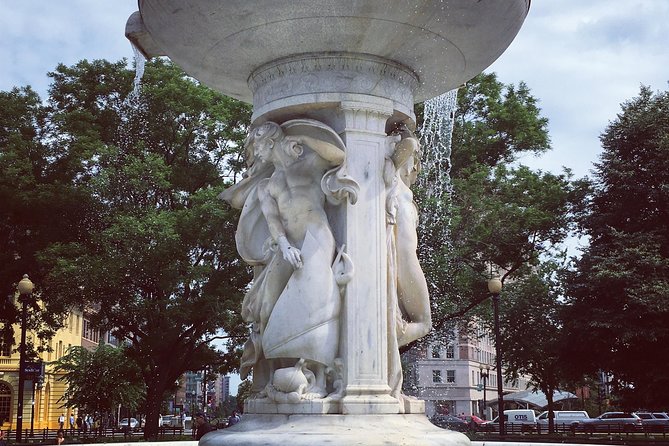
Dupont Circle is more than a convenient meeting place. Its round park and central fountain give you an immediate sense of the neighborhood’s scale, and the fountain was designed by the same firm associated with the Lincoln Memorial.
Your guide begins by explaining why the circle was established and how the surrounding district developed. That opening matters because the rest of the walk is not just a parade of attractive buildings. You get the social and political setting that made this corner of Washington a fashionable place to live.
The walk starts at Dupont Circle in northwest Washington, near public transportation. You will spend the full experience on foot, with short stops mixed into a steady stroll. Most people can take part, and service animals are allowed.
More Walking Tours in the USA
- The Official Art Deco Walking Tour by The Miami Design Preservation League
★ 5.0 · 1,580 reviews - Chicago in a Day: Food, History & Architecture Walking Tour
★ 5.0 · 1,153 reviews - Miami South Beach Art Deco Walking Tour
★ 5.0 · 1,039 reviews
Massachusetts Avenue and the old Millionaires Row
The strongest stretch of the tour follows Massachusetts Avenue, where private wealth once made a public display of itself. Industrial fortunes, newspaper money, political connections, and family status all found expression in large homes built along the avenue.
Today, many of those buildings serve as embassies, social clubs, offices, or cultural institutions. That change gives the walk a useful second layer. You are not only looking at old houses. You are seeing how Washington’s elite residential district adapted as the city’s social and diplomatic life shifted.
The architecture changes from one block to the next. You might see Neo-classical symmetry, Beaux-Arts ornament, Queen Anne details, and other period styles. You do not need a background in architecture to follow the tour. The guides explain what to look for, then connect those details to the people who commissioned the homes.
That people-centered approach is one reason the tour works for a mixed group. You can focus on columns, rooflines, windows, and stonework, or follow the stories of the social climbers and power brokers who wanted their homes to announce their place in Washington.
The Indonesian Embassy and the Hope Diamond connection
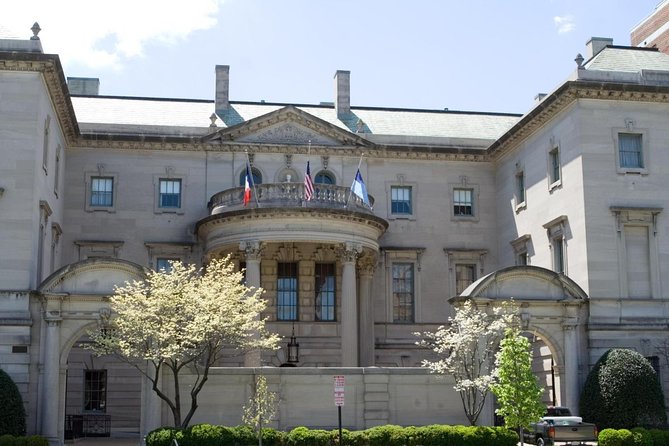
One early stop is the Embassy of Indonesia, known for its opulent appearance and its link to the Hope Diamond. The building was once associated with Evalyn Walsh McLean, whose name is closely tied to the famous blue jewel.
This is a good example of the tour’s method. A building that might seem closed and formal from the sidewalk becomes a doorway into Washington’s old social world. You hear how wealth, display, and celebrity worked together among the city’s upper class.
Keep in mind that the tour is primarily an exterior walk. The stop is brief, listed at about five minutes, so the value comes from the guide’s explanation rather than from an extended visit inside the property.
Anderson House and the Society of Cincinnati
Anderson House is an imposing mansion that once belonged to one of Washington’s wealthiest couples. It is now the headquarters of the Society of Cincinnati, described as the nation’s oldest patriotic organization.
The building helps show how these homes were designed to project status. Even from the street, the scale and formal character make clear that this was not an ordinary residence. Your guide places the house within the wider story of Washington’s wealthy families and the institutions that later took over their properties.
The nearby Cosmos Club and Society of Cincinnati also add to the sense that Embassy Row is not only about foreign missions. It is a district of clubs, political connections, private wealth, and old social networks.
Same city, a different facade:
- Chicago Architecture River Cruise
★ 5.0 · 15,756 reviews - Chicago River 90-Minute Architecture Tour
★ 4.5 · 9,629 reviews - Chicago River: 1.5-Hour Guided Architecture Cruise
★ 4.8 · 8,046 reviews - Chicago Architecture Center River Cruise aboard First Lady
★ 5.0 · 5,536 reviews
Turkish Ambassador’s residence and Sheridan Circle
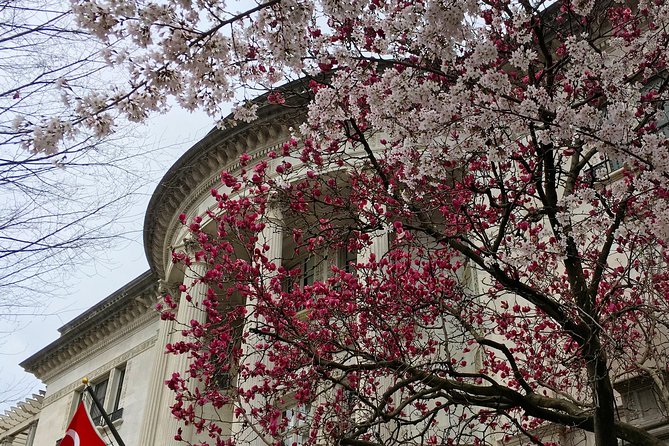
The residence of the Turkish ambassador is a Beaux-Arts mansion just off Sheridan Circle. The stop also connects the building to music history through Ahmet Ertegun, who got his start there.
That detail gives the tour a welcome change of subject. The route moves beyond presidents and diplomats into music, culture, and personal ambition. This is one of the pleasures of walking through a neighborhood where so many stories overlap.
Sheridan Circle brings a different mood. Its Civil War monument has an unusual backstory and was designed by the sculptor associated with Mount Rushmore. The monument gives your guide another chance to show how public art, national memory, and Washington’s grand avenues fit together.
The stop is short, about five minutes, but the circle is a useful pause in the route. It also offers a chance to look around before continuing toward Kalorama.
Kalorama, a quieter side of Embassy Row
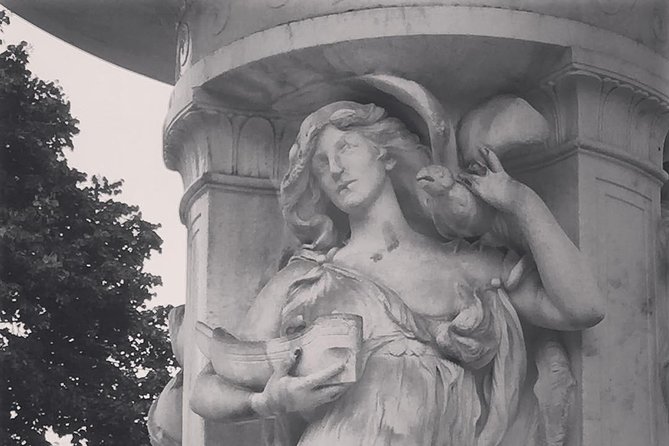
Kalorama means beautiful view in Greek, and the neighborhood feels quieter than the main avenue. The route uses this residential area to show where influential Washington figures chose to live away from the formal embassy strip.
This part of the walk is less about one famous facade and more about the atmosphere of the neighborhood. You will see how the grand homes and calmer streets fit together, and you will continue hearing about the people who gave Washington its peculiar mix of government, diplomacy, money, and society.
The guide may also point out the place known as the Hobbitt House, connected to artist Edward Lind Morse and his inventor father. It is an unusual personal story that breaks up the run of official buildings and famous residents.
Woodrow Wilson’s post-presidency home
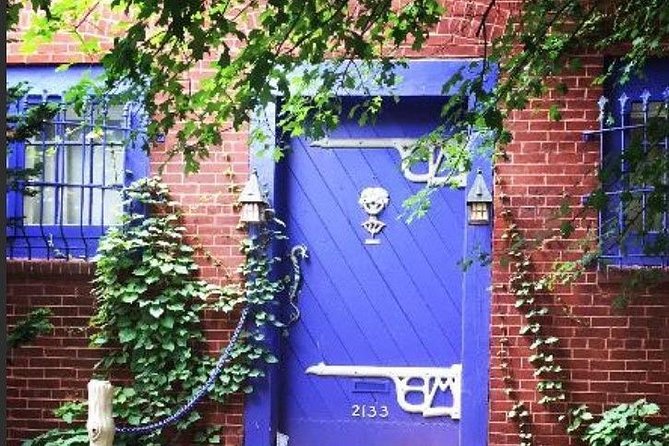
The route passes the former home of President Woodrow Wilson. This was his post-presidency residence, a useful reminder that Washington’s important addresses were not reserved only for people currently holding office.
The stop is listed at about five minutes. Admission to the Woodrow Wilson House is not included, so you should think of this as a street-side visit rather than a museum tour. If you want to explore the interior, you would need to arrange that separately.
That limitation is worth knowing before you book. The experience gives you a broad look at the neighborhood and its architecture, but it does not provide extended indoor access to the homes and embassies along the way.
Washington’s modest Spanish Steps
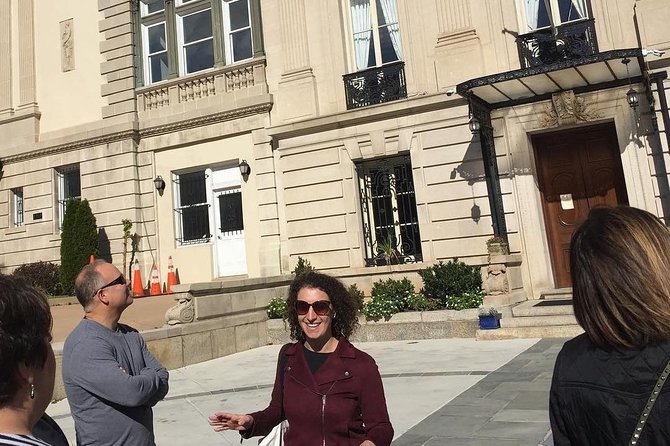
The Spanish Steps are one of the route’s quieter surprises. Washington’s version is much smaller than the famous landmark in Rome, but it creates a tucked-away place to pause in the middle of the city.
The setting adds variety to the walk. After grand avenues, diplomatic residences, and formal monuments, the steps offer a more intimate view of the neighborhood. You can see why this corner is often treated as a local curiosity rather than a major sightseeing stop.
The visit lasts about five minutes, but that is enough to appreciate the design and take a breather. It also gives you a useful reminder that Dupont Circle and Kalorama are not only districts of large houses. They include small public spaces with their own character.
Finishing near the Phillips Collection
The final stop is the Phillips Collection, described as the first modern art museum in the United States. The tour takes in its red-brick exterior before ending near 21st Street Northwest.
This is a sensible finish. You end beside a major cultural institution rather than back on a generic avenue, and you can use the location to continue your afternoon if you choose. The tour itself does not include admission to the museum, so treat the Phillips Collection as an exterior landmark and endpoint.
The listed endpoint is The Phillips Collection at 1600 21st Street Northwest. The route description also refers to returning toward Dupont Circle, so confirm the precise meeting and finishing instructions when you book, especially if you are arranging transportation or a timed museum visit afterward.
What the $48 price really buys you
At $48 per person, this is not a bargain-priced orientation walk. You are not paying for museum entry, transportation, food, or access to embassy interiors. You are paying for a local guide, a carefully planned route, and the stories that turn a series of closed buildings into a readable part of Washington.
I think the price makes sense if you care about architecture, American political life, or the people behind famous addresses. It is also useful on a first visit because it helps you understand a neighborhood that can otherwise feel like a pleasant but slightly mysterious collection of mansions.
The value is less clear if you prefer to explore at your own speed or want to enter several buildings. The tour moves through many stops in two hours, and most visits are short. You will gain context and a strong overview, not a series of long interior tours.
The small-group limit of 20 helps protect that value. It is large enough to keep the tour affordable, but smaller than a big sightseeing coach group. Guides have room for questions, and the experience feels more personal when the group is not spread across a whole sidewalk.
The guide makes the difference
This tour depends heavily on the person leading it. Sam is praised for strong storytelling, humor, and keeping the group engaged in difficult weather. Natalie is noted for clear explanations and for using supplemental images to help people picture former residents. Christine brings humor and a solid grasp of the architecture and local history, while Mark is described as considerate and well prepared.
Those details point to the tour’s real strength: it is not a lecture about building styles. The best guide connects design with ambition, family stories, politics, diplomacy, and odd personal details.
You can expect a guide-led experience in English. Because different guides may lead different departures, the exact tone can vary. The common thread should be a balance of architecture and history, but it is sensible to book this tour if you enjoy listening, asking questions, and walking at the group’s pace.
Pace, weather, and practical planning
The advertised duration is about two hours, but allow extra time. One departure lasted around 2 hours and 20 minutes, so do not book a timed activity immediately afterward.
The route is outdoors from start to finish. Summer heat and humidity can make the walk demanding, while winter wind and rain can also affect your comfort. Bring water in warm weather and wear shoes suited to city sidewalks. On wet days, an umbrella or rain jacket will help, although the guide cannot control the weather.
The tour is near public transportation, begins at Dupont Circle, and ends near the Phillips Collection. Confirmation is provided when you book. The tour requires a minimum number of participants, and if that minimum is not reached, you will be offered another date or experience, or a full refund.
Free cancellation is available up to 24 hours before the start time. Changes or cancellations made inside that window are not accepted for a refund.
Who should book this Dupont Circle walk?
I would choose this tour for anyone who wants more than postcard views of Washington. It suits couples, families with older children, solo visitors, and even people who already live in the area but have never learned the stories behind the buildings.
It is especially good for:
- Architecture fans who want an approachable introduction to several styles.
- First-time Washington visitors looking for a neighborhood walk beyond the National Mall.
- Repeat visitors who have already seen the major monuments.
- People interested in diplomacy, political society, and America’s wealthy families.
- Anyone who enjoys guided storytelling more than silent sightseeing.
It may not suit you if you need frequent indoor breaks, dislike walking in uncertain weather, or want to tour the interiors of embassies and historic homes. The route gives you a broad and thoughtful exterior view, but it cannot replace a dedicated museum or house tour.
Should you book it?
Book it if you want Washington’s grand homes to make sense. The strongest parts are the links between architecture and personal stories, from the Hope Diamond to Alice Roosevelt Longworth, Woodrow Wilson, Ahmet Ertegun, and the families who turned Massachusetts Avenue into a showcase of status.
At $48, the tour earns its price through interpretation rather than admission tickets. I would schedule it early in your Washington visit, when the local context can sharpen the way you see other neighborhoods. Just allow a little extra time, dress for the weather, and remember that you will be viewing most sites from the street.
FAQ
How long is the Dupont Circle and Embassy Row tour?
The tour lasts approximately two hours, though you should allow extra time because one departure lasted about two hours and 20 minutes.
Where does the tour begin?
It begins at Dupont Circle in Washington, DC 20036.
Where does the tour end?
The listed endpoint is The Phillips Collection at 1600 21st Street Northwest, Washington, DC 20009.
What language is the tour offered in?
The tour is offered in English.
How many people can join the tour?
The maximum group size is 20 travelers.
Is admission to the Woodrow Wilson House included?
No. Admission to the President Woodrow Wilson House is not included. The tour passes the former residence as part of the walking route.
Can I cancel for a full refund?
Yes. You can cancel at least 24 hours before the start time for a full refund. Cancellations or changes made less than 24 hours before the experience are not accepted for a refund.
Newly added in the USA
- Art Deco Tour of South Beach in French★ 4.5 · 8 reviews
- Award-winning Art Deco & Neon Lights Walking Tour★ 5.0 · 5 reviews
- Miami Beach Art Deco Segway Tour★ 4.5 · 17 reviews
- Boston: Freedom Trail History and Architecture Walking Tour★ 4.8 · 18 reviews
- Boston: Harbor and Charles River Architecture Boat Tour★ 4.6 · 9 reviews
- Chicago: Guided Tour with Architecture River Cruise★ 4.5 · 20 reviews
- Iconic Capitol Hill Architectural Walking Tour★ 5.0 · 21 reviews
- South Beach Food Tour- Culinary & Art Deco & History★ 5.0 · 22 reviews
Walking Tours, compared.
The Official Art Deco Walking Tour by The Miami Design Preservation League
Read our review →
Baroque Architecture and Underground Walking Tour
Read our review →
Chicago in a Day: Food, History & Architecture Walking Tour
Read our review →

Ramblas, Old Town, Gothic and Gaudi Architecture Walking Tour
Read our review →
Chicago’s Secret Interiors Architectural Walking Tour
Read our review →
Browse the lists this tour appears in