
Review · GUIDED
Modernism to Traditions from UAE to OMAN with Fully Live Guided Tour- 11D / 10N
Dubai’s glass towers are only the opening act here. This 11-day UAE and Oman journey moves from Burj Khalifa and desert camps to old forts, fishing towns, mountain wadis, and Oman’s quiet souks. I like the sharp contrast between modern Dubai and traditional Oman, and I like that the tour includes several meals, airport transfers, hotels, and a guide throughout.
The tradeoff is time. You cover a lot of ground, with several nine-hour days and a border crossing into Oman. The Wadi Shab walk, dune drives, and desert camp also call for decent stamina. This suits you best if you want broad coverage and help with the details, not a slow, stay-put holiday.
Key points at a glance
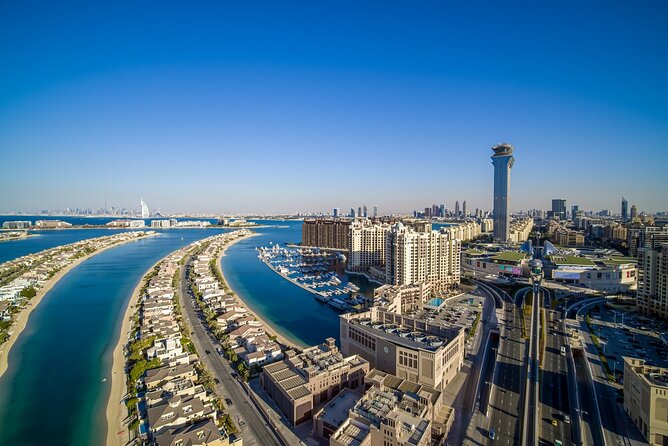
- Dubai’s modern face and old creek district: See Palm Jumeirah, Burj Al Arab, Jumeirah Mosque, Al Fahidi, Dubai Museum, and cross Dubai Creek by abra.
- Four different UAE perspectives: Abu Dhabi brings grand architecture and art, Al Ain adds oasis traditions, and Sharjah focuses on crafts, trade, and local culture.
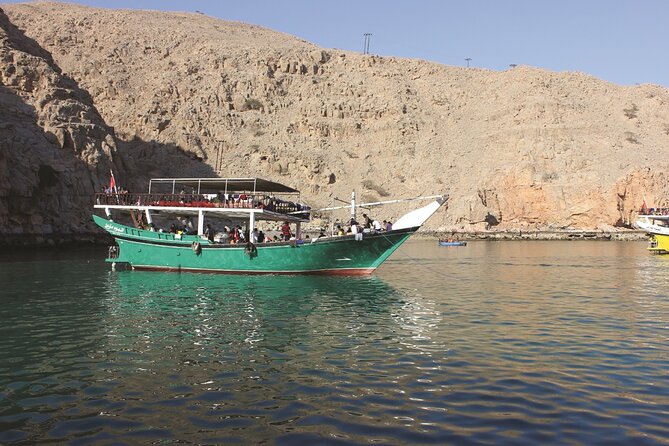
- Musandam by traditional dhow: Cruise among steep coastal mountains, with time for swimming, snorkeling, and a possible dolphin sighting.
- Oman’s strongest outdoor days: Expect Wadi Shab, Wahiba Sands, Wadi Bani Khalid, and long stretches of rugged coast.
- A practical guided format: Airport transfers, hotels, breakfasts, 10 lunches, 9 dinners, and full-time guide assistance are included.
- A fast pace with real variety: The maximum group size is 25, and the price is $1,828 per person.
Why this UAE and Oman route works
I see this trip as a sampler of two Gulf countries at very different stages of development. Dubai supplies the spectacle: giant malls, record-breaking towers, polished hotels, and a city built for speed. Oman slows the picture down with forts, fishing villages, mountain roads, frankincense scents, traditional sweets, and old trading towns.
The route also avoids making the whole holiday about one city. You visit Abu Dhabi, Al Ain, and Sharjah before crossing into Oman. That matters because each stop shows a different part of regional life. Abu Dhabi feels formal and civic, Al Ain is tied to oasis culture, and Sharjah puts more attention on traditional arts and customs.
At $1,828 per person, the price has to be judged against what is included. You receive 10 nights of accommodation, airport arrival and departure transfers, full-time guide assistance, breakfast each day, 10 lunches, 9 dinners, city tours, the Musandam cruise, desert transport, and several major admissions. Hotels are described as selected accommodations, but their names and star ratings are not supplied, so I would confirm those before paying.
The value is strongest if you would otherwise need to arrange several hotels, a cross-border transfer, a desert safari, a dhow cruise, and long-distance transport yourself. It is less appealing if you prefer to choose your own restaurants, linger in museums, or spend several days in one place.
More Guided Tours in the world:
- Chicago River: 1.5-Hour Guided Architecture Cruise
★ 4.8 · 8,046 reviews - Charleston: History and Architecture Guided Walking Tour
★ 4.8 · 349 reviews - Vienna: Spanish Riding School Guided Architectural Tour
★ 4.8 · 333 reviews
Dubai from the creek to the dunes
Your first day is simple: airport pickup, transfer by air-conditioned vehicle, hotel check-in, and an evening on your own. That is useful after a long flight, although dinner is not included that night.
Day two gives you Dubai in two very different settings. The morning tour begins around Atlantis on Palm Jumeirah, continues to a photo stop at Burj Al Arab, and passes through Jumeirah for a view of the Grand Mosque. These stops are mainly for orientation and photographs rather than long visits.
The more rewarding part for me is old Dubai. In Al Fahidi, you see the city’s earlier character and visit Dubai Museum in the old Al Fahidi Fort. The abra crossing of Dubai Creek is brief but worthwhile. It gives you a simple, local-feeling pause between the highways and towers.
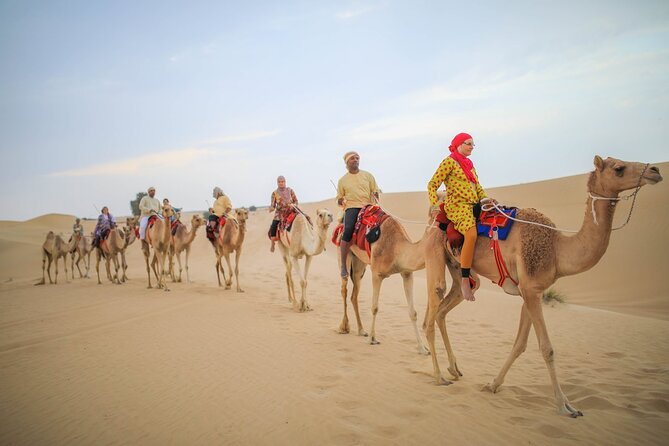
In the afternoon, you switch to four-wheel-drive vehicles for the desert safari. Dune driving is the main thrill, with steep climbs and drops across the sand. At the camp, you watch the sunset, eat a barbecue dinner, and see a belly dance performance. This is a packaged evening, not a quiet desert retreat, but it gives first-time visitors a clear taste of the familiar Arabian-night show.
You return to Dubai that night. The day lasts about nine hours, so plan for a full schedule and plenty of time seated in vehicles.
Abu Dhabi’s grand architecture and public culture
Abu Dhabi arrives on day three. The route starts on Yas Island, home to the Formula 1 circuit and Ferrari theme park, before moving to Sheikh Zayed Grand Mosque. The mosque is the day’s major architectural stop, with space for more than 30,000 worshippers and a design that combines polished modern work with Islamic tradition.
Dress rules matter at the mosque. The supplied information does not spell them out, so ask the operator before departure. As with any religious site, build in patience for entry procedures and follow the guide’s instructions.
After lunch, the day turns toward public history and city views. Heritage Village presents daily life before oil, while the Corniche gives you a broad look at Abu Dhabi’s white mosques, offices, and high-rise housing. Qasr Al Hosn adds an important link to the ruling family and the city’s earlier development.
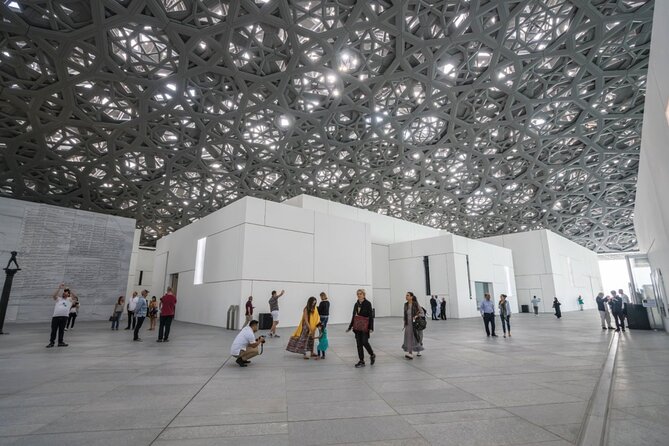
The final major stop is Louvre Abu Dhabi on Saadiyat Island. The museum brings art and civilization into the tour, giving you more than architecture and shopping. Since the day is packed, your time inside the museum may feel limited. If art is a top priority, check how long the visit lasts.
Al Ain and Sharjah bring the past closer
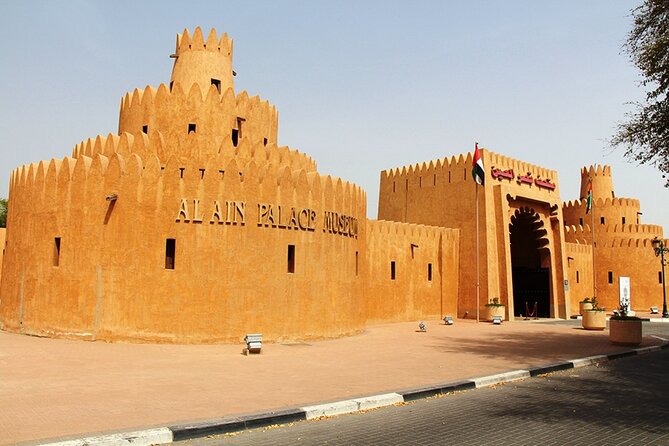
Al Ain on day four feels far removed from Dubai’s polished center. The city grew around oasis routes used by caravans, and the stop at Jebel Hafeet gives you a strong mountain view. Lunch follows in the city, then you visit the camel market, Jahili Fort, Al Ain Palace, and Qasr Al Muwaiji.
These sites help explain the UAE before its oil wealth. Jahili Fort shows local military architecture, while Al Ain Palace connects directly with Sheikh Zayed Bin Sultan Al Nahyan’s time in the city. Qasr Al Muwaiji adds more political and regional context.
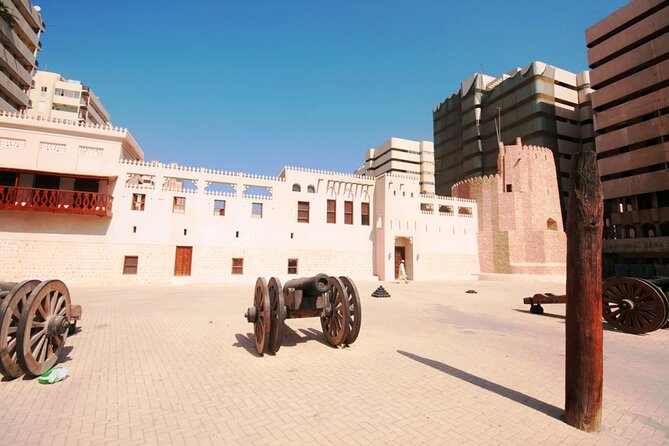
Day five begins at Hili Gardens, known for archaeological remains from the third millennium B.C. After the drive toward Dubai and Sharjah, you visit King Faisal Mosque, Sharjah Fort, and Sharjah Heritage Museum. The museum focuses on pearling, fishing, education, currency, early postal services, jewelry, clothing, herbal medicine, music, and folklore.
I especially like the combination of museum and market. At Souk Al Arsa, you see a traditional shopping setting and may watch Omani halwa being made. Lunch is a local mandi meal, usually meat or fish served with spiced rice. This is one of the better food stops because it connects the meal to the region’s Bedouin traditions.
The day ends at Dubai Mall, with free time for shopping and an optional Burj Khalifa visit. The tower visit must be booked in advance, and it is not included as a standard admission. That distinction matters. If the observation deck is a must for you, arrange it before the tour rather than assume there will be space.
A few more architecture walks in the world worth a look
- Chicago Architecture River Cruise
★ 5.0 · 15,756 reviews - Chicago River 90-Minute Architecture Tour
★ 4.5 · 9,629 reviews - Chicago Architecture Center River Cruise aboard First Lady
★ 5.0 · 5,536 reviews - Chicago: Architecture River Cruise Skip-the-Ticket Line
★ 4.8 · 4,325 reviews
Musandam’s fjord-like coast by dhow
Day six crosses into Oman’s Musandam Governorate for a full-day dhow cruise. The peninsula is famous for steep Hajar Mountain slopes dropping toward the Gulf of Oman, with coves, caves, pebble beaches, and sheltered water.
The traditional dhow is fitted with cushions, carpets, and seats. Lunch is served on board, and the day includes time for swimming, snorkeling, and playing in the water. Fish, coral, turtles, and other marine life may be seen, and dolphins are possible, but no wildlife sighting is guaranteed.
Bring your passport. Police checks require it, and the border rules deserve serious attention. Your passport must be valid for at least six months, and your Emirates ID must be valid for at least three months. The listed exit fee is AED 31. Some UAE residents receive a free Oman visa, while others pay AED 50.
Single-entry UAE visa holders cannot take this trip into Oman. Multiple-entry UAE visa holders are allowed, and some nationalities with low-skilled professions may not be permitted to cross the border. Confirm your eligibility before booking, not at the border.
You return to Dubai after the cruise. This is a long day, but the change from city streets to open water makes it one of the route’s most memorable sections.
The road to Muscat through Hatta and Sohar
On day seven, you leave Dubai for Muscat by bus, passing through Hatta. The drive covers mountain country and includes the option to see Hatta’s heritage village, old mosque, military towers, and nearby rock pools, though the supplied schedule does not clearly state how much time is allocated there.
Lunch is in Sohar, Oman’s third-largest city. You take an orientation tour, stop at Sohar Mosque, and visit an Omani halwa factory. The factory visit gives you a practical look at how this distinctive sweet is made, rather than only seeing it packaged in a shop.
The route continues through Barka and Seeb before reaching Muscat near the end of the day. Dinner is at the hotel. This is mainly a transport day, so do not expect a long list of major sights. Its value is in the gradual change from the UAE into Oman.
Muscat’s mosque, old harbor, and Muttrah Souk
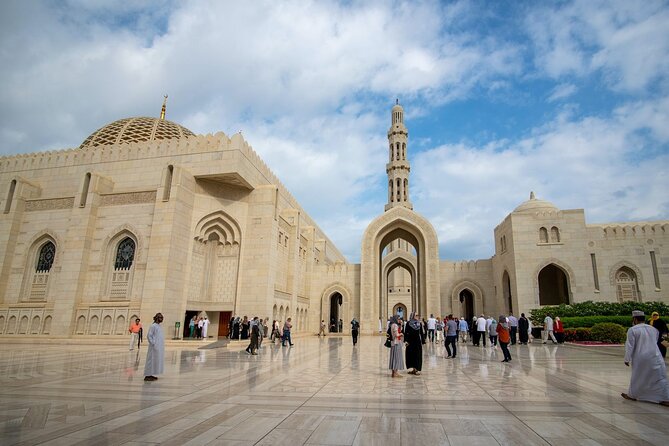
Day eight is Muscat’s main city day. The morning begins with a group briefing and guide introduction before you visit the Sultan Qaboos Grand Mosque. The building is presented as a modern religious landmark that also reflects Omani values and Islamic design.
You then visit the Royal Opera House, another polished expression of modern Oman. Lunch is at a fish restaurant with local diners, which gives the meal a more grounded setting than a hotel buffet.
Old Muscat brings the strongest sense of place. The city is surrounded by steep mountains and marked by the 16th-century forts of Jalali and Mirani. You see Al Alam Palace, the ceremonial palace associated with the Sultan, then visit Bait Al Zubair Museum.
The museum displays Omani weapons, jewelry, costumes, household objects, and recreated urban and rural settings. It helps explain the country through everyday objects, not just grand buildings.
Finish at Muttrah, Muscat’s main port and commercial center. The souk has winding lanes lined with textiles, jewelry, frankincense perfumes called bukhoor, souvenirs, and antiques. Dinner is at a traditional Omani restaurant. This is one of the tour’s strongest days because it balances architecture, food, museum displays, and ordinary shopping streets.
Wadi Shab, Sur, and a night in Wahiba Sands
Day nine is one of the most active. You travel along a dramatic stretch of Oman’s coast, stop at the Bimmah Sinkhole, and continue toward Fins and Wadi Shab. At the wadi, you have time to admire the scenery and walk a little before lunch.
The phrase walk a little should not be taken as a promise of an easy stroll. One of the trip’s strongest warnings is that the wadi section requires stamina. Wear shoes suitable for uneven ground and bring what you need for a warm outdoor day. The exact walking length is not provided, so ask the guide on the morning of the visit.
The route then reaches Sur, a seafaring town known for traditional dhow building and its position on the bay. After a quick city visit, you continue through coastal villages toward Wahiba Sands.
At the desert edge, you transfer to 4×4 vehicles for dune driving. The shifting sand supports desert plants and wildlife, and Bedouin families have lived in the region for thousands of years. Dinner is at a desert camp, followed by an overnight stay in Wahiba Sands.
This is an excellent day for you if you enjoy outdoor scenery and road travel. It is not ideal if you need lots of free time or find long drives tiring.
Wadi Bani Khalid and the old capital of Nizwa
Day ten starts with another 4×4 transfer out of the desert. You then reach Wadi Bani Khalid, a green valley surrounded by rugged mountains. You walk through the wadi and have time for photographs before lunch and the drive to Nizwa.
Nizwa was once Oman’s capital and a major center of learning. The souk is known for silver jewelry, and the Friday cattle auction is a notable local event, though the schedule does not guarantee that your visit falls on Friday.
You get an orientation of the old city, visit the souk, and check into the hotel. The pace is easier than the previous day, but this remains a road-heavy trip.
Jabreen, Bahla, and the return to Muscat
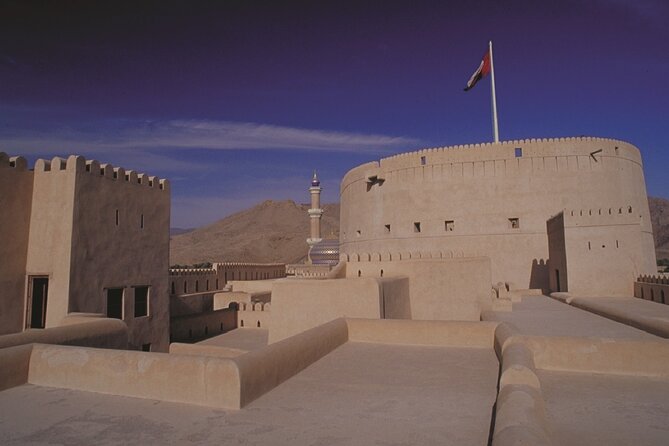
The final day begins near Nizwa with Birkat Al Mawz, an ancestral village at the foot of Jebel Akhdar. The route then continues to Jabreen Fort, a 17th-century building noted for its plasterwork, carved doors, and painted ceiling beams.
You pass through Bahla, with an outside view of its fort, and stop at Al Hamra’s palm groves to see the falaj irrigation system. These water channels are a practical reminder of how communities farmed in dry conditions.
After lunch, you continue toward Muscat, passing through the Jebel Shams area of the Hajar Mountains before an evening airport transfer. Because the departure transfer follows a full sightseeing day, confirm your flight time carefully and keep your luggage arrangements simple.
Who should book this tour?
Book it if you want one organized trip covering both the UAE and Oman, especially if border paperwork, long transfers, and desert transport would be difficult to manage alone. It is also a good match for solo passengers, since the group setting gives you company and the guide handles much of the daily structure.
Think twice if you want a relaxed holiday. The schedule includes repeated nine-hour days, long drives, early starts, active wadi walks, dune rides, and several hotel changes. The maximum group size is 25, which is manageable but not intimate.
The cancellation terms are fairly clear: cancel at least six full days before the start for a full refund. Cancellations two to six days ahead receive 50 percent, while cancellations less than two days ahead are not refunded. Bad weather or failure to meet the minimum group size can lead to a new date, another experience, or a full refund.
FAQ
How long is the tour?
The tour lasts 11 days and includes 10 nights of accommodation.
What is the price?
The listed price is $1,828 per person.
What meals are included?
Breakfast is included for 10 days, lunch for 10 days, and dinner for 9 days. Dinner on the first arrival night is on your own.
Are airport transfers included?
Yes. Arrival and departure airport transfers are included.
Is a guide provided throughout the trip?
Yes. Full-time guide assistance is included, with tours available in English, French, and Italian.
What is the maximum group size?
The maximum group size is 25 people.
Do I need a passport for the Musandam cruise?
Yes. You must carry your passport because it is required for police checks.
Can every UAE visa holder enter Oman on this tour?
No. Single-entry UAE visa holders cannot travel to Oman on this trip. Multiple-entry UAE visa holders are allowed, while some nationalities with low-skilled professions may not be permitted to cross the border.
Is the Burj Khalifa visit included?
No. A visit to Burj Khalifa is offered as an optional extra and must be booked in advance.
Newly added in the world
- Venice Art and Architecture Private Walking Tour★ 4.5 · 11 reviews
- Basilica San Marco and the Pala d’Oro with Architect Guide★ 4.5 · 19 reviews
- Walking tour in Venice with an architect★ 5.0 · 16 reviews
- Neoclassical Paris Architecture 2-Hour Private Walking Tour★ 5.0 · 7 reviews
- Street Art and Architecture:Porto Speaks Through Its Streets★ 3.0 · 2 reviews
- Wrocław Architecture Cruise by Catamaran★ 4.7 · 25 reviews
- Paris: Discover the hidden architecture gems of Le Marais★ 3.8 · 4 reviews
- Porto Tour: Street Art & Architecture Experience 3h★ 5.0 · 4 reviews
Guided, compared.

Chicago River: 1.5-Hour Guided Architecture Cruise
Read our review →
Park Güell: Guided Tour with Optional Gaudí Experience Entry
Read our review →

Vienna: Spanish Riding School Guided Architectural Tour
Read our review →
Charleston History, Homes, and Architecture Guided Walking Tour
Read our review →
Casa Vicens, Pedrera, and Casa Batlló Guided Tour
Read our review →Browse the lists this tour appears in