
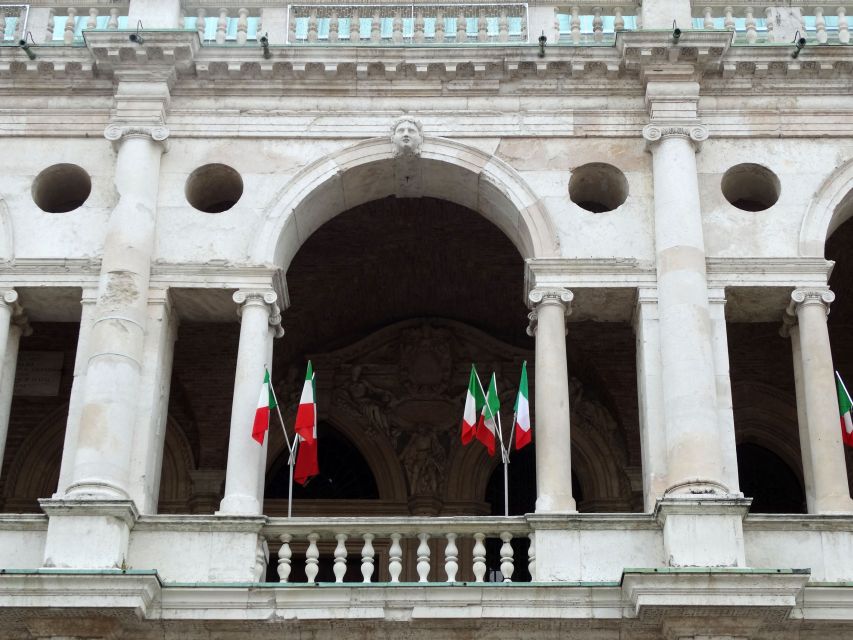
Review · WALKING TOURS
Vicenza: Palladian Architecture Private Walking Tour
Vicenza is one of Italy’s best cities for seeing architecture in its original setting, and this private walk puts Andrea Palladio at the center of the story. In two hours, you move from the Olympic Theater and Chiericati Palace to Corso Palladio and Piazza dei Signori, where Renaissance façades, medieval towers, cafés, and civic buildings share the same compact city center.
I like the private format, which lets you ask questions without keeping pace with a large group. I also like the clear focus on Palladio, whose work in Vicenza influenced buildings far beyond Italy, including the design tradition behind the White House. The main drawback is that the major sights are viewed from outside, so you should not book this expecting interior visits or museum admission.
Key points
- Palladio takes center stage: The walk explains how one Vicentine architect changed Renaissance architecture in Italy and abroad.
- Exterior sightseeing only: The Olympic Theater, Chiericati Palace, Basilica Palladiana, and Captain’s Palace are admired from the outside.
- A compact historic center: Corso Palladio links several major sights with shops, cafés, churches, and medieval towers.
- Private groups up to 15: You get a guide for your own party rather than joining a mixed group.
- Two languages available: Tours are offered in English or Italian.
- Value depends on group size: The $328.53 price is per group, not per person, so it makes far more sense for a larger party.
Why Vicenza is the right place for a Palladian walk
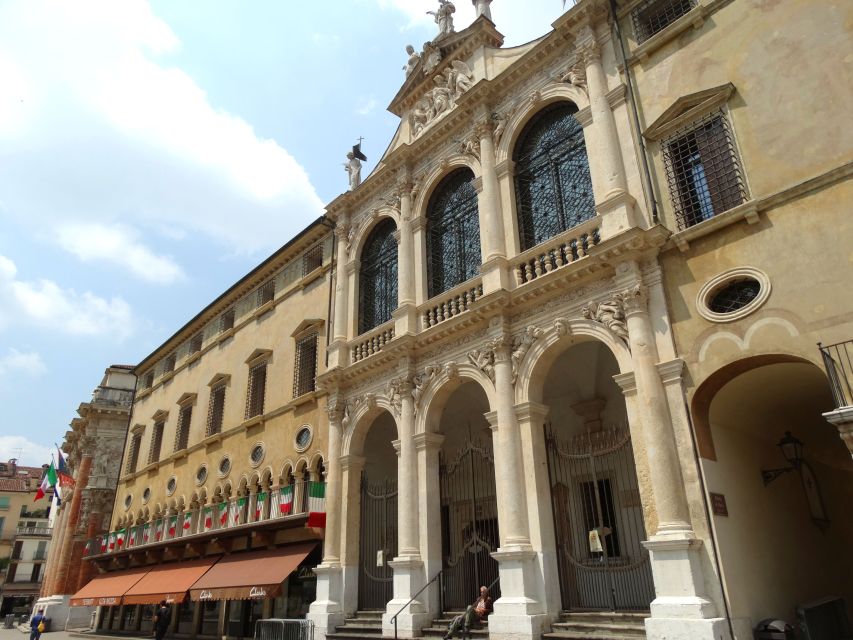
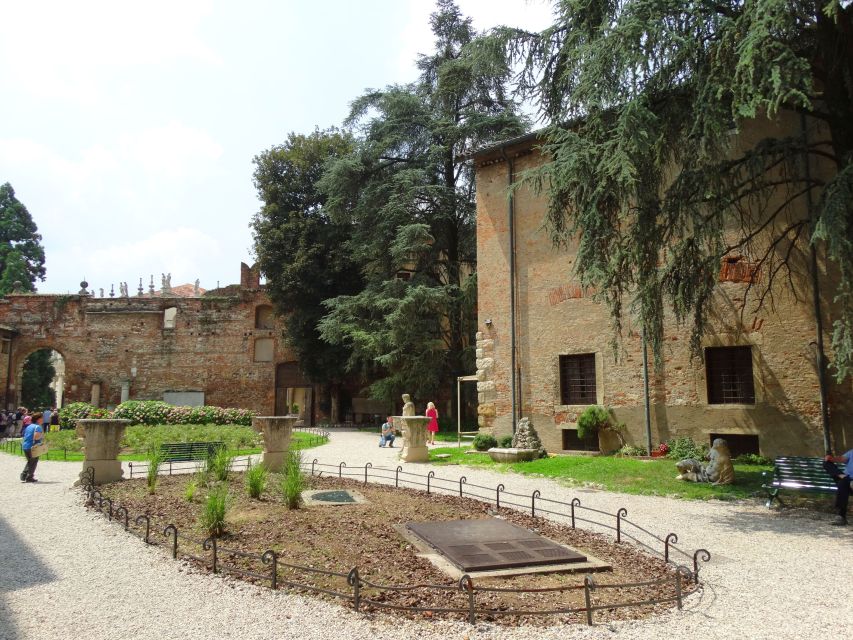
Palladio did not merely leave one grand building behind. He helped give Vicenza its architectural identity, and his work appears throughout the city center in palaces, public buildings, and carefully balanced façades.
That makes Vicenza especially suited to a walking tour. You do not need a bus or a long transfer between sights. The buildings sit along streets and squares where daily city life continues around them. A café table, a shopfront, a church, and a Renaissance palace may all appear within the same short stretch.
I find this kind of tour most useful when you want the city to make sense as a whole. A building can look attractive on its own, but a guide can explain why Palladio used columns, loggias, stairways, and classical proportions in a particular way. The tour gives you a framework for noticing those details as you continue walking around Vicenza on your own.
The focus also helps if your time in Veneto is limited. Venice receives most of the attention, while Vicenza offers a calmer architectural stop with a strong identity of its own. This tour does not try to cover every church and museum. It keeps the subject narrow and gives you a practical introduction to Palladian Vicenza.
More Walking Tours in Italy
- Lecce: Baroque Architecture and Underground Walking Tour
★ 4.6 · 1,248 reviews - Experience Florence’s Art and Architecture on a Walking Tour
★ 5.0 · 318 reviews - Palermo: Art and Architecture Walking Tour
★ 4.7 · 136 reviews
Meeting at Piazza Castello
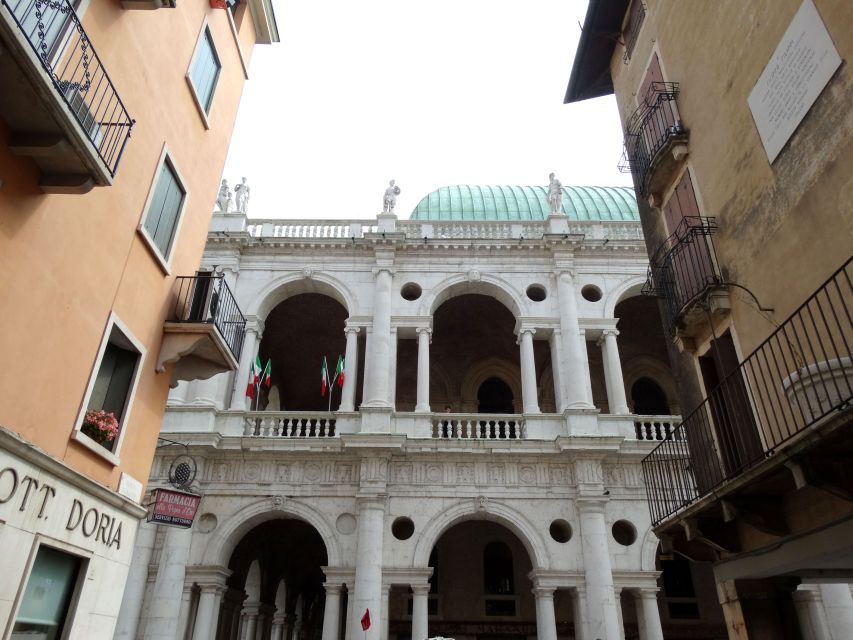
The tour begins at Piazza Castello, beside the statue of Giuseppe Garibaldi. Look for a guide wearing a clearly visible license badge around the neck. The activity ends back at the same meeting point, which makes the walk easy to fit into a day of independent sightseeing.
Starting and finishing in the same place is helpful if you arrive by train, are staying in central Vicenza, or want to continue exploring after the tour. You do not need to arrange a separate pickup or figure out a return transfer.
The meeting information is simple, but punctuality still matters. This is a private tour with a fixed two-hour duration, so a late start can reduce the time available for questions and explanations. Check the available start times when booking, since the exact departure time is not fixed in the basic description.
The Olympic Theater and Chiericati Palace
The first major stop is the Olympic Theater, viewed from the outside. It was designed by Palladio and is described as the oldest stable covered theater of the modern era. Even without entering, the building gives you an immediate sense of the classical ideals that shaped his work.
The exterior visit is also the first point where you should set your expectations. The tour does not include a theater ticket, and the listed plan specifies an outside visit only. If you want to see the interior, its stage design, or its famous perspective effects, you will need to arrange that separately and pay any admission required.
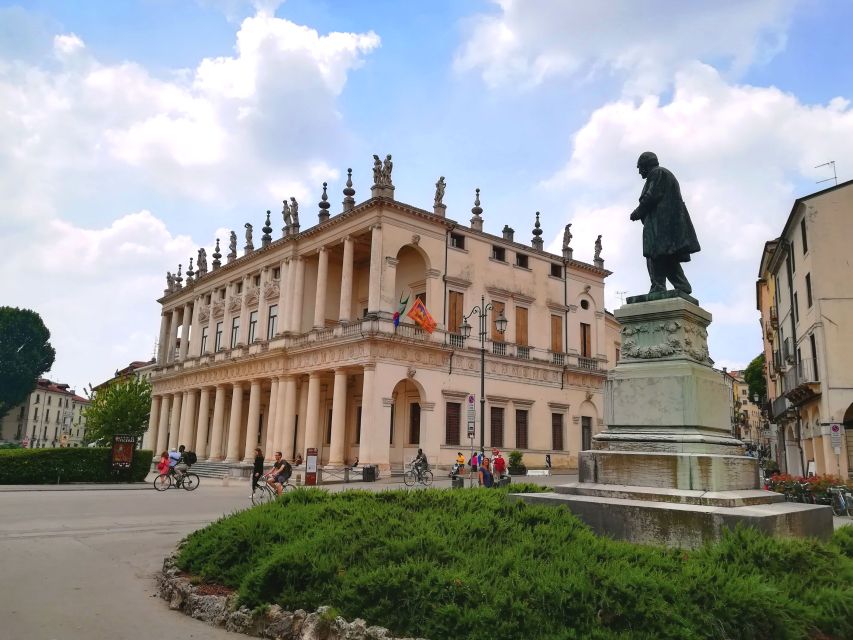
In the same square is Chiericati Palace, another Palladian work from the 16th century. Its design includes a distinctive staircase and broad loggias on the noble floor, features that are easier to appreciate when a guide points them out from the square.
The palace now houses the Civic Museum, with works of significant artistic value, but museum entry is not included. That can be either a useful saving or a limitation, depending on your plans. If you mainly want architecture and city orientation, the exterior may be enough. If you hope to see the collections, treat this walk as an introduction and allow extra time for a separate museum visit.
Walking Corso Palladio
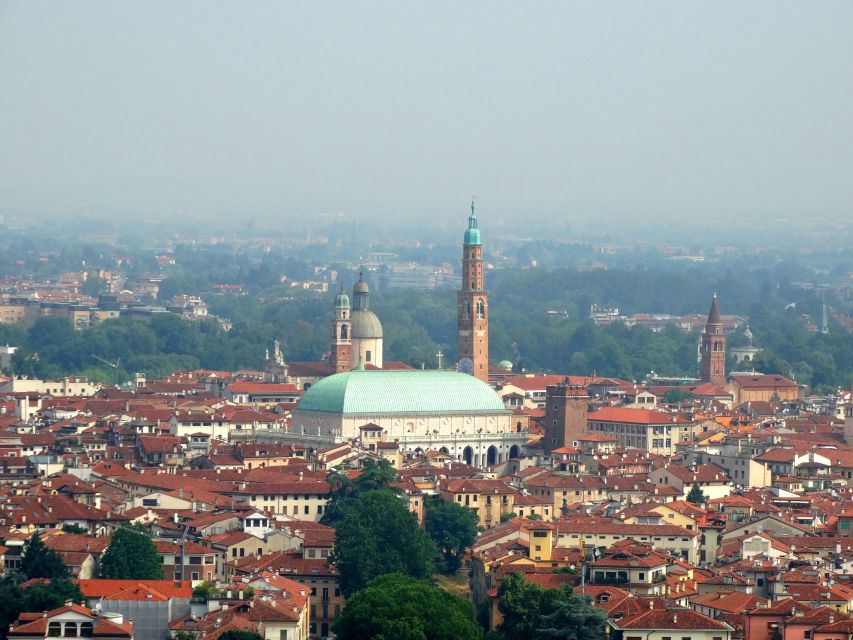
From the opening sights, the route continues along Corso Palladio, the main street crossing Vicenza. This is where the tour shifts from individual monuments to the way Palladian buildings fit into the wider city.
The street brings together historic palaces, churches, medieval towers, shops, cafés, and taverns serving Venetian specialties. That mixture gives the walk a more useful feel than a simple parade of façades. You see how Vicenza’s grand architecture shares space with ordinary city life.
I like this part of the route because it gives you practical bearings. After the tour, Corso Palladio can serve as your main reference point for returning to central sights, stopping for a coffee, or finding a place to try a spritz. The tour description also points to taverns with traditional Venetian products, so you can use the walk to plan a meal or aperitivo afterward.
Do not expect a long food tour or dedicated shopping time. The cafés and taverns are part of the street setting, not scheduled tastings. The real subject remains architecture, with the street acting as the link between the principal monuments.
Same city, a different facade:
- Naples: San Gaudioso Catacombs Guided Tour
★ 4.7 · 1,105 reviews - Caprarola: Villa Farnese, masterpiece of Renaissance architecture
★ 4.5 · 28 reviews - Best of Bologna in one day : Food, architecture, art and history
★ 5.0 · 27 reviews - City Walk with Architect: Private walking tour of Rome
★ 5.0 · 22 reviews
Piazza dei Signori and the center of city power
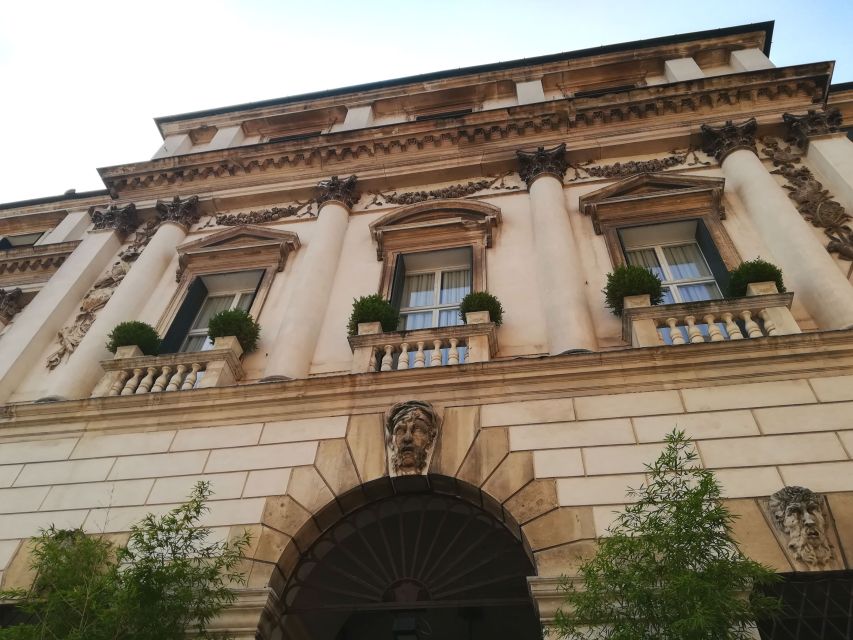
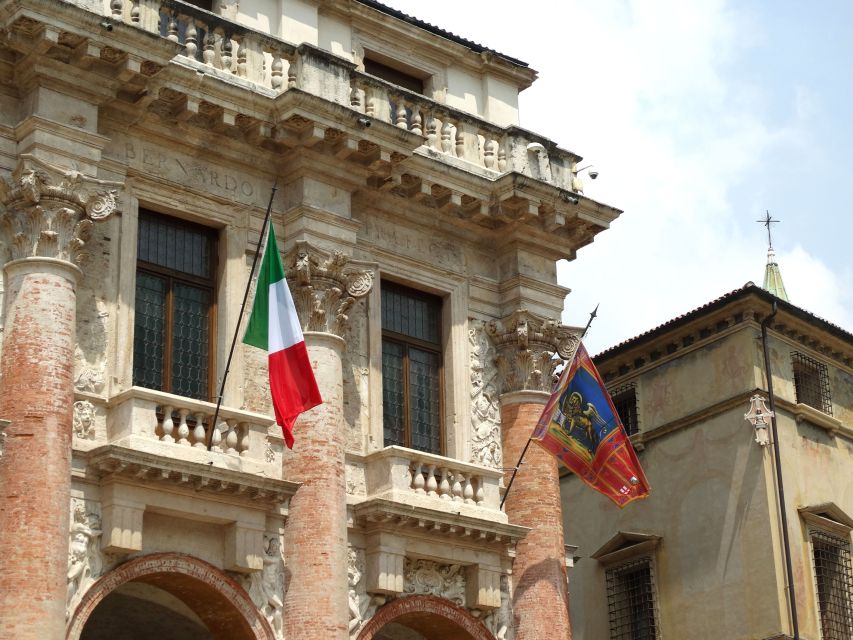
The tour continues to Piazza dei Signori, Vicenza’s main civic and social square. This is the point where several layers of the city gather in one view, including the Basilica Palladiana, Bissara Tower, Monte di Pietà Palace, Church of San Vincenzo, and Captain’s Palace.
The square begins with two columns dedicated to Venice, also called the Serenissima. One carries the Lion of Saint Mark, while the other features Christ the Redeemer. These details connect Vicenza to the wider Venetian state and help explain why local public buildings carry such a strong Venetian character.
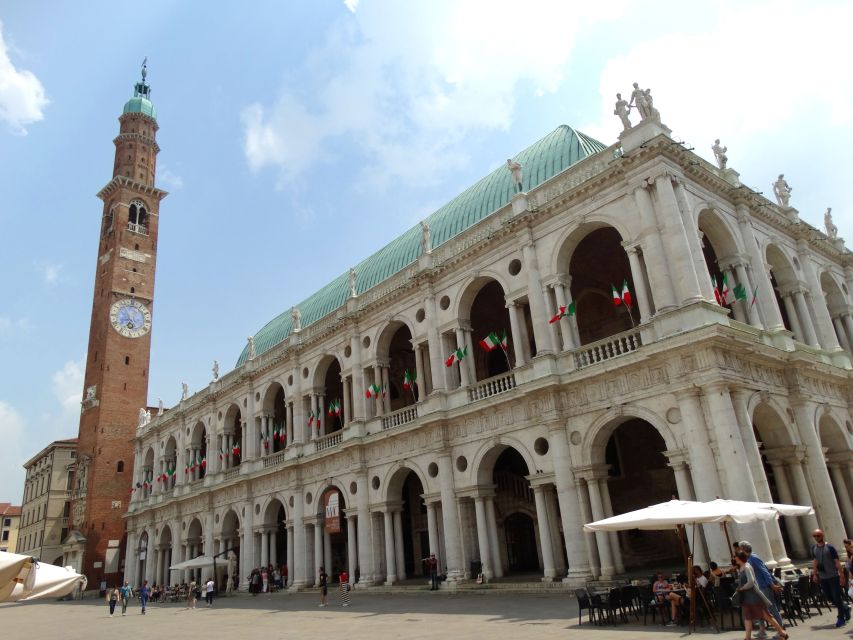
The Basilica Palladiana dominates the square. Despite its name, it is not a religious basilica. Palladio used the classical term in honor of Roman antiquity, while the building itself served civic purposes and housed municipal councils. It was built around the older Palace of Reason, giving the site both medieval and Renaissance layers.
From outside, focus on the marble staircase, the repeated loggia, and the green copper roof. Together, they give the building its unmistakable profile. The façade is a good example of Palladio’s method: take classical forms and adapt them to a practical urban building.
Again, the visit is exterior only. If you want to see the interior of the Basilica or attend a special exhibition, you must handle admission separately. The advantage of the guided exterior visit is that you can understand the building before deciding if further exploration is worth your time.
Bissara Tower and Captain’s Palace
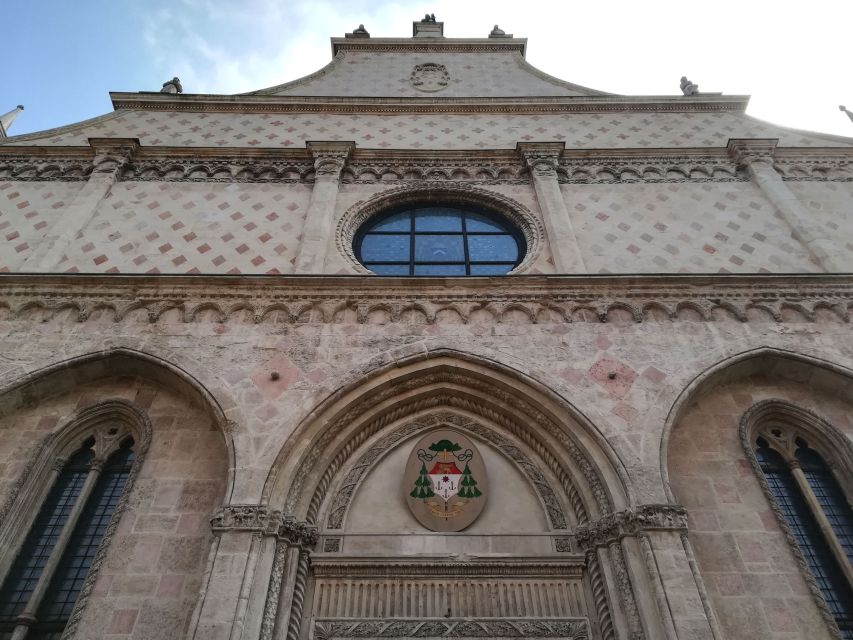
Next to the Basilica is the Bissara Tower, which rises 82 meters above Vicenza. Its height makes it visible from many parts of the city, and it gives Piazza dei Signori a strong vertical marker beside the long horizontal lines of the Basilica.
The tower is not a Palladian building, but it adds important contrast. Vicenza is not a city made only of Renaissance palaces. Medieval elements remain part of the urban view, and the tower helps you see how older structures sit alongside Palladio’s classical designs.
The Captain’s Palace provides another direct connection to Palladio. This Renaissance building is decorated with columns, statues, and other architectural details, and it now serves as the seat of the Town Council.
That current civic role matters. You are not looking at an isolated museum piece. The palace still belongs to the working public center of Vicenza, just as the Basilica still reflects the city’s communal and political life. The tour helps you read the square as a place of government and commerce, not simply as a backdrop for photographs.
What a private guide adds in two hours
A private group can include as many as 15 people, though the value changes depending on how many are in your party. At the full group size, the $328.53 cost works out to about $22 per person. For two people, it is roughly $164 each, before any museum or attraction tickets. That is a major difference.
I would consider this tour best for a family, group of friends, or organized party that wants a dedicated guide. The private format lets you ask about Palladio, Vicenza, local buildings, or the route without competing with strangers for attention.
The guide speaks either English or Italian, and the experience includes a licensed tour guide. One especially positive piece of feedback described the guide as friendly, responsive, and willing to answer questions. That is important here because the value of an exterior architecture tour depends heavily on explanation. Without context, a loggia can look like just another elegant façade. With a good guide, its purpose and design become easier to understand.
The feedback is not uniformly positive. The overall score is 3.3 from three ratings, and one low rating describes a shorter visit and a price that felt too high. That criticism is worth taking seriously, especially for a small party paying the full group price. The tour is advertised as two hours, so you may want to keep an eye on the timing and confirm the route at the start.
The low rating also refers to a theater visit in Padua, which does not match the Vicenza route described here. That mismatch makes the comment less useful for judging this exact walk, but it still reinforces a sensible point: confirm what will be visited and what will be seen only from outside.
Who will get the most from this walk
I would choose this tour if you want an architectural introduction without spending a full day in museums. It suits first-time visitors to Vicenza, people making a short stop in the Veneto, and anyone curious about why Palladio matters beyond Italy.
It is also a good fit for visitors who like to walk at an easy city pace and pause for questions. The route connects major sights rather than rushing through a long list of minor ones. You get a clear central orientation, then can decide where to return for a longer visit.
This may not be the right choice if you want extensive interior access. The Olympic Theater, Chiericati Palace, Basilica Palladiana, and Captain’s Palace are presented externally, and attraction tickets are not included. You should also compare the cost with a self-guided visit if your group has only one or two people and you mainly want photographs.
The tour is less suitable for anyone looking for a food-focused outing, a broad survey of all Vicenza attractions, or a long historical walk outside the city center. Its strength is a concentrated Palladian route.
Practical details before you book
The activity lasts two hours, so wear comfortable walking shoes and plan to remain on foot through the central streets and squares. No transportation is listed as part of the experience.
English and Italian are available. At the meeting point, look for the guide’s visible license badge beside the Garibaldi statue in Piazza Castello.
The booking terms are flexible: you can cancel up to 24 hours before the start for a full refund, and you can reserve now while paying later. These terms are useful if you are still arranging a Veneto itinerary.
Remember that the price is $328.53 per group of up to 15, not $328.53 for each person. Museum and attraction tickets are extra. Ask yourself two questions before paying: how many people are in your group, and do you want an exterior architecture walk or interior visits?
Should you book the Vicenza Palladian Architecture walk?
Book it if you have a medium or large private group and want a focused explanation of Palladio’s most important city buildings. The route is compact, the meeting plan is straightforward, and the guide can help turn façades and squares into a coherent story.
For a couple or solo visitor, the price requires more thought. You may still value the personal attention, especially if architecture is a main reason for visiting Vicenza, but the cost per person is high. You should also reserve extra time if you want to enter the Civic Museum, Olympic Theater, or other attractions.
The best choice is to treat this as a guided exterior introduction, not a ticketed monument tour. If that matches your plans, it can give you a strong understanding of Vicenza in two hours. If interior access matters most, book the walk only if you are comfortable arranging those visits separately.
FAQ
Where does the Vicenza Palladian Architecture tour begin?
It begins at Piazza Castello, beside the statue of Giuseppe Garibaldi. The guide will wear a clearly visible license badge.
Where does the tour end?
The activity ends back at the meeting point in Piazza Castello.
How long does the tour last?
The walking tour lasts two hours. Available starting times are shown during the booking process.
Is this a private tour?
Yes. It is a private group activity for up to 15 people.
What languages are available?
The tour is offered in English or Italian.
Are museum and attraction tickets included?
No. Museum and attraction tickets are not included, and the listed visits to the Olympic Theater, Chiericati Palace, Basilica Palladiana, and Captain’s Palace are external visits.
Newly added in Italy
- Private Personalized Architecture Tour of Rome with an Architect★ 5.0 · 5 reviews
- Architectural Milan: Private Tour with a Local Expert★ 4.5 · 2 reviews
- The Architect’s Water★ 4.5 · 11 reviews
- Architectural Florence: Private Tour with a Local Expert★ 5.0 · 3 reviews
- Rione Sanità: tour among street art, architecture, folklore★ 4.5 · 2 reviews
- Palermo Tour: Magnificent Mixture Of Architectural Styles★ 4.2 · 6 reviews
- Discover Coppedè in Rome: Liberty architecture, symbols, and jewels★ 5.0 · 2 reviews
- Bologna: Guided Architecture Walking Tour★ 4.5 · 2 reviews
Walking Tours, compared.
The Official Art Deco Walking Tour by The Miami Design Preservation League
Read our review →
Baroque Architecture and Underground Walking Tour
Read our review →
Chicago in a Day: Food, History & Architecture Walking Tour
Read our review →
Ramblas, Old Town, Gothic and Gaudi Architecture Walking Tour
Read our review →
Chicago’s Secret Interiors Architectural Walking Tour
Read our review →
Browse the lists this tour appears in