

Review · ARCHITECTURE TOURS
Tbilisi Architectural Tour Explore Iconic Landmarks and Culture
Tbilisi’s architectural story unfolds through contrasts: grand European avenues, painted wooden balconies, a former Persian-style palace, and a modern library. This three-hour private walk with Marina takes you beyond the usual postcard view and points out buildings you might otherwise pass without a second look.
I like the route’s clear focus on design, and I like that the guide created it herself rather than following a standard city checklist. Marina’s warm, simple explanations make the tour suitable even if you know little about architecture. The main consideration is that the walk includes several exterior stops, while the Tbilisi State Academy of Arts requires a separate $4.50 admission fee.
Key points at a glance
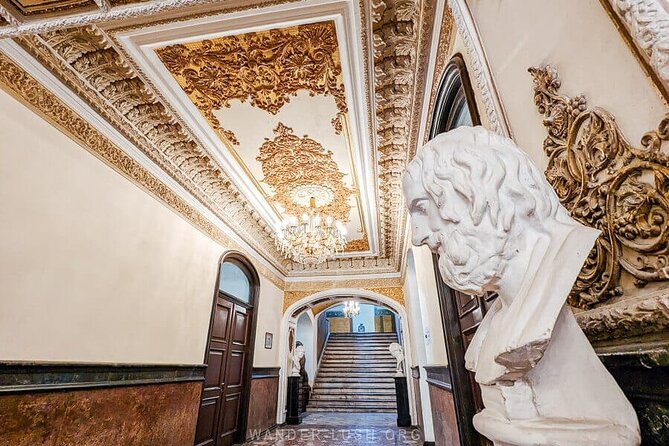
- A private English-language walk with Marina: Only your group takes part, so the pace and conversation can feel more personal.
- Five very different architectural stops: The route moves from Rustaveli Avenue’s formal façades to old wooden balconies and modern public design.
- Gabashvili House is a special visual stop: Its blue tones, carved details, and balconies show the softer side of old Tbilisi.
- The Art Academy costs extra: Allow $4.50 per person if you want to enter this former Persian-style palace.
- The price is $25 per person: That includes a professional local guide, while lunch and the Academy entry are separate.
- It starts at 9:00 am and returns to the meeting point: Begin at Rustaveli Metro area, at 2 Merab Kostava Street.
Why this three-hour Tbilisi walk is different
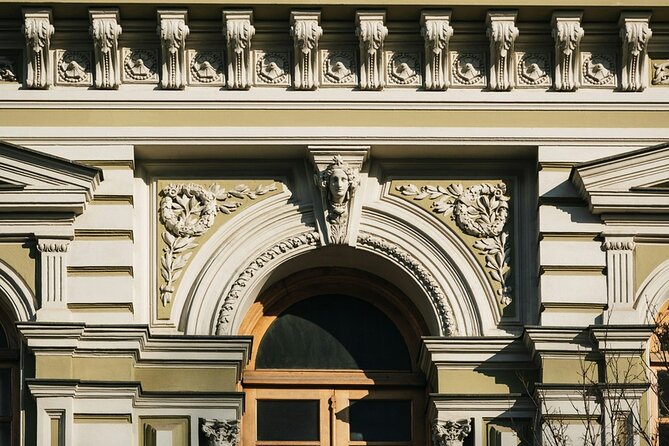
Many city walks concentrate on famous churches, viewpoints, and central squares. This one takes a narrower but more distinctive approach. You spend the morning looking at buildings, façades, balconies, arches, mosaics, and the way Tbilisi has changed its visual language over time.
That focus gives the experience a useful shape. Instead of hearing a little about everything, you follow a thread from 19th-century and early-20th-century architecture to newer civic design. You see how Tbilisi has borrowed from European, Persian, and local traditions without becoming visually uniform.
The route is also private. Only your group participates, which matters if you prefer to pause for photographs, ask questions, or keep the conversation at a relaxed pace. The published tour lasts about three hours, although the listed stops add up to roughly 80 minutes. The remaining time is likely used for walking between sites and for the guide’s explanations, but the exact walking distance is not stated.
At $25 per person, the tour is fairly priced for a private experience with a local guide. You should add $4.50 if you want to enter the Academy of Arts. There is no lunch included, so plan to eat before or after the walk.
A few more architecture walks in the world worth a look
- Chicago Architecture River Cruise
★ 5.0 · 15,756 reviews - Chicago River 90-Minute Architecture Tour
★ 4.5 · 9,629 reviews - Chicago River: 1.5-Hour Guided Architecture Cruise
★ 4.8 · 8,046 reviews
Starting with Shota Rustaveli on the city’s grand avenue
The tour begins near Rustaveli Metro Station, at 2 Merab Kostava Street, with the statue of Shota Rustaveli as the first named stop. The meeting point is practical because it is near public transportation and sits on one of the city’s main cultural streets.
Rustaveli Avenue is the formal face of central Tbilisi. Along its length, you see elegant 19th-century and early-20th-century buildings, theatres, cafés, and balconies. The avenue gives you a quick lesson in the city’s urban character: it can feel stately in one block and relaxed in the next.
Shota Rustaveli is Georgia’s most beloved poet, and his statue provides a useful cultural introduction before the route turns toward buildings. The stop lasts about 15 minutes and has no admission charge.
I would treat this opening as an orientation rather than a major sightseeing stop. You are not entering a museum or spending a long time at the statue. Instead, you are getting your bearings and beginning to notice the details around you: façades, street proportions, decorative features, and the relationship between public monuments and everyday city life.
Gabashvili House and the character of old Tbilisi
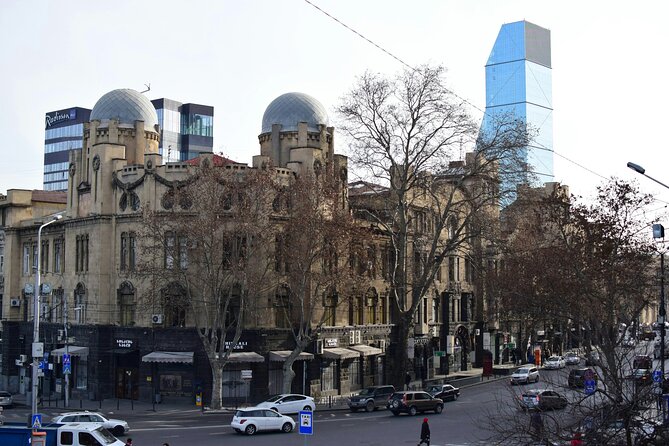
The second stop is the Vasil Gabashvili House, a 19th-century residence known for its colorful wooden balconies, delicate carvings, and soft blue shades. It is one of the route’s most appealing examples of old Tbilisi residential design.
The house has a warmer, more intimate feeling than the formal buildings along Rustaveli Avenue. Its balconies are especially important. In Tbilisi, an exterior balcony can be more than decoration. It gives a home a visible connection to the street and helps create the layered appearance that makes older neighborhoods so memorable.
You have about 15 minutes here, with no admission ticket required. That makes it an easy stop for photographs, though the information provided does not specify whether you go inside the house. You should expect to appreciate the exterior and hear about its architectural details rather than plan on a full interior visit.
I like this part of the route because it shifts the focus from public monuments to domestic architecture. It helps you see that Tbilisi’s appeal is not only in its grand theatres and institutions. Some of the city’s strongest visual details come from private homes, painted wood, carved trim, and balconies that soften the street frontage.
Inside the Persian-style Tbilisi State Academy of Arts

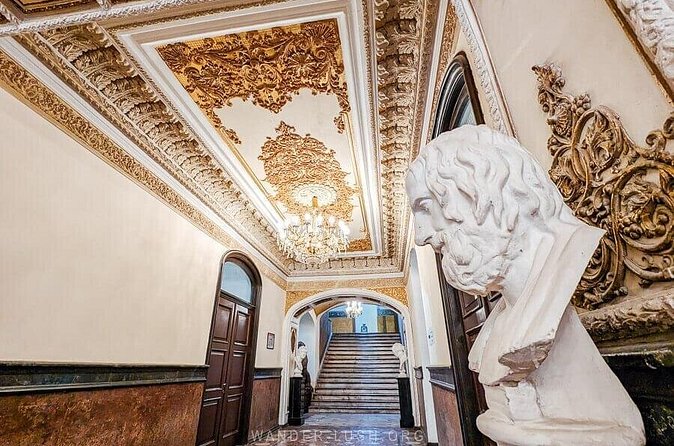
The Art Academy is the most substantial stop on the walk. The building began as a Persian-style palace, and its interior and exterior details include colorful mosaics, elegant arches, and intricate decoration. Today, it is home to Georgia’s young artists.
This is where the tour connects historic architecture with present-day creative life. You are not looking only at an old building preserved as a monument. The Academy continues to function as a place of art and study, carrying an older architectural language into modern use.
The stop is scheduled for about 20 minutes, the longest single visit on the route. Entry is not part of the $25 tour price. The separate ticket costs $4.50 per person, so you should bring that amount into your budget if you want to go inside.
The extra charge is modest, but it is worth knowing before you book. The listing does not state exactly what areas the ticket covers, so you should not assume that every part of the building is open. Still, if architecture is your main reason for booking, this is likely the stop you will care about most.
The Academy also gives the guide a chance to explain Tbilisi’s mixed cultural influences without turning the tour into a lecture. The building’s Persian style, its decorative surfaces, and its current role in art education make it a compact example of the city’s ability to reuse older spaces.
Same city, a different facade:
- Chicago Architecture Center River Cruise aboard First Lady
★ 5.0 · 5,536 reviews - Chicago: Architecture River Cruise Skip-the-Ticket Line
★ 4.8 · 4,325 reviews - Chicago River 45-Minute Architecture Tour from Magnificent Mile
★ 4.5 · 2,924 reviews - Barcelona: Sant Pau Recinte Modernista Entry Ticket
★ 4.6 · 2,567 reviews
The Opera and Ballet Theatre on Rustaveli Avenue

The Tbilisi Opera and Ballet State Theatre returns you to the grand public architecture of Rustaveli Avenue. It is a neoclassical building with columns, ornate decoration, and a formal presence. The theatre remains an important part of Georgia’s cultural life.
The stop lasts about 15 minutes and is free. The supplied details do not say that you enter the theatre, so plan to view the building from outside unless your guide provides different access on the day.
This pause works well after the Academy because the buildings make a useful comparison. The Academy is decorative and palace-like, with Persian influence. The Opera is more openly European in its neoclassical style. Both are tied to artistic life, but they express it through very different architectural choices.
You may find that the Opera is less about a long visit and more about understanding the avenue as a cultural corridor. The theatre, cafés, and other formal buildings help explain why Rustaveli Avenue is considered the heart of Tbilisi. The route uses the street not just as a place to walk, but as evidence of the city’s changing ambitions.
Finishing at the National Library’s modern design
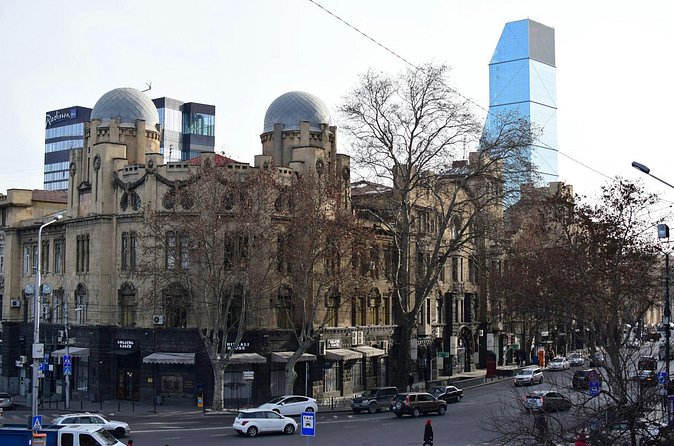
The walk ends at the National Library of Georgia, described as a beautifully designed modern library. This final stop changes the mood again. After old houses, a former palace, and a neoclassical theatre, you finish with a building that reflects Tbilisi’s newer urban direction.
The library is presented as a calm, inspiring space where architecture and atmosphere work together. Admission is listed as free, although the details do not confirm whether the tour includes an interior visit or a close look at every section of the library.
As a final stop, it makes good sense. You begin with Rustaveli and the city’s established cultural identity, then move through older domestic and institutional buildings before ending with modern public architecture. The route suggests that Tbilisi is not simply preserving its past. It is also developing new ways to express civic life.
The activity ends back at the meeting point. That wording may mean the group returns after visiting the library, even though the National Library is also described as the finishing stop. Because the timing and walking route are not fully detailed, I would confirm the exact return arrangement when booking if your schedule is tight.
What the guiding style adds

The tour’s strongest feature is the guide’s personal approach. Marina created the route herself and explains the architecture in simple, enthusiastic language. That matters because architectural tours can easily become a string of dates, styles, and names that are hard to follow.
Here, you can expect the focus to remain on what you are looking at. A balcony, arch, mosaic, or façade detail becomes a way to understand the building and the city around it. You do not need specialist knowledge to take part.
The private format should help if you have particular interests. You can ask why one building looks Persian while another feels neoclassical, or request more attention to residential balconies and decorative details. The information does not promise a fully customized route, so you should not assume that every request can be added, but a private group is still more flexible than a large scheduled walk.
The two available ratings are both five out of five. The praise centers on Marina’s warm manner, clear explanations, creativity, and ability to reveal buildings that are easy to miss. Those are useful qualities for this particular tour because the experience depends less on famous ticketed attractions and more on noticing design.
Timing, cost, and practical planning
The tour begins at 9:00 am. That early start is useful if you want to make architectural sightseeing part of your first full morning in Tbilisi. You can learn the city’s central layout before spending the rest of the day on your own.
The meeting point is at 2 Merab Kostava Street near Rustaveli Metro Station. The tour is offered in English and uses a mobile ticket. It is also near public transportation, which makes the start easier to reach without arranging a private transfer.
The $25 price includes a professional local guide and the private tour. It does not include the $4.50 Academy admission or lunch. There are no other listed entrance charges, and the Rustaveli statue, Gabashvili House, Opera, and National Library stops are marked as free.
For value, I would rate the tour best for people who care about explanation and access to a personal route rather than a long list of paid interiors. If you are traveling alone, the per-person cost may feel higher because the activity is private. For two or more people, the price becomes more attractive, especially if you enjoy discussing what you see rather than simply taking photographs.
The activity is suitable for most participants, and service animals are allowed. No special physical requirements are listed. Since this is a walking tour lasting about three hours, comfortable shoes remain a sensible choice, but the supplied information does not give a distance or accessibility assessment.
Free cancellation is available if you cancel at least 24 hours before the 9:00 am start time. Changes or cancellations made within 24 hours are not accepted for a refund, and the cut-off follows local Tbilisi time.
Who should book this architecture tour
I would recommend it to you if you want a more focused introduction to Tbilisi than a general city tour provides. It suits first-time visitors who want to understand the center, as well as repeat visitors looking for buildings they may have missed on an earlier trip.
It is particularly good for:
- People who enjoy architecture but do not want an academic lecture
- Couples, families, or small groups who value a private guide
- Visitors interested in balconies, façades, decorative arts, and urban change
- Anyone who wants a morning activity near public transportation
- Visitors who appreciate a route created around less obvious buildings
I would be more cautious if you want a full interior tour of every building, a museum-style experience, or a meal included in the price. Several stops are short, and the information provided does not confirm interior access at the Gabashvili House, Opera, or National Library.
Should you book the Tbilisi Architectural Tour?
Book this tour if you want to see Tbilisi through its buildings and prefer a personal English-language walk. The route is compact but varied, Marina’s guiding style is a major strength, and the $25 price is reasonable for a private three-hour experience.
Add the $4.50 Academy ticket if the former palace is a priority. If you only want quick exterior views, you can keep the basic price and still see five distinct sites. The best reason to choose this walk is not the number of stops. It is the chance to notice the city’s lesser-seen details with someone who designed the route around them.
FAQ
How long does the Tbilisi Architectural Tour last?
The tour lasts approximately three hours.
What time does the tour start?
The tour starts at 9:00 am.
Where does the tour begin?
It begins at Rustaveli, 2 Merab Kostava Street, Tbilisi, Georgia.
Where does the activity end?
The activity ends back at the meeting point.
Is the tour offered in English?
Yes. The tour is offered in English.
Is this a private tour?
Yes. Only your group participates in the activity.
How much does the tour cost?
The price is $25 per person.
Is admission to the Tbilisi State Academy of Arts included?
No. Entry to the Academy costs an additional $4.50 per person.
Is lunch included?
No. Lunch is not included.
Can I cancel for a full refund?
Yes, if you cancel at least 24 hours before the experience start time. Cancellations or changes made less than 24 hours before the start are not accepted for a refund.
Newly added in the world
- Venice Art and Architecture Private Walking Tour★ 4.5 · 11 reviews
- Basilica San Marco and the Pala d’Oro with Architect Guide★ 4.5 · 19 reviews
- Walking tour in Venice with an architect★ 5.0 · 16 reviews
- Lesser Poland Wooden Architecture Trail UNESCO Private Tour from Krakow★ 5.0 · 15 reviews
- Lisbon Contemporary Architecture★ 5.0 · 3 reviews
- Private Munich Tour for History Buffs with Architectural Gems and WWII sites★ 5.0 · 3 reviews
- Neoclassical Paris Architecture 2-Hour Private Walking Tour★ 5.0 · 7 reviews
- Street Art and Architecture:Porto Speaks Through Its Streets★ 3.0 · 2 reviews
Architecture Tours, compared.


Chicago River: 1.5-Hour Guided Architecture Cruise
Read our review →
Chicago Architecture Center River Cruise aboard First Lady
Read our review →
Architecture River Cruise Skip-the-Ticket Line
Read our review →
Chicago River 45-Minute Architecture Tour from Magnificent Mile
Read our review →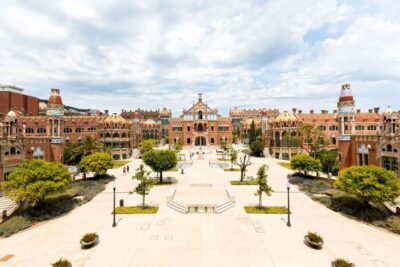

Browse the lists this tour appears in