
Review · WALKING TOURS
Private Santa Barbara History and Architecture Walking Tour
Santa Barbara’s past is easiest to grasp when you are standing beside its old adobe walls, not just reading dates on a plaque. This private walk connects the 1782 Presidio, tucked-away homes, Spanish Colonial Revival buildings, courtyards, theaters, and gardens into one clear story, led by Sullivan Israel, known as Sully, whose enthusiasm for the city comes through in every stop.
I especially like the chance to see places many independent visitors miss, including the Lugo Adobe, Rochin Adobe, Presidio Street, and the back courtyards around El Paseo. I also like the flexible format: Sully can adjust the pace, answer your questions, and shape the route around your interests. The main consideration is that this is a long, information-packed walk, and some interiors may be closed or restricted.
Key points at a glance
- A private route through old Santa Barbara: Your group explores the Presidio district, historic adobes, downtown courtyards, theaters, parks, and public buildings without joining a larger party.
- Sully’s specialty is local detail: He uses historical photographs and stories about the people who built and shaped the city.
- The walk reaches beyond the standard sights: Lugo Adobe, Meridian Studios, Presidio Street, and lesser-seen adobe buildings add real depth.
- Architecture is the main thread: You see Spanish Colonial Revival, Mexican-Californio adobe, Streamline Moderne, and early California styles side by side.
- Expect about two to three hours on foot: The route covers many stops, so comfortable shoes, water, and a small snack are sensible.
- Only some admissions are included: Presidio entry is included, while the Historical Museum is optional and not included. Most other stops are viewed from public areas at no extra charge.
Why this walking tour works
Santa Barbara can look polished and resort-like at first glance. Its tiled roofs, stucco walls, palm trees, and carefully kept streets may seem like a single architectural style. This tour shows you that the city is really a collection of different periods layered together.
You begin with the Spanish military presence at El Presidio, move through Mexican-era family homes, then follow the city’s turn toward Spanish Colonial Revival after the 1925 earthquake. Along the way, you see how architects, civic leaders, theater owners, military officers, and local families all helped shape the city you see today.
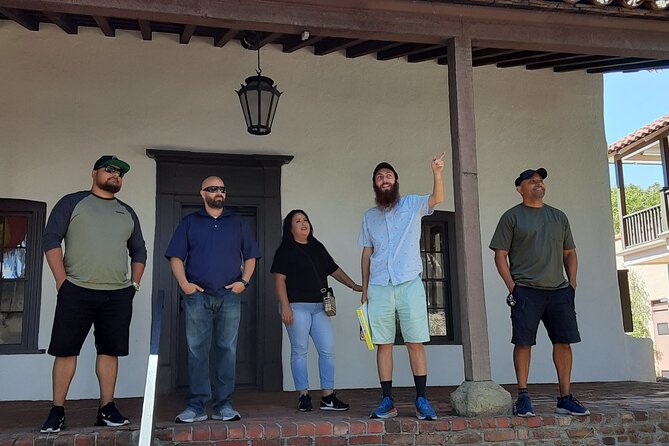
The private setup matters. You are not tied to a fixed group pace or a guide trying to deliver a speech to twenty people. If you want more architecture, Sully can spend longer on design details. If you are more interested in people and political history, he can follow that thread instead. Several people who took the tour with children also found that his storytelling kept younger listeners involved.
Sully’s strongest quality is his passion for Santa Barbara. He has studied old books and collected historical images, which gives his explanations more texture than a basic list of construction dates. He also has an academic background in engineering, a useful advantage when he explains how adobe buildings were made and why certain structures survived.
More Walking Tours in the USA
- The Official Art Deco Walking Tour by The Miami Design Preservation League
★ 5.0 · 1,580 reviews - Chicago in a Day: Food, History & Architecture Walking Tour
★ 5.0 · 1,153 reviews - Miami South Beach Art Deco Walking Tour
★ 5.0 · 1,039 reviews
Starting at the 1782 Presidio
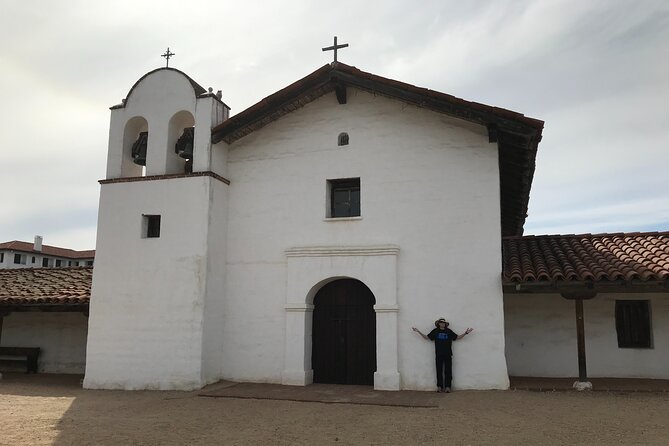
The tour begins at El Presidio de Santa Bárbara State Historic Park, at 123 East Canon Perdido Street. Built in 1782 from adobe brick, the Presidio is one of California’s oldest surviving structures.
This is the right place to begin because it explains why Santa Barbara developed where it did. You see original rooms, soldiers’ gardens, a chapel, and reconstructions of ordinary 18th-century objects. The buildings were made from materials found in the surrounding countryside, so Sully can use the site to explain both military life and the practical limits of living on the far edge of the Spanish Empire.
Admission to the Presidio is included. You spend about 20 minutes here, though a private tour gives you a chance to ask questions rather than simply move from room to room.
Across the way, you pass the Rochin Adobe. Built in 1856 by a descendant of Captain Francisco Ortega, the Presidio’s first commandant, it reused adobe bricks salvaged from the badly damaged fort. The building was later covered in wooden clapboard around 1900, which gives it a different appearance from the exposed adobe walls nearby.
That small detail captures the character of the tour. You are not only looking at major monuments. You are learning how old materials were reused, altered, and folded into later versions of the city.
Adobes, courtyards, and overlooked architecture
The Santa Barbara Historical Museum is housed in a 1964 adobe-style building, with exhibits on local history, paintings, and etchings. Its courtyard includes two adobe structures dating from 1817 and makes a pleasant photo stop.
You can enter if you wish, but admission is not included. This flexibility is useful because the museum may appeal strongly to history fans, while some families may prefer to keep moving. Ask Sully how much time makes sense for your group.
At 112 East De La Guerra Street, the route reaches Meridian Studios and the Lugo Adobe. Meridian Studios was designed by George Washington Smith and completed in 1925. Its pastel stucco walls and broad glass windows show the softer, more decorative side of Santa Barbara design.
Behind the studios is the Lugo Adobe, built by a retired Presidio soldier in the early 19th century. It has been preserved and remodeled, but its secluded position means many people pass nearby without noticing it. This is one of the best examples of why a private local guide adds value. You may walk downtown on your own and never realize what lies behind the more visible buildings.
At 802 Anacapa Street, you see a 1945 structure that incorporates two Mexican-period adobes and the former 1906 Nardi Hotel. Behind it is a courtyard and garden, along with Presidio Street, technically the city’s earliest street. It once formed part of the route from the waterfront to the Presidio and then onward to the Mission.
The adobe buildings along this section of East De La Guerra Street were built in 1849 by José de la Guerra, the fifth commander of the Presidio. They are strong examples of Mexican-Californio architecture and later passed to the Orena family, whose descendants still own them.
City Hall and Casa de la Guerra
Santa Barbara City Hall dates from 1923, before the 1925 earthquake, and is an early example of the Spanish Colonial Revival style. Look for its hand-painted tiles, arches over the sidewalk, and the large California pepper tree in front.
The building faces Plaza de la Guerra with Casa de la Guerra and the News-Press Building. This square functions as a civic center, but it also shows how Santa Barbara deliberately adopted a Hispanic visual identity in the early 20th century.
Casa de la Guerra was built in 1819 by José de la Guerra as both a family home and a business center. In the early settlement, it served as a place for social and political activity. Today it remains closely tied to the city’s annual Fiesta celebrations.
The house is open to visitors on weekends. Since the walking tour operates Monday through Friday, you should not assume you will be able to go inside. Even from the exterior, its size and position help explain the influence of the Presidio commandant’s family.
Same city, a different facade:
- Chicago Architecture River Cruise
★ 5.0 · 15,756 reviews - Chicago River 90-Minute Architecture Tour
★ 4.5 · 9,629 reviews - Chicago River: 1.5-Hour Guided Architecture Cruise
★ 4.8 · 8,046 reviews - Chicago Architecture Center River Cruise aboard First Lady
★ 5.0 · 5,536 reviews
El Paseo and La Arcada
El Paseo marks a major shift in Santa Barbara’s architectural story. Built between 1922 and 1929, it helped turn downtown away from a conventional Eastern American main street and toward a Hispanic Pueblo style.
You walk through narrow passageways, a romantic courtyard, and the well-known Street in Spain before returning to State Street. This section is especially good for photographs, but it is not only decorative. The complex shows how architecture can be used to create a civic identity, in this case a carefully planned version of old California.
Further along State Street, the route enters the La Arcada Courtyard. Its tiled paseo passes shops and restaurants through the center of the block, with second-story bridges, fountains, bronze figures, and live turtles.
This is a pleasant pause in the middle of the walk. You can take photographs, look at the small details, or simply enjoy a few minutes away from traffic. The route also makes clear that Santa Barbara’s historic character is not confined to museums. It survives in working courtyards and commercial spaces.
The courthouse and downtown civic buildings
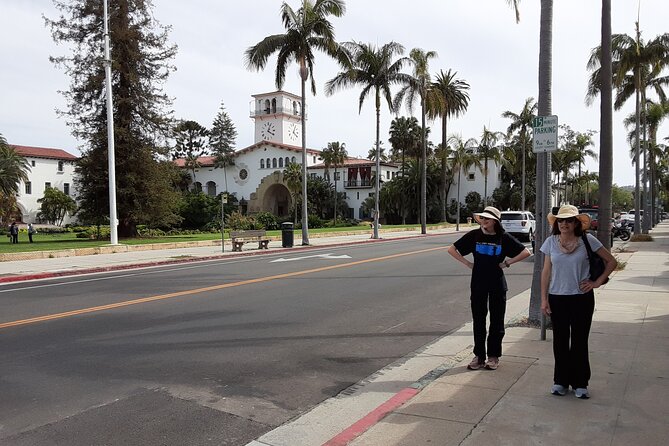
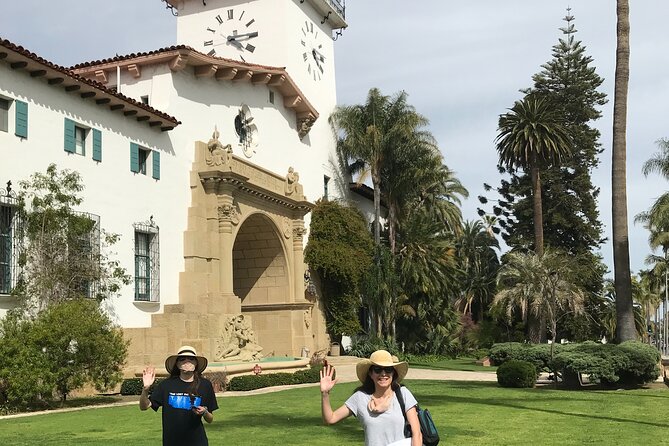
Santa Barbara County Courthouse is the architectural high point of the tour. Built in the Spanish Colonial Revival style, it is decorated with carved capitals, painted tiles, stone figures, and a large Roman triumphal arch on its front facade.
You spend about 30 minutes here, the longest single stop on the route. The building is important not only because it is beautiful, but because it represents Santa Barbara’s public commitment to Spanish Colonial Revival design in the 20th century.
When access is available, you may see the mural room and take the stairs or elevator to the clock tower for a 360-degree view of the city. Interior access can change, so treat those elements as possibilities rather than guarantees. Even if you stay outside, the courthouse gives you plenty to examine.
Across Anapamu Street is the Santa Barbara Public Library, with sections dating from 1917, 1925, and 1930. As you walk past, look for the detailed stone sculpture around the entrances.
The Granada Theatre is another useful stop. Built in 1924, it remains the city’s tallest building because it predates the 60-foot height limit. Its upper floors use glazed terra cotta, and its interior may be accessible only when restrictions and operating conditions allow.
These buildings help you see how civic architecture changed before and after the 1925 earthquake. The tour does not treat the courthouse as an isolated showpiece. It places the building within a wider downtown story.
Arlington Theatre and Santa Barbara’s public parks
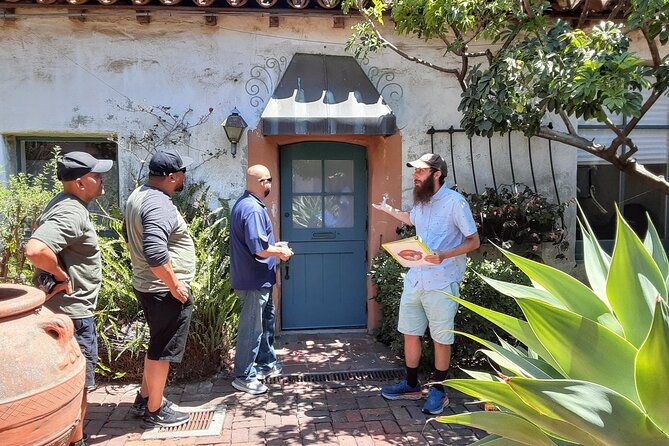
The Arlington Theatre is a brief stop, but it is worth your attention. Its tower rises above the surrounding streets, while the arched paseo at ground level provides a shaded place to pause.
Inside, the theater was designed to feel like a Spanish village square. Painted stars cover the vaulted ceiling, and three-dimensional building fronts line the auditorium. Interior access is not guaranteed, but the exterior alone shows how strongly Spanish imagery shaped local entertainment buildings.
The tour then reaches Alameda Park, public space first laid out in 1850. The park includes trees brought from other parts of the world, an 1880s bandstand, and Kids’ World, an extensive playground. Seasonal events include Summer Solstice and Earth Day celebrations.
This portion makes the walk feel less like a chain of historic buildings and more like a look at daily city life. You see how public parks, playgrounds, ceremonies, and theater spaces fit into Santa Barbara’s civic routine.
Alice Keck Park and the old Mirasol site
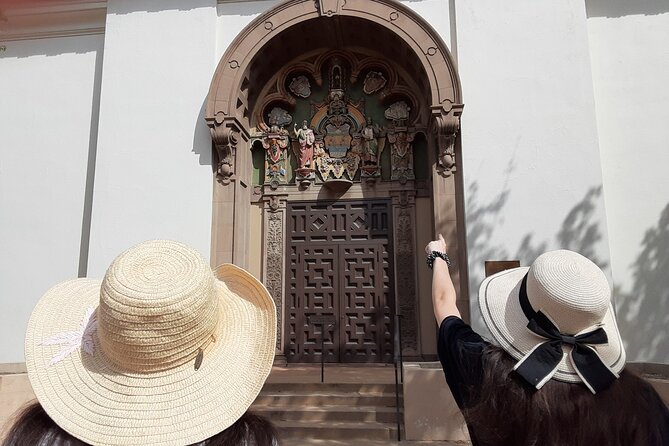
Alice Keck Park Memorial Gardens occupies the former site of the El Mirasol Hotel. After a fire badly damaged the hotel in 1966, the block became a public garden.
The garden includes a butterfly meadow that attracts monarchs, a running creek with stepping stones, a duck pond, live turtles, and a large Australian fig tree. Admission is included.
I like this stop as a change of pace. After several hours of adobe walls, civic buildings, and architectural details, you have room to sit in the shade and reset. Families may appreciate the open space, while photographers have plenty of natural subjects.
The garden also adds a useful reminder: historic preservation does not always mean keeping a building. Sometimes a site changes completely while retaining a connection to the city’s past.
The Post Office, El Cuartel, and the final steps
The Santa Barbara Main Post Office combines Streamline Moderne design with Spanish elements. Sculptures appear inside and outside the building, making it a quick but worthwhile architectural stop.
The walk ends at El Cuartel, at 122 East Canon Perdido Street, across from the starting point. Built in 1788, this small structure was part of the Presidio complex and is considered the oldest building in town.
You can see its rooms and back garden, which offer a relatively unchanged look at an 18th-century structure. Ending here brings the tour back to its beginning and ties the later downtown architecture to Santa Barbara’s military roots.
The nearby Lobero Theatre is another important landmark. It was built in 1924 by George Washington Smith, but the site had already served as a theater since 1873, when José Lobero opened Southern California’s first opera house there. The painted vaulted ceiling may be visible inside when access permits.
Pace, group size, and practical planning
The tour lasts about two to three hours and is available in English. It runs Monday through Friday from 10 a.m. to 3 p.m. The exact pace depends on your interests, questions, and the amount of time spent at optional interiors.
Because the activity is private, only your group participates. That makes it a good choice for couples, families, solo visitors, and friends who do not want to match a stranger’s walking speed. The route is generally suitable for most people, and service animals are allowed. Public transportation is nearby.
Wear comfortable shoes and bring water. The walk is not presented as strenuous, but it includes many stops and several hours on city streets. If you bring children, a snack for the halfway point is sensible.
Parking fees and lunch are not included. The tour does not list a price here, so I cannot judge the exact cost. In value terms, a private guide makes the most sense if you care about context, want to ask many questions, or have limited time in Santa Barbara. If you only want to photograph the courthouse and walk down State Street, you can see several sights independently at no guiding cost.
The included and optional admissions are also worth noting. Presidio entry and Alice Keck Park access are included. The Historical Museum can be entered if you choose, but its admission is not included. Most other stops are exterior views or public spaces.
Who should book this Santa Barbara tour?
Book it if you want Santa Barbara’s architecture explained rather than simply displayed. It is especially useful for first-time visitors who want a clear introduction, locals curious about overlooked buildings, and families who benefit from stories instead of a dry lecture.
Sully’s flexible approach also helps if you have a particular interest in adobe construction, Spanish Colonial Revival architecture, local families, theaters, or the city’s changing civic identity. He can adjust the route to your questions and offer restaurant and future sightseeing suggestions at the end.
Think twice if you dislike walking, want guaranteed access to every interior, or prefer a quick highlights tour with little commentary. The route covers a lot, and the amount of information may feel heavy if you are looking only for a casual stroll.
The cancellation policy is practical: cancel at least 24 hours before the start for a full refund. Poor weather or failure to meet the minimum number of participants can also lead to a new date or a full refund.
Final verdict: a strong choice for curious visitors
I would choose this tour for a first or second day in Santa Barbara, especially if you want to understand why the city looks the way it does. The best parts are not limited to the famous courthouse or Presidio. They include the small adobe details, quiet courtyards, old street routes, and stories about the people behind the buildings.
Sully’s enthusiasm, historical images, and ability to adapt the walk are the main reasons to book. Give yourself comfortable shoes, water, and an appetite for detail. If that sounds appealing, this private tour offers one of the clearest ways to connect Santa Barbara’s Spanish, Mexican, American, and modern chapters in a single morning or afternoon.
FAQ
How long does the private Santa Barbara history tour last?
The tour lasts approximately two to three hours, depending on the pace and the interests of your group.
Where does the tour begin and end?
It begins at El Presidio de Santa Bárbara State Historic Park, at 123 East Canon Perdido Street, and ends back at the same meeting point.
Is the tour private?
Yes. Only your group participates in the activity.
Is admission to the sights included?
Admission to El Presidio and Alice Keck Park Memorial Gardens is included. The Santa Barbara Historical Museum can be entered if you choose, but its admission is not included. Other listed stops are free or viewed from public areas.
Is the tour offered in English?
Yes, the tour is offered in English.
What happens if the weather is poor?
The experience requires good weather. If it is canceled because of poor weather, you will be offered a different date or a full refund. You can also cancel at least 24 hours before the start time for a full refund.
More History Walks in the USA
- Charleston’s Best Highlights: History, Culture & Architecture
★ 5.0 · 422 reviews - Palm Springs Modernism Architecture & History Bike Tour
★ 5.0 · 359 reviews - Charleston: History and Architecture Guided Walking Tour
★ 4.8 · 349 reviews - Historic Georgetown: History, Gossip, & Architecture Walking Tour
★ 5.0 · 321 reviews
Newly added in the USA
- Art Deco Tour of South Beach in French★ 4.5 · 8 reviews
- Award-winning Art Deco & Neon Lights Walking Tour★ 5.0 · 5 reviews
- Miami Beach Art Deco Segway Tour★ 4.5 · 17 reviews
- Boston: Freedom Trail History and Architecture Walking Tour★ 4.8 · 18 reviews
- Boston: Harbor and Charles River Architecture Boat Tour★ 4.6 · 9 reviews
- Chicago: Guided Tour with Architecture River Cruise★ 4.5 · 20 reviews
- Iconic Capitol Hill Architectural Walking Tour★ 5.0 · 21 reviews
- South Beach Food Tour- Culinary & Art Deco & History★ 5.0 · 22 reviews
Walking Tours, compared.
The Official Art Deco Walking Tour by The Miami Design Preservation League
Read our review →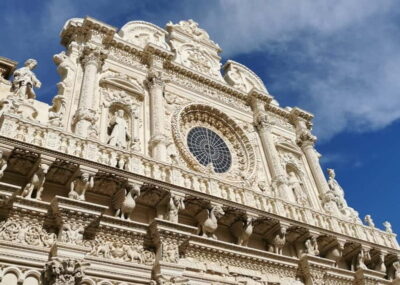
Baroque Architecture and Underground Walking Tour
Read our review →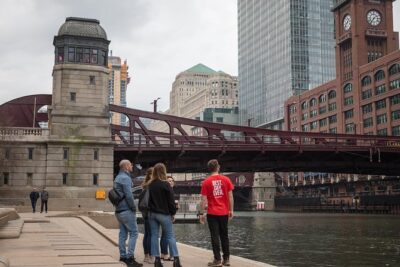
Chicago in a Day: Food, History & Architecture Walking Tour
Read our review →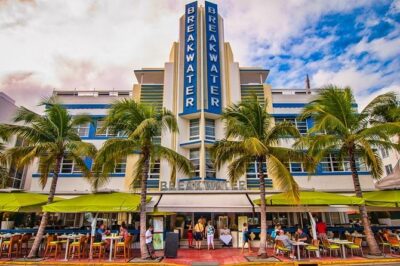
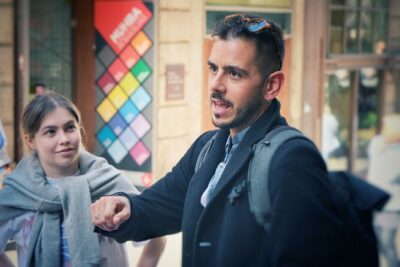
Ramblas, Old Town, Gothic and Gaudi Architecture Walking Tour
Read our review →
Chicago’s Secret Interiors Architectural Walking Tour
Read our review →
Browse the lists this tour appears in