
Review · HISTORICAL TOURS
Charleston’s Best Highlights: History, Culture & Architecture
Charleston’s past is packed into a remarkably walkable stretch of streets. In about two hours, you’ll move from the Old Exchange, where the Declaration of Independence was read in 1776, to the waterfront Battery, with Fort Sumter in view. Along the way, the city’s grand houses and churches become part of a larger story about politics, slavery, religion, and war.
I like the strong historical range here: this is not only a pretty-architecture stroll. I also like the guides’ flexible teaching style. Brian and Fin have answered questions, adjusted the pace, and connected South Carolina events to the wider story of the United States.
The main consideration is that the tour can run well beyond its advertised two hours, especially when questions get going. That can be a pleasure if you have time, but it may not suit a tight schedule. Several interiors also depend on availability, and some admission fees are separate.
Key points to know before you book
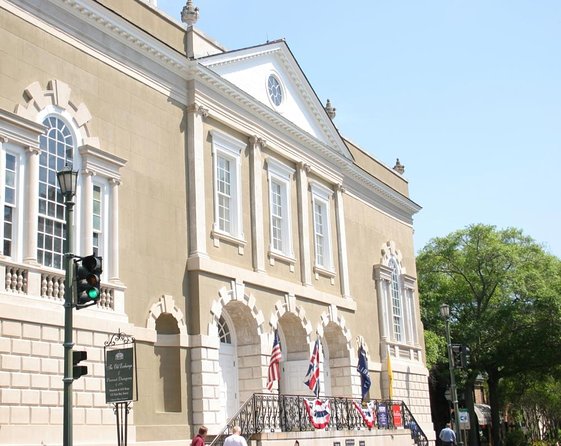
- The route covers nine major sights, including the Old Exchange, Rainbow Row, the Old Slave Mart, St. Michael’s Church, and the Battery.
- Brian and Fin lead with plenty of context, drawing on backgrounds in teaching and long experience guiding Charleston.
- The Old Slave Mart stop is discussed from outside, so entry to the museum is not part of the walking tour.
- The route balances beauty with difficult history, including Charleston’s role in slavery and the Civil War.
- Small groups keep the walk personal, with a maximum of 20 people and the possibility of a much smaller group.
- Plan for more than two hours if you can, since the walk may continue when the guide is answering questions.
Why this walk gives you a useful first look at Charleston
This is a downtown orientation walk, but it is more than a quick roll call of old buildings. The route follows Charleston’s major themes in a sensible order: colonial government, trade, slavery, faith, theater, civic life, wealthy merchants, and the Civil War.
That broad reach is the tour’s best feature. You get visual highlights such as Rainbow Row and the Battery, yet you also hear about the forces that made Charleston wealthy and politically important. The discussion of slavery is part of the main story, not an afterthought.
I would book this early in a Charleston visit. The route gives you a mental map of the historic center, and the guides connect people and events across different periods. Brian has been praised for linking South Carolina figures to the formation of the United States, while Fin brings the perspective of a former high school history teacher and a guide with 15 years of experience in Charleston.
The group limit of 20 is helpful. A smaller group makes it easier to ask questions and hear the guide on busy streets. Several bookings have had only a few people, though you should plan for the stated maximum rather than count on a private-style walk.
More History Walks in the USA:
- Chicago in a Day: Food, History & Architecture Walking Tour
★ 5.0 · 1,153 reviews - Palm Springs Modernism Architecture & History Bike Tour
★ 5.0 · 359 reviews - Charleston: History and Architecture Guided Walking Tour
★ 4.8 · 349 reviews
The Old Exchange sets the political stage
The walk begins at 122 East Bay Street, at the Old Exchange and Provost Dungeon. Built around 1771, this is one of South Carolina’s most important colonial buildings.
The guide uses the site to establish Charleston’s place in national history. The Declaration of Independence was read here in 1776. During the American Revolution, the building served as a British prison for about two years. South Carolina also ratified the US Constitution here in 1788, and George Washington was entertained at the building during his week-long visit in May 1791.
That is a lot of material for a 15-minute stop, so expect the guide to select key stories rather than provide a full building tour. Admission is not included, and the main experience here is the outdoor explanation unless you choose to return and visit separately.
I like beginning here because it prevents the rest of Charleston from becoming a collection of attractive facades. You start by seeing how the city fit into the American Revolution, the Constitution, and the early republic.
Rainbow Row shows Charleston’s preservation instinct
Rainbow Row is a five-minute stop, but it delivers one of the city’s most recognizable views. The attached Georgian row houses form the longest row of their kind in the country, and their bright colors make an immediate contrast with the city’s more restrained historic buildings.
These structures began as mariners’ stores in the 18th and 19th centuries. They were restored in the 1930s, when Charleston’s preservation efforts helped turn old buildings into a major part of the city’s identity.
The stop is brief, so you will have time to admire the facades and take photographs, but not much time for a detailed architectural lecture. That is fine. Rainbow Row works best as a visual pause after the political weight of the Old Exchange.
The guide can also help you see the buildings as working commercial spaces rather than simply colorful houses. That shift matters. Charleston’s historic center was shaped by shipping, trade, and labor long before it became a destination for architecture lovers.
The Old Slave Mart requires serious attention
The Old Slave Mart Museum is an important stop because it addresses Charleston’s role in the interstate slave trade. The building was known as Ryan’s Slave Mart in the 1850s and served as an auction site.
You do not enter the museum during this tour. The guide speaks about the site from outside, while the City of Charleston operates the museum and offers tours separately. Admission is not included.
This limitation is worth understanding before you book. If you want to see the museum’s interior and exhibits, you will need to return on your own. Still, the outdoor discussion gives the tour an important moral and historical center. Charleston’s wealth, architecture, and political influence cannot be understood without discussing enslavement and the trade that supported the city’s economy.
I appreciate that this stop sits among the other major sights instead of being treated as a separate subject. The route asks you to hold both sides of Charleston in view: the city’s grand public buildings and the human cost behind much of its prosperity.
A few more architecture walks in the USA worth a look
- Chicago Architecture River Cruise
★ 5.0 · 15,756 reviews - Chicago River 90-Minute Architecture Tour
★ 4.5 · 9,629 reviews - Chicago River: 1.5-Hour Guided Architecture Cruise
★ 4.8 · 8,046 reviews - Chicago Architecture Center River Cruise aboard First Lady
★ 5.0 · 5,536 reviews
The French Huguenot Church adds a religious thread
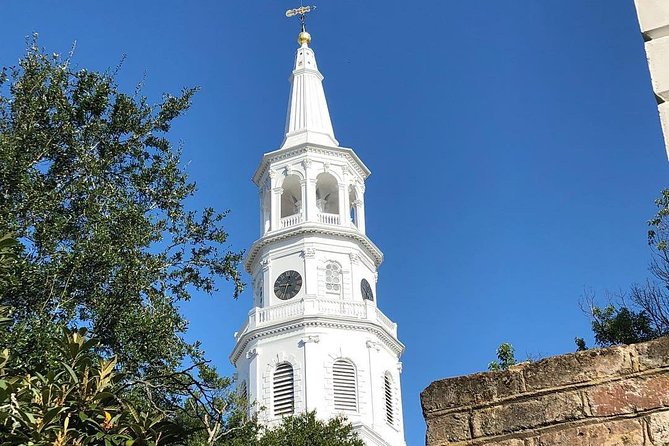
The French Huguenot Church is a short stop, but it introduces a group that helped shape Charleston’s religious and cultural life. The Gothic Revival building dates from 1845 and remains one of the few practicing Huguenot, or French Protestant, churches in the country.
The exterior itself is worth your attention, especially if you have been focused on Georgian houses and colonial civic buildings. The church adds a different architectural note and reminds you that Charleston’s identity was never made by one community alone.
The stop lasts about five minutes, so it is best understood as an introduction rather than a full church visit. You can ask the guide about the congregation and the city’s religious history, but the tour does not promise an extended interior viewing.
Dock Street Theater connects performance and preservation
Dock Street Theater occupies the site of the first theater in the British colonies. The current building dates from about 1937 and was restored from the former Planter’s Hotel, built around 1809.
That layered past makes the theater particularly interesting. You are not seeing one building from one period, but a performance site shaped by several different uses. Charleston Stage, South Carolina’s largest professional theater company, operates there and presents roughly 120 performances each year.
A 10-minute stop cannot cover the theater’s full story, and entrance depends on availability. If the doors are open, you may get a closer look. If not, the exterior and the guide’s explanation still make the building worthwhile.
I like this stop because it breaks up the sequence of churches, civic buildings, and private homes. It shows that Charleston’s old center has continued to function as a living part of the city rather than a preserved set.
City Hall reveals the Four Corners of Law
Charleston City Hall sits at one of the city’s Four Corners of Law, a name associated with Robert Ripley. The building began as a bank in 1801 and has served as City Hall since 1818.
The building’s civic role is the key point. You are looking at one of the oldest continuously operating city halls in the country, not just another historic facade. The guide can explain how the surrounding corner brings together different forms of authority in a compact part of downtown.
On weekdays, visitors can enter the council chamber and see the city’s collection at no charge. That access is a useful extra, but it is not guaranteed at every tour time. The stop itself is only about two minutes, so consider returning later if the interior interests you.
This is one of the better examples of the tour’s efficient rhythm. Some stops are short because the guide wants to keep the route moving, while others receive more time because they carry a larger story.
St. Michael’s Church brings together faith and national politics

St. Michael’s Church dates from about 1761 and is the oldest house of worship in Charleston. The church still has much of its original woodwork, along with Tiffany stained-glass windows.
The churchyard also connects local religious life to the founding of the nation. John Rutledge and Charles Cotesworth Pinckney, both signers of the US Constitution, are buried there.
Entrance depends on availability, so you should not assume you will see the interior. Even from outside, the church is an important landmark. The guide discusses Charleston’s religious past and present, giving you a better sense of how worship, politics, and public life overlapped in the colonial and early national periods.
At about 15 minutes, this is one of the longer stops. It gives you time to notice details rather than simply take a photograph and move on.
Nathaniel Russell House shows private wealth in Federal style
At the Nathaniel Russell House, the group enters the garden of an elegant Federal-style townhouse built in 1808. Nathaniel Russell came from Rhode Island and made his fortune as a merchant involved in shipping.
The garden visit offers a change of pace after the denser civic and religious stops. It also gives the guide a chance to discuss the people who accumulated wealth through Charleston’s port economy.
Admission is not included, and the route enters the garden rather than promising a complete house tour. That distinction matters if you are specifically hoping to see the interior rooms. Still, the setting helps you understand the scale and refinement available to successful merchants in the early 19th century.
I find this stop valuable because it makes the economic story personal. Instead of hearing only about commerce in the abstract, you see the home of one merchant and the social world that his business helped support.
The Battery and Edmondston-Alston House close with the Civil War
The final major stop takes you up onto the High Battery wall, where you look toward waterfront mansions and out toward Fort Sumter. This is one of the route’s most scenic sections, but it also carries heavy historical meaning.
The Edmondston-Alston House has remained in the same family since 1838. The house became a viewing point during the bombardment of Fort Sumter, when General Beauregard and other onlookers watched the opening of the Civil War.
The combination of the waterfront view and the story of the bombardment makes a strong ending. You can see the setting that shaped Charleston’s defenses, trade, and social life, then connect it to the conflict that tore the nation apart.
Admission to the Edmondston-Alston House is not included. The walk focuses on the exterior setting and the Battery view. I would not book this tour expecting a house-museum experience, but I would value the stop for its location and context.
Guide style matters more than a memorized route
The route is fixed, but the best part of the experience may be how Brian or Fin handles it. Both guides are described as warm, engaged teachers who welcome questions. Brian has a reputation for connecting Charleston to wider American history, while Fin brings decades of classroom experience and a long period guiding in the city.
That makes the tour suitable for people who want more than dates and building names. You can ask how Charleston relates to other colonies, how religious groups shaped the city, or why a particular building mattered. The guide can adapt the emphasis to the group, although the amount of detail may also stretch the tour beyond two hours.
The tone appears friendly rather than formal. You are walking with an instructor who enjoys the subject, not listening to a rigid audio script. That is useful in Charleston, where a small architectural detail can lead into politics, trade, religion, or family history.
Timing, walking, and practical value
The advertised duration is about two hours, but you should leave extra room. Some walks have lasted 90 minutes, while others have continued for three hours. The difference seems to depend on group size, questions, weather, and the guide’s pace.
The tour begins and ends at 122 East Bay Street. It is a walking experience in the historic center, with no transport between stops. Most people can participate, service animals are allowed, and the area is near public transportation.
Wear comfortable shoes and check the forecast. The experience requires good weather, and the route has outdoor exposure at places such as Rainbow Row and the Battery. A weather cancellation offers a different date or a full refund.
The maximum group size is 20. That is small enough for a personal exchange, though the streets can still be active and you may need to stay close to the guide. If you prefer a quiet, private walk, ask about group size when booking, but do not assume a private tour.
No price is provided here, so I cannot judge the exact cost. The value depends on what you want. If you plan to visit several sites on your own, the guide’s connections and explanations can make the walk worthwhile. If you only want photographs of Rainbow Row and the Battery, a self-guided stroll will cost less, but it will not provide the same historical framework.
Who should book this Charleston walk?
I would recommend it for a first visit, especially if you want to understand the city before spending time in its museums and historic houses. It also suits returning visitors who have seen the famous streets but want stronger context for the buildings.
History fans should be happy here, but you do not need specialist knowledge. The guides explain the major events in clear language and make room for questions. Families can benefit from the variety of stops, although younger children may find the long historical explanations demanding.
This is also a good choice for anyone who wants Charleston’s difficult history handled alongside its beauty. The Old Slave Mart and the Civil War discussion are not side notes. They are part of the city’s story, and the walk gives them proper space.
You may want to skip it if your schedule allows only a precise two-hour window, if you need extensive indoor sightseeing, or if you want every admission included. The tour visits several sites from outside and gives only limited interior access.
Should you book Charleston’s Best Highlights?
Book this tour if you want a clear, human explanation of Charleston’s historic center, not just a pleasant walk past old buildings. Brian and Fin bring different strengths, but both offer the kind of teaching that can give the rest of your stay more meaning.
I would schedule it near the start of your visit and keep your afternoon open. You will see major landmarks, hear about slavery and the Civil War, and finish with Fort Sumter in view. Just remember that the two-hour estimate can expand, and some interiors and admission fees require a separate plan.
FAQ
How long does Charleston’s Best Highlights last?
The stated duration is approximately two hours. The walk can sometimes last longer, depending on the guide, group, questions, and pace.
Where does the tour begin?
The tour begins at 122 East Bay Street, Charleston, South Carolina 29401.
Where does the tour end?
The activity ends back at the original meeting point.
Is the tour offered in English?
Yes. The experience is offered in English.
Who may lead the tour?
The guides named for this experience include Brian and Fin. Fin has a background as a high school history teacher and has guided in Charleston for 15 years.
Does the tour enter the Old Slave Mart Museum?
No. The group discusses Charleston’s role in the slave trade from outside the building. The City of Charleston operates the museum, and separate tours are available on site.
Are admission fees included?
Admission is not included for the Old Exchange, the Nathaniel Russell House, or the Edmondston-Alston House. Entry to Dock Street Theater and St. Michael’s Church depends on availability. City Hall’s council chamber and collection can be visited without charge on weekdays.
How large can the group be?
The maximum group size is 20 people.
Can I cancel for a full refund?
Yes, if you cancel at least 24 hours before the experience’s start time. Cancellations within 24 hours are not refunded, and poor-weather cancellations offer a different date or a full refund.
Newly added in the USA
- Miami Beach Art Deco Segway Tour★ 4.5 · 17 reviews
- Boston: Freedom Trail History and Architecture Walking Tour★ 4.8 · 18 reviews
- Boston: Harbor and Charles River Architecture Boat Tour★ 4.6 · 9 reviews
- Chicago: Guided Tour with Architecture River Cruise★ 4.5 · 20 reviews
- Iconic Capitol Hill Architectural Walking Tour★ 5.0 · 21 reviews
- South Beach Food Tour- Culinary & Art Deco & History★ 5.0 · 22 reviews
- Chicago: Architecture Center Exhibit Admission★ 4.3 · 22 reviews
- Chicago: First Lady River Cruise & Architecture Center Combo★ 4.7 · 24 reviews
Historical Tours, compared.
Chicago in a Day: Food, History & Architecture Walking Tour
Read our review →
Palm Springs Modernism Architecture & History Bike Tour
Read our review →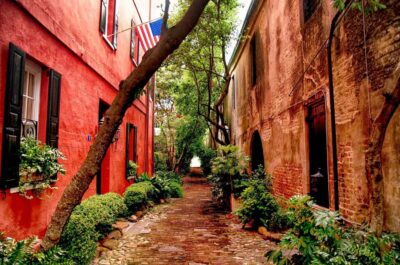
Historic Georgetown: History, Gossip, & Architecture Walking Tour
Read our review →
Charleston History, Homes, and Architecture Guided Walking Tour
Read our review →

Historical and Architectural Chicago Fireboat River & Lake Cruise
Read our review →
Downtown Freedom Trail Walking Tour – History & Architecture
Read our review →Browse the lists this tour appears in