
Review · WALKING TOURS
Downtown Freedom Trail Walking Tour – History & Architecture
Boston’s Freedom Trail is easy to follow, but its brick line does not explain itself. This tour gives the route a human voice, connecting Faneuil Hall, the Boston Massacre site, King’s Chapel, and Boston Common in one brisk walk.
I like two things here: the tour links architecture with history, and the 70-minute length works well for a first look at Boston. Guides such as Alan and Andrew have been praised for humor, clear explanations, and involving children. The main concern is that sound quality can vary, and one guide may be harder to hear in city traffic.
- Faneuil Hall to Boston Common: Follow the central stretch of the Freedom Trail rather than trying to cover all of Boston’s historic route.
- History and architecture together: See how churches, government buildings, marketplaces, and schools reflect changing Boston.
- A compact introduction: The 70-minute format gives you useful bearings without taking up half your day.
- Small-group setting: The maximum group size is 20, which can make questions and conversation easier.
- Family-friendly subject matter: Guides often bring children into the discussion, though the amount of interaction depends on the guide.
- Outdoor planning matters: The tour operates in changing weather, and cancellation terms allow a full refund when the operator cancels for poor conditions.
Why this short Freedom Trail walk works
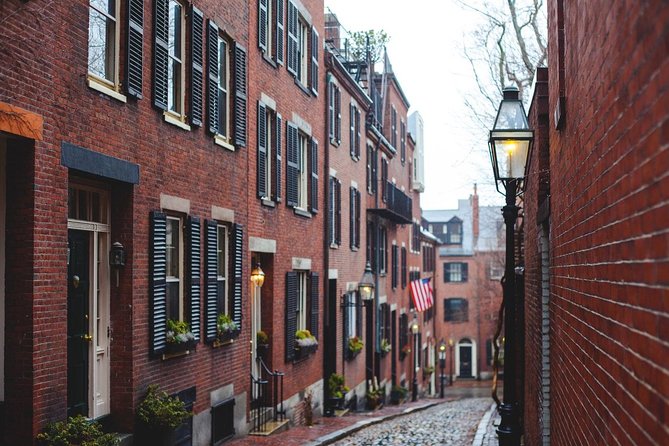
The strongest feature is its route. You begin near State Street and Congress Street, close to Faneuil Hall, then move through Boston’s historic core toward Boston Common and the New State House. That direction gives you a clear sense of how the commercial center, political buildings, religious sites, and public spaces fit together.
At $45 per person, this is not the cheapest way to walk the Freedom Trail. Still, the price is reasonable if you want more than a self-guided stroll and prefer a guide to explain the connections between places. You are paying for a compact lesson, not admission to a string of interiors. The attractions listed are mainly viewed from outside, with time to explore some sites on your own.
I would treat this as an orientation tour. It gives you a useful first pass, then helps you decide where to return for a longer visit. The walk lasts about 70 minutes, so you still have time for lunch, museums, shopping, or a longer route afterward.
Faneuil Hall and Quincy Market set the tone
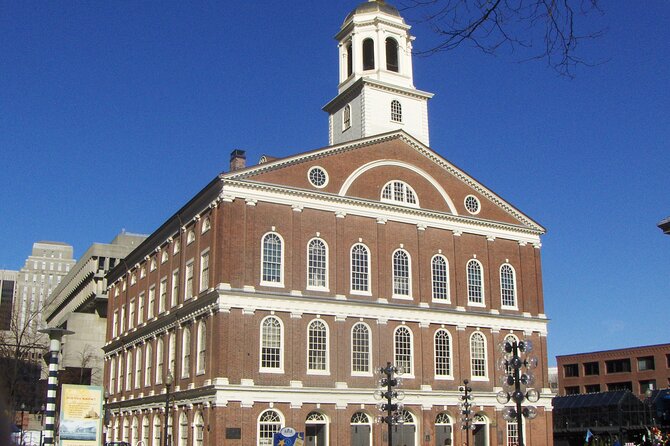
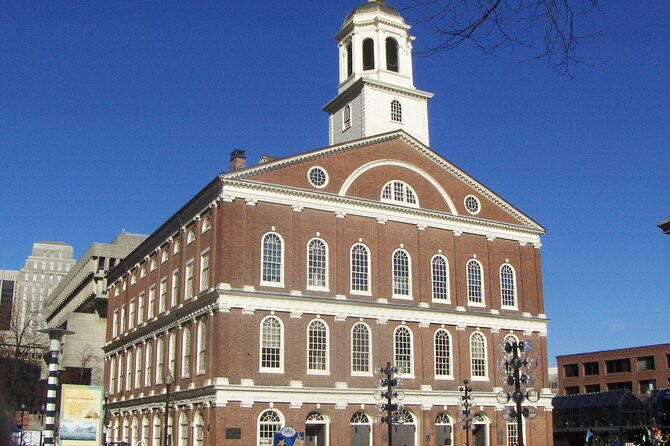
The tour begins with Faneuil Hall, often called the Cradle of Liberty. Its importance comes from the public arguments and protests held here before the American Revolution. This is a place where politics was not tucked away in a distant government district. It unfolded in a marketplace, among merchants, workers, and townspeople.
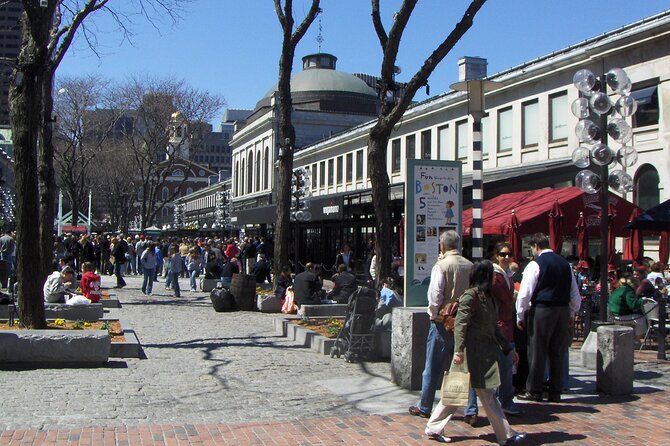
Look up at the grasshopper weathervane. It is one of the building’s best-known details and an easy feature to miss if you are focused only on the ground-level crowds. The nearby Quincy Market adds a commercial layer to the stop, showing how this part of Boston remains tied to food, trade, and public life.
The drawback is noise. Faneuil Hall and Quincy Market can be active, and a guide without a microphone may be difficult to hear. One practical tip is to arrive early and position yourself near the guide at the start.
More Walking Tours in the USA
- The Official Art Deco Walking Tour by The Miami Design Preservation League
★ 5.0 · 1,580 reviews - Chicago in a Day: Food, History & Architecture Walking Tour
★ 5.0 · 1,153 reviews - Miami South Beach Art Deco Walking Tour
★ 5.0 · 1,039 reviews
The Old State House and Boston Massacre site
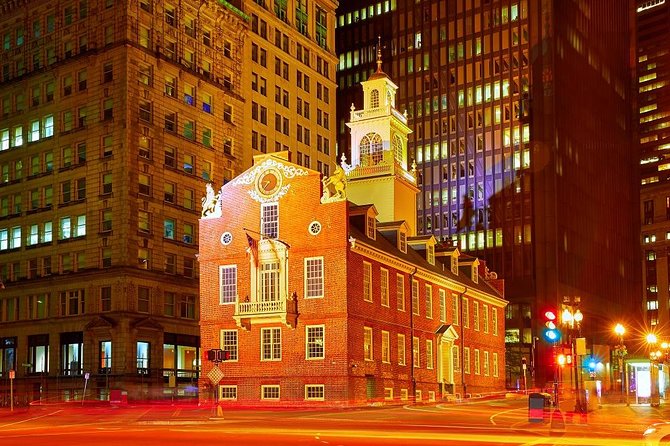
The Old State House is one of the tour’s most useful stops because it brings colonial government into view. Built in 1713, it served as the seat of British colonial rule. The balcony later became the place where the Declaration of Independence was first read to Bostonians.
Just outside is the Boston Massacre site, marked by a cobblestone ring in the pavement. The mark is modest, but the event it identifies became a powerful political symbol. In 1770, a confrontation between British soldiers and colonists ended with the deaths of five colonists. The tour helps place that moment within the rising tensions of the period.
This is where a guide adds real value. A quick photograph of the marker tells you little. An explanation of why the event was used in revolutionary arguments gives the location weight without requiring a long lecture.
Old South Meeting House and the city’s changing voices
The massive brick Old South Meeting House is associated with the signals that helped begin the Boston Tea Party in 1773. Its importance is not only architectural. It was a place where large public gatherings could shape political action.
The route also passes the Boston Irish Famine Memorial, a plaza with two groups of statues. One depicts an Irish family suffering during the Great Famine of 1845 to 1852. The other shows a prosperous family that had immigrated to America. The contrast makes the site easy to understand, but it also opens a broader question about immigration, hardship, and opportunity in Boston.
This section gives the walk more range than a simple parade of revolutionary landmarks. You move from colonial protest to the experience of later immigrants. If you want only battle dates and founding fathers, that wider view may feel like a change of subject. I see it as useful context for understanding the city as more than a stage for 1770s events.
Old Corner Bookstore and Old City Hall
The Old Corner Bookstore, at 283 Washington Street and School Street, began life in 1718 as a residence and apothecary shop. It became a bookstore in 1828. Ralph Waldo Emerson, Charles Dickens, and other writers gathered there, giving the building a literary connection as well as an old commercial form.
You will not get the full experience of a bookstore today, but the stop is a good reminder that Boston’s history includes publishing and ideas as much as war and government. The building’s small scale also contrasts with the larger public structures nearby.
Old City Hall brings a different architectural style. Built between 1865 and 1869 as Boston’s city government moved into a new home, it is one of the early American examples of French Second Empire design. Its formal exterior gives the guide a chance to explain how Boston changed after the colonial period and how public buildings expressed civic ambition.
The tour’s architecture focus is valuable here. Some people come expecting a stronger focus on historic personalities, while others want to know why buildings look the way they do. This experience tries to connect the two. If your main interest is military history or revolutionary biography, ask questions as you walk.
Same city, a different facade:
- Chicago Architecture River Cruise
★ 5.0 · 15,756 reviews - Chicago River 90-Minute Architecture Tour
★ 4.5 · 9,629 reviews - Chicago River: 1.5-Hour Guided Architecture Cruise
★ 4.8 · 8,046 reviews - Chicago Architecture Center River Cruise aboard First Lady
★ 5.0 · 5,536 reviews
The first schoolhouse and King’s Chapel
The original site of Boston Latin School is marked by a statue of Benjamin Franklin and a sidewalk mosaic. Founded in 1635, it was the first public school in America and offered free classical education to boys. The stop is brief, but it adds an important civic detail: education was part of Boston’s early public life.
King’s Chapel is one of the more substantial historic sites along this stretch. Its story reaches from its founding in 1686 through the American Revolution, the creation of the United States, and later periods of change. Even if you do not go inside, the church gives you a sense of how religious institutions shaped the city.
Nearby, Tremont Temple carries a different social history. It began in 1839 as a Free Baptist church and became known as the first integrated church in America. Its open attendance policy encouraged a racially diverse congregation. The building also hosted public events, including speeches against slavery by Frederick Douglass and Sam Houston, as well as an Egyptian mummy exhibition in 1850.
These stops make the walk less predictable. You are not only hearing about the Revolution. You are also hearing about schools, religion, race, public debate, and the way old buildings were reused.
Omni Parker House and the Old Granary Cemetery
The Omni Parker House, founded by Harvey D. Parker in 1855, is described as the oldest continuously operating hotel in the United States. It is linked with every American president since Ulysses S. Grant, Boston Cream Pie, Parker House Rolls, and the word scrod.
This is a quick, entertaining stop. It connects national figures and food history to a working hotel rather than a monument. For families, details like these can break up the heavier political material.
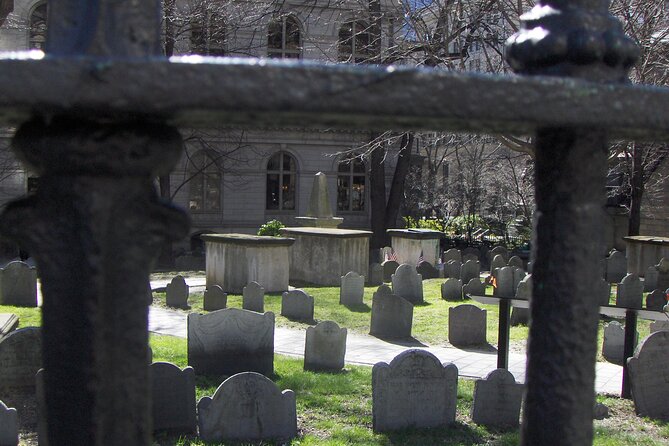
Old Granary Cemetery is the emotional center of the final part of the route. Paul Revere, Samuel Adams, and John Hancock are buried here, along with other important figures from Boston’s past. The cemetery is among the country’s most visited, and its worn stones provide a direct connection to the people named in the city’s revolutionary story.
You should not expect an extended cemetery visit within the 70-minute schedule. The tour covers a lot of ground, and the guide must keep the group moving. If this is a major interest, return later with more time.
Park Street Church, Boston Common, and the New State House
Park Street Church is another major landmark near the end of the route. The tour links it with the wider story of Boston’s public religious life and its place beside the Common. The exact amount of detail may depend on the guide and the size of the group.
Boston Common gives the walk room to breathe. At 50 acres, it is the oldest city park in the United States. It is bordered by Tremont Street, Park Street, Beacon Street, Charles Street, and Boylston Street. The tour ends near Brewer Fountain, making the Common a practical place to continue exploring on your own.
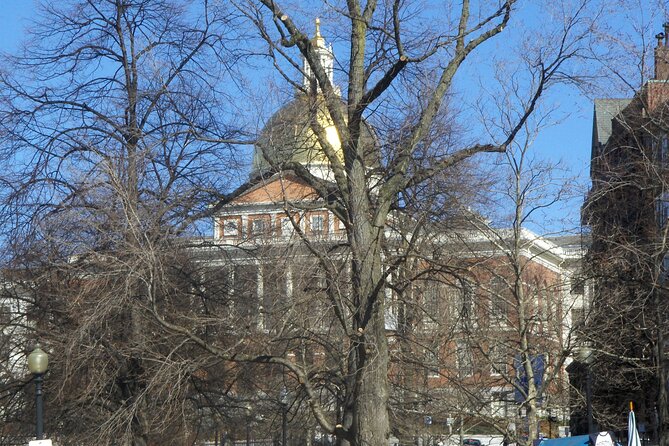
The final major view is the New State House, completed in 1798. Its 23-karat gold dome is hard to miss, and the building remains the modern seat of Massachusetts government. It overlooks Boston Common and provides a fitting endpoint: you begin with colonial authority at the Old State House and finish with the government of the new state.
The route can end in different moods depending on the day. A demonstration or event in Boston Common may affect the final stop, and weather can make the open park less comfortable. Those are normal city conditions, not something the guide can fully control.
Guides, group size, and the sound issue
Boston CityWalks uses more than one guide, so your experience can vary. Alan is praised for tying Boston’s past to modern life and for explaining complex subjects in simple terms. Andrew is described as funny, engaging, and especially good with families. That does not mean you can request either guide or that every departure will have one of them.
The best guides on this tour appear to use humor and questions to keep the group involved. That can help children stay interested, especially when the route includes cemeteries, government buildings, and dates. It can also mean that the tour feels less like a formal lecture.
There is a clear caution: some guests have found a guide difficult to hear. City traffic, crowds, and open plazas work against a quiet speaking voice. Stay close, ask the guide to repeat important points, and avoid drifting to the back of the group.
The group maximum is 20 people. That is small enough for a more personal feel than a large bus tour, but it is not private. If you want a fully customized discussion, a very small departure may suit you better. One person described having a particularly personal experience when the group was only two people, but that kind of setting cannot be promised.
Timing, weather, and practical value
The scheduled start is 10:00 a.m. at State Street and Congress Street. The endpoint is Brewer Fountain on the Freedom Trail near Boston Common. The route is close to public transportation, and confirmation is provided when you book.
Wear comfortable shoes and dress for the forecast. The tour is outdoors and is listed as operating in all weather, while the cancellation terms also say poor weather can lead to a new date or full refund. In practical terms, prepare to walk in ordinary rain or cold, but check for operator updates if conditions become severe.
Children must be accompanied by an adult, and most people can participate. The provided information does not promise step-free access or a private vehicle, so ask the operator directly if you have specific mobility needs.
Free cancellation is available up to 24 hours before the start time. Within 24 hours, changes are not accepted and the payment is not refunded, except when the operator cancels because of weather or an insufficient number of bookings.
Who should book this tour
I would choose this walk for a first morning in Boston, especially if you want the basic map of downtown before exploring alone. It suits history lovers, families, and anyone who likes buildings as much as famous names.
It is also a good fit if you prefer a short, guided introduction over a full-day historical program. The route covers a lot, but the pace leaves limited time for interiors or long cemetery visits.
I would hesitate if you want a theatrical, costume-led performance. Some Freedom Trail groups use costumed guides, but this tour is presented by guides in modern clothing. I would also think twice if you need every sentence amplified, since sound has been a concern for some participants.
Should you book the Downtown Freedom Trail Walking Tour?
Book it if you want a reasonably priced, 70-minute introduction to Boston’s central historic district, with architecture included alongside revolutionary events. The strongest value comes from the number of landmarks packed into a short walk and from guides such as Alan and Andrew, when available.
Do not book it expecting admission to every building or a complete tour of the entire Freedom Trail. You are getting a focused downtown section, mostly viewed from the street, with time to explore selected places later. Arrive early, stay near the guide, wear weather-ready shoes, and ask questions. With those expectations, this is a useful first chapter in Boston, not the whole book.
FAQ
How long is the Downtown Freedom Trail Walking Tour?
The tour lasts approximately 1 hour and 10 minutes, or 70 minutes.
Where does the tour start?
The meeting point is at State Street and Congress Street in Boston, Massachusetts.
Where does the tour end?
The tour ends at Brewer Fountain on the Freedom Trail near Boston Common.
What time does the tour start?
The scheduled start time is 10:00 a.m.
What landmarks are included?
The route includes Faneuil Hall, Quincy Market, the Old State House, the Boston Massacre site, Old South Meeting House, Old Corner Bookstore, Old City Hall, the Boston Latin School site, King’s Chapel, Tremont Temple, Old Granary Cemetery, Park Street Church, the New State House, and Boston Common.
Is the tour offered in English?
Yes. The tour is offered in English.
How many people can join the tour?
The maximum group size is 20 people.
Can I cancel for a refund?
You can cancel at least 24 hours before the start time for a full refund. Cancellations or changes made within 24 hours are not refunded. If the operator cancels because of poor weather or because the minimum number of participants is not met, you can receive a different date or experience, or a full refund.
More History Walks in the USA
- Charleston’s Best Highlights: History, Culture & Architecture
★ 5.0 · 422 reviews - Palm Springs Modernism Architecture & History Bike Tour
★ 5.0 · 359 reviews - Charleston: History and Architecture Guided Walking Tour
★ 4.8 · 349 reviews - Historic Georgetown: History, Gossip, & Architecture Walking Tour
★ 5.0 · 321 reviews
Newly added in the USA
- Miami Beach Art Deco Segway Tour★ 4.5 · 17 reviews
- Boston: Freedom Trail History and Architecture Walking Tour★ 4.8 · 18 reviews
- Boston: Harbor and Charles River Architecture Boat Tour★ 4.6 · 9 reviews
- Chicago: Guided Tour with Architecture River Cruise★ 4.5 · 20 reviews
- Iconic Capitol Hill Architectural Walking Tour★ 5.0 · 21 reviews
- South Beach Food Tour- Culinary & Art Deco & History★ 5.0 · 22 reviews
- Chicago: First Lady River Cruise & Architecture Center Combo★ 4.7 · 24 reviews
- Chicago River 90-Min Architecture Boat Tour★ 4.5 · 24 reviews
Walking Tours, compared.
The Official Art Deco Walking Tour by The Miami Design Preservation League
Read our review →
Baroque Architecture and Underground Walking Tour
Read our review →
Chicago in a Day: Food, History & Architecture Walking Tour
Read our review →

Ramblas, Old Town, Gothic and Gaudi Architecture Walking Tour
Read our review →
Chicago’s Secret Interiors Architectural Walking Tour
Read our review →
Browse the lists this tour appears in