
Review · GAUDí TOURS
Barcelona & Gaudi. Regular Tour
Barcelona’s Modernist buildings can look like a parade of pretty façades until someone explains the ideas behind them. This three-hour walk connects Gaudí’s twisting forms with Barcelona’s social conflicts, religious life, politics, and ambitious urban growth. You see Casa Milà, Casa Batlló, Casa Calvet, the Block of Discord, the Tàpies Foundation, and other major works without spending the morning inside museums.
I like the small maximum group of 20, which gives an architect-guide room to point out details and answer questions. I also like the wider view: Gaudí is not treated as a lone genius floating above Barcelona, but as part of a lively Modernist movement shaped by bourgeois wealth, utopian socialism, anarchism, science, and religion.
The main drawback is simple: you do not enter any of the buildings. If you want Gaudí’s interiors, tile work, rooftop sculptures, or the Sagrada Família itself, you’ll need a separate visit and ticket.
Key points about Barcelona’s Modernist walk
- Three hours on foot: The route covers a compact but architecturally dense section of the Eixample.
- Practicing architect guides: Expect more than dates and famous names, with attention to structure, materials, symbolism, and urban design.
- A strong Gaudí focus: Casa Milà, Casa Batlló, and Casa Calvet show different phases of his work.
- Barcelona beyond Gaudí: Domènech i Montaner, Puig i Cadafalch, and Antoni Tàpies also enter the story.
- Maximum 20 people: The group size should make it easier to hear the guide and ask questions.
- Outdoor-only sightseeing: The buildings are viewed from the street, so plan separate interior visits if they matter to you.
Why an architect-led walk changes what you see
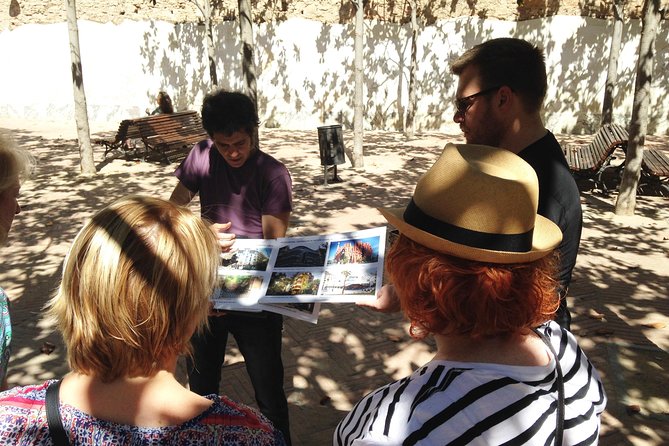
Gaudí’s buildings are easy to admire and easy to misunderstand. Their curved balconies, bone-like columns, colorful surfaces, and unusual roofs can seem like pure fantasy. A practicing architect can help you read them as working structures, urban statements, and products of a particular time.
That is the real value here. The guide does not simply point at a façade and announce its architect. You get a story about how Barcelona’s Eixample expanded, how the intellectual bourgeoisie commissioned ambitious homes, and how Modernism developed as both an artistic movement and a social expression.
The route also follows Gaudí’s changing outlook. It begins with his concerns about society and moves toward his increasing religious devotion. The discussion reaches the idea of Gaudí as the last great cathedral builder, a useful way to understand why his later work became less concerned with ordinary domestic design and more focused on sacred purpose.
Pia is the guide named in the available comments, and the strongest praise centers on her warmth, humor, passion, and command of the subject. That combination matters on an architecture walk. Technical explanations can become dry fast, so a guide who can connect ideas to people and keep the group engaged is a real advantage.
The tour also places Gaudí among his peers. You’ll hear about eclecticism and the end of Modernism, then compare Gaudí’s work with buildings by Lluís Domènech i Montaner and Josep Puig i Cadafalch. That comparison keeps the walk from becoming a single-architect fan club.
More Gaudi Tours in Barcelona:
- Barcelona: Park Güell and Gaudí House Museum Entry Ticket
★ 4.5 · 6,326 reviews - Barcelona: Gaudí’s Park Güell Tour with Fast-Track Ticket
★ 4.8 · 4,512 reviews - Sagrada Familia & Gaudi Tour Private or Small Group with Tickets
★ 4.5 · 1,188 reviews
Casa Milà, where stone seems to flow
The walk begins at Casa Milà, better known as La Pedrera. Its broad, irregular stone façade is one of Gaudí’s clearest breaks from the straight lines of conventional apartment design. The building seems to ripple along the street, with wrought-iron balconies that add another layer of movement.
From outside, focus on the building as part of a dense city block. Casa Milà is not a freestanding palace in a garden. It is an urban apartment building, commissioned for wealthy residents but designed with an almost geological sense of motion. That tension is worth discussing: Gaudí was working within the commercial city while trying to make architecture feel alive.
The roof is one of the reasons many people want to enter Casa Milà. Its chimneys and ventilation towers are famous, and its interior courtyards help explain how light and air move through the building. You will not see those spaces on this walk, so treat the stop as an architectural introduction rather than a complete visit.
I like starting here because it gives you a strong visual key for the rest of the morning. Look for the absence of rigid symmetry, the changing texture of the façade, and the way practical features become sculptural. If rooftop views and interiors are high on your list, schedule La Pedrera separately.
Casa Batlló and Gaudí’s most theatrical façade
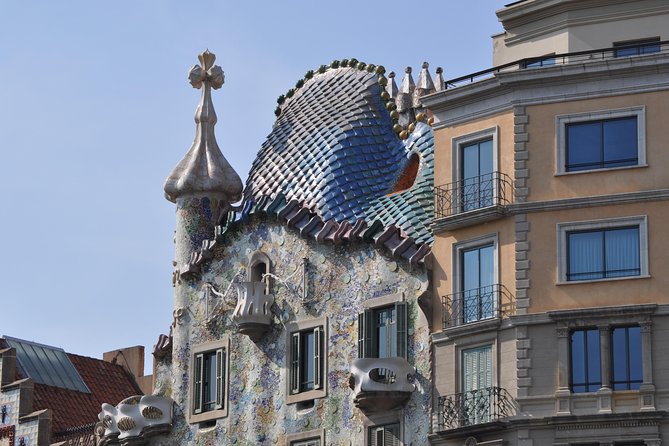
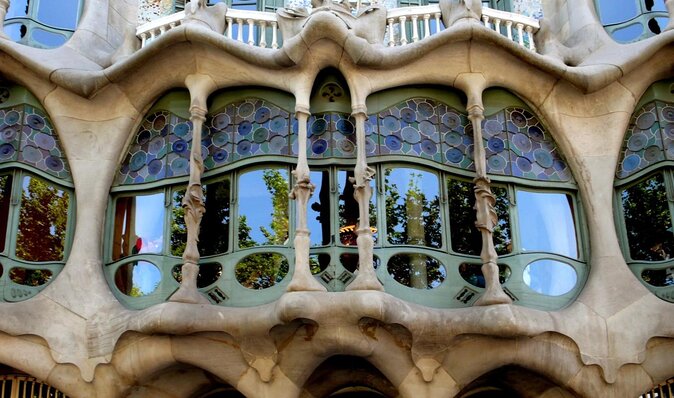
Casa Batlló is usually the most instantly popular stop. Its façade is covered with color, curved forms, and details that invite several readings. The roof may suggest a dragon’s back, while the balconies and window shapes give the building an almost organic face.
The guide’s job here is to move beyond the usual fairy-tale description. You can examine how Gaudí reshaped an existing building rather than starting from an empty site. That tells you something about Barcelona’s competitive urban culture, where major families commissioned eye-catching renovations along the same prestigious avenue.
Casa Batlló also helps explain Gaudí’s use of light, surface, and controlled irregularity. The building is not merely decorated. Windows, balconies, tiles, and structural forms work together to create a total visual effect. An architect can show you how those parts relate instead of leaving you with a collection of colorful details.
Again, the outside-only format limits the stop. The interior has its own sequence of rooms and surfaces, and the roof is a major part of the experience. Still, the street view is valuable because you can compare Casa Batlló directly with its neighbors and see how one façade competes with another.
Casa Calvet, Gaudí with a more restrained face
Casa Calvet often receives less attention than Casa Batlló or Casa Milà, which makes it a useful stop. It shows Gaudí working within a more conventional urban format, even while adding his own sense of craft and symbolism.
The building is associated with a more disciplined façade and a stronger connection to ordinary apartment architecture. That does not make it dull. It lets you see that Gaudí’s career was not one long march toward the wildest possible shape. He could adapt his approach to the client, the street, and the building’s function.
This is where the tour’s historical framing earns its keep. You can consider the relationship between the architect and Barcelona’s wealthy commercial class. Modernist architecture needed patrons with money and ambition, but it also reflected broader arguments about progress, identity, religion, and social order.
Casa Calvet is especially useful if you want to understand development rather than collect famous photographs. It gives the route a quieter pause between the more theatrical façades.
Same city, a different facade:
- Barcelona: Sant Pau Recinte Modernista Entry Ticket
★ 4.6 · 2,567 reviews - Barcelona: Sagrada Familia, Modernism, and Old Town Tour
★ 4.7 · 1,621 reviews - Complete Gaudi Tour: Casa Batllo, Park Guell & Sagrada Familia
★ 5.0 · 1,152 reviews - Park Güell: Guided Tour with Optional Gaudí Experience Entry
★ 4.1 · 832 reviews
The Block of Discord, Barcelona’s architectural contest
La Mansana de la Discordia, or the Block of Discord, brings several important architects into one stretch of the Eixample. The name captures the competitive feeling of the block, where distinctive façades sit close together and each building makes its own claim for attention.
Casa Batlló is part of this group, but it is not the only reason to stop. Casa Amatller by Puig i Cadafalch and Casa Lleó Morera by Domènech i Montaner help you compare different versions of Catalan Modernism. The point is not to decide which building is prettiest. It is to see how architects answered similar urban and social pressures in different ways.
Casa Amatller gives the block a more historical and geometric character. Casa Lleó Morera adds another layer of decorative detail and craftsmanship. Together with Casa Batlló, they show that Barcelona’s Modernism was not a single style with one formula.
This is one of the best places to slow down and compare. Look up, then look sideways. Notice how each architect handles balconies, windows, ornament, and the relationship between a private home and a public street. You may find that the most useful lesson is not about Gaudí at all. It is about how a city can turn a row of apartment buildings into an open-air argument.
The Antoni Tàpies Foundation and Modernism’s later conversation
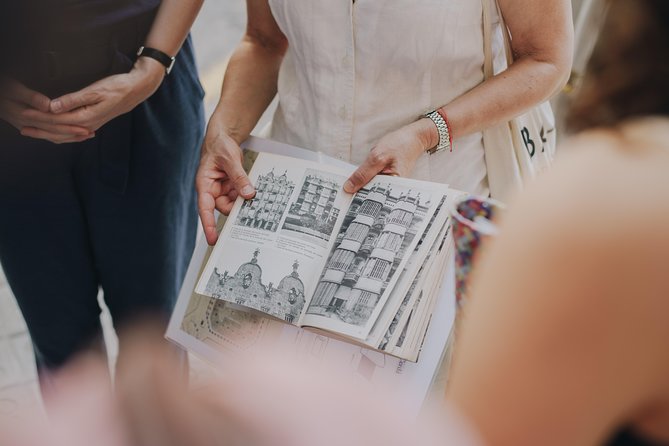
The Antoni Tàpies Foundation adds a later chapter to the route. Its building, associated with Domènech i Montaner, creates a bridge between Barcelona’s Modernist architecture and the work of Antoni Tàpies.
This stop keeps the tour from ending with Gaudí as if Barcelona’s architectural story stopped in the early twentieth century. The Tàpies Foundation places older Modernist ideas beside a more recent artistic voice, giving you a chance to think about how the city keeps reworking its visual identity.
The emphasis here is not simply on another famous façade. It is on continuity and change. You can consider how buildings acquire new uses, how art institutions shape their surroundings, and how Barcelona’s interest in unusual form continued after Gaudí’s main period.
Because the tour does not include interior entry, you should not expect a full museum visit or a gallery tour. The stop works best as part of the architectural walk, not as a substitute for visiting the foundation itself.
Courtyards, politics, and the ideas behind the façades
Some of the most useful moments may come between the headline buildings. The route includes hidden Eixample courtyards and discussion of the city’s development, giving you a better sense of the neighborhood as a planned urban system rather than a string of isolated monuments.
The conversation can move through utopian socialism, positivist materialism, anarchism, and the Spanish Civil War. Those topics are not decorative extras. They help explain why architecture in Barcelona carried such a heavy load of meaning.
Barcelona’s Modernist buildings were linked to a society wrestling with industrial growth, class tensions, political movements, religious belief, and Catalan cultural identity. A façade could signal wealth, modernity, tradition, or personal taste. The buildings were commissioned by real people in a city full of competing ideas.
The reference to beatification and deliquescent surfaces points toward Gaudí’s religious direction and his increasingly fluid forms. You do not need a background in architectural theory to follow the route, but you should enjoy ideas as well as photographs. This is not a quick parade of Instagram stops.
What three hours and a group of 20 mean in practice
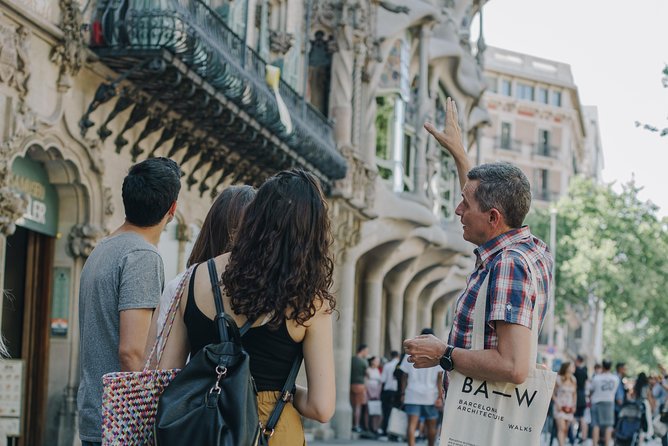
At about three hours, the walk is long enough to build a real story but short enough to fit into a busy Barcelona schedule. The 10:30 am start gives you a useful morning block, though you should allow time afterward if you plan to visit one of the buildings inside.
The meeting point is the Monument al Llibre on Gran Via de les Corts Catalanes, 634, in the Eixample. The walk returns to that same meeting point, which makes planning easier. The route is near public transportation, and most people can take part, but you should expect to be on foot for the full experience.
A maximum of 20 people is a sensible middle ground. You get the energy of a shared walk without the scale of a large coach group. Since the subject depends on pointing out small features on façades, staying close enough to the guide matters.
The tour is offered in English and includes a mobile ticket. Service animals are allowed. The experience requires good weather and a minimum number of people, so check the conditions before you set your day around it.
Is $54.44 a fair price?
At $54.44 per person, this is not a cheap orientation walk. The price makes more sense if you value a practicing architect’s interpretation and want the social and artistic background that a basic sightseeing stroll may skip.
You are paying for about three hours of focused instruction, a small group, and access to a route that brings several major buildings into one connected story. You are not paying for admission to Casa Milà, Casa Batlló, Casa Calvet, the Tàpies Foundation, or the Sagrada Família. Those costs, if you choose to visit inside, come separately.
I would call the value good for an architecture fan, a design student, or anyone who wants to understand why Barcelona looks the way it does. It is less attractive if you mainly want quick photo stops or a low-cost introduction to the city.
The walk can also save you time. Instead of seeing famous façades one by one and trying to work out their differences yourself, you get a framework for reading them. That framework can improve every later visit, including time inside the buildings.
Who should book this Barcelona walk?
I would choose this experience if you like architecture, city planning, art, politics, or the human stories behind famous buildings. It suits first-time visitors who want a strong introduction to the Eixample, as well as returning visitors who have already seen Gaudí’s façades but want more context.
It is particularly useful for anyone who has wondered why Casa Batlló and Casa Milà feel so different, or why Gaudí should be discussed alongside Domènech i Montaner and Puig i Cadafalch. The route gives you comparisons instead of isolated facts.
You may want another activity if you need interior access, a visit to the Sagrada Família, or a gentle sightseeing option with little walking. The subject is serious at times, and the references to political and social movements may be more than you want from a short city tour.
Free cancellation is available up to 24 hours before the start time. Changes or cancellations inside that period are not accepted for a refund. If bad weather or an insufficient minimum group causes cancellation, you are offered another date or experience, or a full refund.
My booking advice
Book this walk if you want Barcelona’s Modernist architecture explained rather than simply photographed. The strongest reasons are the architect-led approach, the small group, the comparison of several important designers, and the attention to religion, politics, and social change.
Skip it if your main goal is to go inside Gaudí’s buildings. In that case, spend the $54.44 toward admission and use a self-guided route outside. For everyone else, this is a focused and thoughtful way to get your bearings in Barcelona’s Modernist center, with Pia’s warm, lively guiding style adding a human touch to a subject that can otherwise feel technical.
FAQ
How long does the Barcelona and Gaudí tour last?
The experience lasts approximately three hours.
What time does the tour begin?
The tour starts at 10:30 am.
Where does the tour meet?
It meets at the Monument al Llibre, Gran Via de les Corts Catalanes, 634, in Barcelona’s Eixample district.
Where does the tour finish?
The activity ends back at the meeting point.
Which buildings are included?
The route includes Casa Milà, Casa Batlló, Casa Calvet, La Mansana de la Discordia, and the Antoni Tàpies Foundation. It also includes views of Casa Lleó Morera, Casa Amatller, and selected Eixample courtyards.
Do you go inside the buildings?
No. The tour views the buildings from outside, so interior visits require separate arrangements.
How many people can join the tour?
The maximum group size is 20 people.
Newly added in Barcelona
- Barcelona: Private Gaudi Guided Segway Tour★ 5.0 · 6 reviews
- Barcelona: Exclusive Exploration of Gaudi’s Masterpieces★ 5.0 · 2 reviews
- Barcelona: Guided tour e-bike Barcelona historical and modernist Barcelona★ 4.5 · 5 reviews
- Barcelona: Wonders of Gaudi Bike Tour★ 4.3 · 6 reviews
- Barcelona Architecture Walking Tour With Casa Batlló Upgrade★ 4.8 · 11 reviews
- Barcelona: Gaudi Tapas & Wine Tasting Small Group Tour★ 5.0 · 3 reviews
- Barcelona: E-Scooter Gaudí & the Sea Tour★ 4.3 · 10 reviews
- Barcelona Beyond Gaudí: Modernism, Rooftops, and Hidden Gems★ 5.0 · 2 reviews
Gaudí Tours, compared.
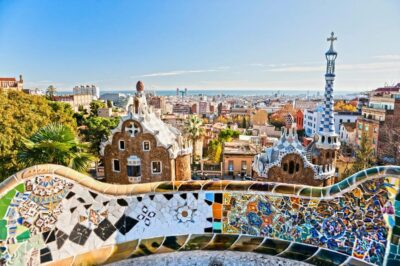
Park Güell and Gaudí House Museum Entry Ticket
Read our review →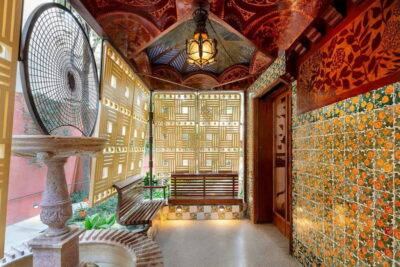
Gaudi’s Casa Vicens Skip-the-Line Entrance Ticket
Read our review →
Gaudí’s Park Güell Tour with Fast-Track Ticket
Read our review →
Sagrada Familia & Gaudi Tour Private or Small Group with Tickets
Read our review →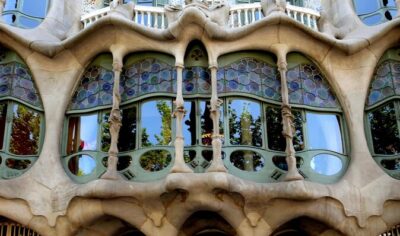
Complete Gaudi Tour: Casa Batllo, Park Guell & Sagrada Familia
Read our review →
Park Güell: Guided Tour with Optional Gaudí Experience Entry
Read our review →
Barcelona e-Bike Tour: Gaudí & Old Town Small Group
Read our review →
Ramblas, Old Town, Gothic and Gaudi Architecture Walking Tour
Read our review →Browse the lists this tour appears in