

Review · WALKING TOURS
Boston: Freedom Trail History and Architecture Walking Tour
Boston’s Freedom Trail works best when someone connects the dots. On this 70-minute walk, you move from Faneuil Hall toward Boston Common while a local guide explains why Boston’s streets, churches, meetinghouses, and civic buildings look so different from one another. The route packs a lot into one morning without asking you to spend hours indoors.
I like the direct route and the strong local focus. I also like that the guide does more than point at old buildings, explaining how Boston changed from its earliest settlement to the quirky downtown you see today. The main drawback is pace: with so many places packed into a short walk, the English-only commentary may be hard to follow if your listening skills are not strong.
Key points at a glance
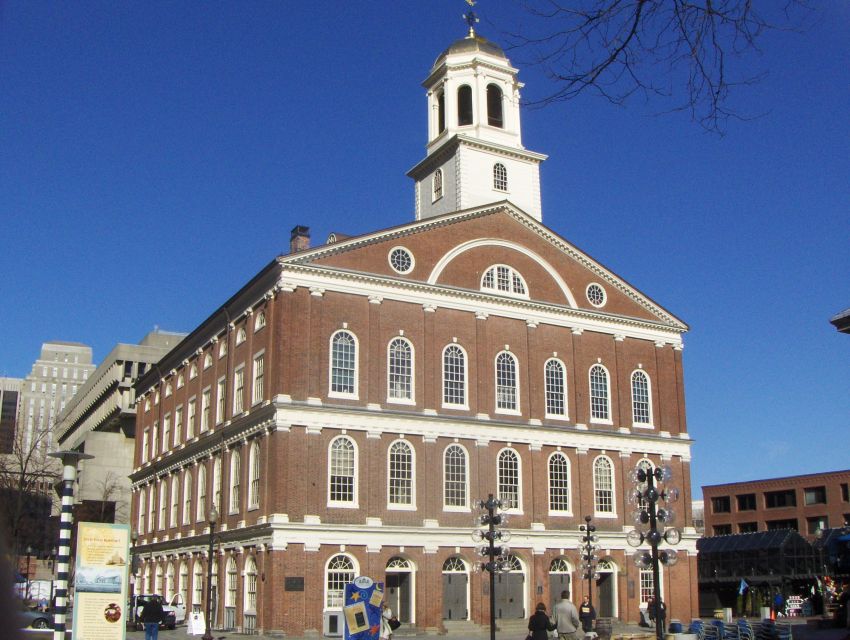
- Follows the Freedom Trail downtown: Walk from Faneuil Hall toward Boston Common along one of Boston’s best-known historic routes.
- Covers major landmarks quickly: See the Old State House, Boston Massacre Site, King’s Chapel, Old South Meeting House, and Old Granary Cemetery.
- Adds architecture to the history: The guide explains how Boston’s buildings and streets changed over time.
- A local guide leads the way: Allan has received particular praise for his friendly manner, patience, and ability to answer questions.
- Good for families with older children: A July tour worked well for teenagers, including those who asked plenty of questions.
- English only and 70 minutes long: You get a compact introduction, but not a slow, inside look at every stop.
Starting at State and Congress Streets
The meeting point is on the northwest corner of State and Congress Streets, outside 28 State Street, where you’ll see Citizens Bank. It is directly across the street from the Old State House, so the building itself is an easy landmark to use while finding the group.
This starting point puts you in the middle of old Boston right away. You do not begin with a long transfer from a visitor center or a distant neighborhood. Instead, the first historic views are already in front of you, and the guide can quickly place the streets around you in context.
I would arrive with enough time to identify the Old State House and the bank entrance without rushing. The tour has a fixed 70-minute length, so a late arrival could matter more here than on a flexible self-guided walk.
The route heads through downtown toward Boston Common. That direction gives you a useful sense of Boston as a city built in layers. Early civic buildings, churches, burial grounds, meetinghouses, commercial streets, and later public spaces all sit close together.
More Walking Tours in the USA
- The Official Art Deco Walking Tour by The Miami Design Preservation League
★ 5.0 · 1,580 reviews - Chicago in a Day: Food, History & Architecture Walking Tour
★ 5.0 · 1,153 reviews - Miami South Beach Art Deco Walking Tour
★ 5.0 · 1,039 reviews
Faneuil Hall and the heart of old Boston
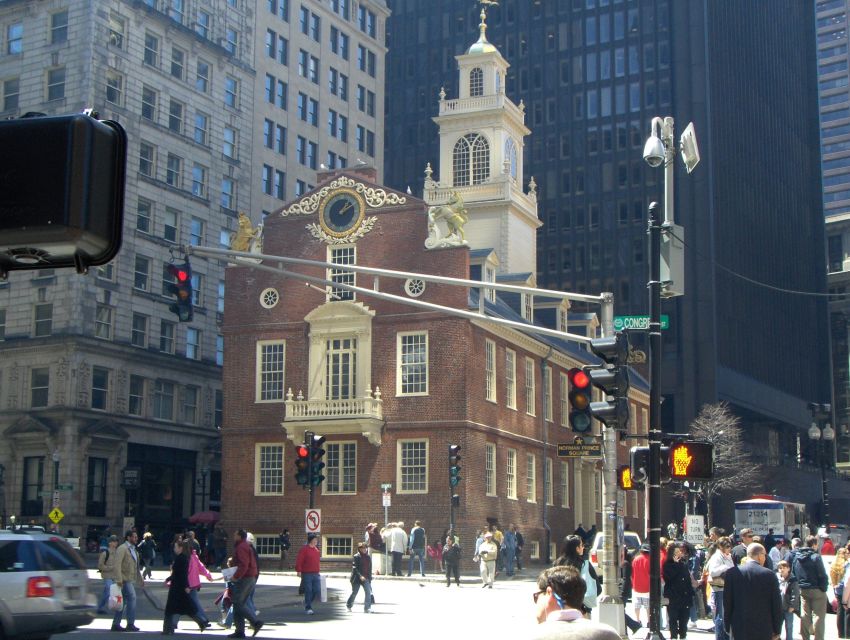
Faneuil Hall is one of the central places on this walk. It connects Boston’s commercial life with its political past, and it helps explain why the Freedom Trail is more than a string of unrelated monuments.
The surrounding area can feel busy, but the tour’s value is not simply in reaching a famous building. Your guide helps explain how the site fits into Boston’s growth and public life. You can look at the architecture while also considering how the city used its public spaces.
This is a good early stop because it gives you a broad frame for the rest of the tour. After Faneuil Hall, individual churches, state buildings, and memorials make more sense as parts of a city that kept changing while retaining older structures.
The walk does not promise an interior visit or a long stop inside each building. That is important when setting expectations. You are getting an outdoor history and architecture lesson, not a series of museum tours.
The Old State House and Boston Massacre Site
Across from the meeting point, the Old State House offers one of the clearest examples of Boston’s layered past. Its position among newer downtown buildings makes the city’s changes easy to see. The old structure is not isolated from modern Boston, and that contrast is part of the experience.
Nearby, the Boston Massacre Site brings the political tension of the colonial period into a very small urban space. A good guide can make this kind of stop useful by explaining not only what happened, but also how a single event gained meaning in the wider story of Boston and the American Revolution.
The stop is valuable for visitors who want context rather than a quick photograph. You are encouraged to notice how public memory works in a crowded city. A historic marker may be small, but the event it recalls had a large effect on Boston’s identity.
Because the tour is short, the guide must keep moving. You will hear the central story and its place in Boston’s history, but you should not expect a long debate over every disputed detail. If you want a very full treatment of Revolutionary-era politics, you will need additional time elsewhere.
Meetinghouses, churches, and Boston’s changing skyline
The route includes King’s Chapel, the Old South Meeting House, and Park Street Church. Together, these buildings show how religion and public life shaped Boston’s streets.
King’s Chapel adds another architectural layer to the walk. Its presence helps you see that Boston’s old center was not built in one single style or period. The Old South Meeting House brings political and civic history into the story, while Park Street Church helps show how later generations added their own institutions to the city center.
I like this part of the walk because architecture becomes evidence. You are not simply told that Boston changed. You can see the changes in the scale, form, and setting of the buildings around you.
The word architecture can sound dry, but the guide’s job is to make it practical. Look at how each building meets the street, how much space it claims, and how later construction surrounds it. These details help explain why downtown Boston feels irregular rather than planned on a simple grid.
The tour does not provide a separate architectural lecture. Instead, buildings support the larger story of the city. That approach should suit you if you want history tied to real places, rather than a technical study of design.
Same city, a different facade:
- Chicago Architecture River Cruise
★ 5.0 · 15,756 reviews - Chicago River 90-Minute Architecture Tour
★ 4.5 · 9,629 reviews - Chicago River: 1.5-Hour Guided Architecture Cruise
★ 4.8 · 8,046 reviews - Chicago Architecture Center River Cruise aboard First Lady
★ 5.0 · 5,536 reviews
Old Granary Cemetery and the city’s early residents
Old Granary Cemetery is one of the most important stops for understanding Boston’s early public memory. Burial grounds can make history feel more immediate because they place names, dates, and individual lives in the middle of the modern city.
The cemetery also adds a change of mood. After the commercial streets and public buildings, you reach a quieter reminder that Boston’s past is made up of people, not only famous events. The stop can help you connect the city’s political story with the lives of those who lived through it.
You will also encounter the First Schoolhouse Site, another small but useful marker. It shows how much of Boston’s story survives through traces rather than grand buildings. The Old Corner Bookstore adds a literary and commercial note, giving the route another way to explain downtown’s past.
These stops are especially helpful for first-time visitors because they broaden the picture. You are not only following the Revolution. You are also seeing how education, books, worship, trade, burial, and government shared a compact part of the city.
Old City Hall, the Irish Famine Memorial, and Boston today
Old City Hall brings the story forward into another phase of Boston’s civic development. Its presence helps you notice that the Freedom Trail is not frozen in the colonial period. Boston kept adding public buildings, communities, and memories long after the Revolutionary era.
The Irish Famine Memorial gives the walk a more modern human dimension. It points to the experiences of Irish immigrants and to the way Boston’s identity grew through migration as well as colonial settlement. This is one of the reasons the tour works as a city introduction, not only as a Revolutionary War walk.
The route eventually reaches Boston Common, one of the city’s best-known public spaces. Ending there gives the tour a natural sense of arrival. You have moved from the tight historic core toward a broad civic space that helps connect downtown with the rest of Boston.
Do not expect every stop to receive equal time. The guide has to balance a long list of places within 70 minutes. Some locations will be quick viewing points, while others receive more explanation. That is a fair trade for a compact tour, but it means you may want to return later to the sites that catch your interest.
What the guide adds to the walk
The guide is the main reason to choose this experience instead of simply following painted Freedom Trail markers on your own. A marker can tell you where you are. A local guide can explain why the place matters and how it relates to the next stop.
Allan has been specifically praised for his personable approach, patience, and ability to answer questions. That matters if you are traveling with teenagers or with a group that likes to stop and ask about small details. One family with teenagers found the tour engaging for the whole group, and the guide handled both easy and more difficult questions politely.
That does not mean the experience is a private conversation. The guide must keep the group moving, and a 70-minute tour can only cover so much. Still, the ability to ask questions gives the walk more life than a recorded route.
The tour is conducted in English. You should be comfortable listening to spoken English while walking through a busy downtown area. If you need frequent translation or prefer to read at your own pace, you may find the tour difficult to follow. An English-speaking visitor who wants a friendly introduction should have a much easier time.
Is $30 good value for 70 minutes?
At $30 per person, this is not the cheapest way to see the Freedom Trail. You can walk much of the route independently for little or no cost. The price pays for a local guide who organizes the story, keeps you moving, and explains the connection among sites that can otherwise feel scattered.
The value is strongest if you are new to Boston, have limited time, or want a quick orientation on your first morning. In 70 minutes, you see a large set of landmarks and gain a basic framework for exploring the city afterward.
The value is weaker if you already know Boston well or want long visits inside historic buildings. The tour is not designed for extensive photography, private questions at every stop, or a slow architectural survey. It is a compact introduction.
I would consider booking it early in your Boston stay. That way, the route can help you choose which places deserve a return visit. You may decide to spend more time at the Old State House, Old South Meeting House, King’s Chapel, or Old Granary Cemetery after hearing the guide’s explanation.
You can reserve now and pay later, which helps if your plans are still shifting. Cancellation is allowed up to 24 hours before the tour for a full refund. Those terms reduce the risk of booking a fixed morning activity during a changeable trip.
Who should book this Freedom Trail walk?
I would recommend it to first-time Boston visitors who want a clear introduction without giving up an entire day. It also suits families with teenagers, especially if the group appreciates stories and has questions.
The tour works well for history fans who want to see famous sites in context. It is also useful for architecture fans who prefer plain explanations tied to real streets instead of a formal lecture.
You should think twice if you need a language other than English, have difficulty keeping up with spoken commentary, or want to enter every building. The tour focuses on an outdoor route and a guide’s explanation, not on extended interior visits.
It is also worth noting that the short duration creates both its strength and its limit. You get a clean introduction, but you will not receive the level of detail possible on a longer specialist walk.
Should you book the Boston Freedom Trail tour?
Book this tour if you want a fast, guided introduction to downtown Boston and value a local voice over a self-guided map. The route links Faneuil Hall, the Old State House, churches, meetinghouses, burial grounds, civic buildings, memorials, and Boston Common in a sensible 70-minute walk.
Skip it if you already know the Freedom Trail or want to spend substantial time inside each historic site. For everyone else, $30 is a reasonable price for getting your bearings, learning the city’s basic story, and finding the places you may want to explore more closely later.
FAQ
How long is the Boston Freedom Trail History and Architecture Walking Tour?
The tour lasts 70 minutes.
How much does the tour cost?
The price is $30 per person.
Where does the tour meet?
It meets at the northwest corner of State and Congress Streets, outside 28 State Street at Citizens Bank, across from the Old State House.
Where does the walking tour go?
The route follows the Freedom Trail from Faneuil Hall toward Boston Common through downtown Boston.
Which historic sites can I see?
The route includes the Old and New State House, Faneuil Hall, the Boston Massacre Site, Park Street Church, King’s Chapel, the Old South Meeting House, Old Granary Cemetery, Old City Hall, the First Schoolhouse Site, the Old Corner Bookstore, Boston Common, and the Irish Famine Memorial, among other places.
Is the tour offered in English?
Yes. The live tour guide speaks English, and English is the listed tour language.
Is a guide included?
Yes. A professional local guide is included.
Can I ask the guide questions?
Yes. The tour is led by a live guide, and Allan has been noted for answering questions patiently and politely.
Can I cancel for a refund?
You can cancel up to 24 hours in advance for a full refund.
Do I have to pay when I reserve?
No. The reserve-now, pay-later option lets you book the tour without paying at the time of reservation.
More History Walks in the USA
- Charleston’s Best Highlights: History, Culture & Architecture
★ 5.0 · 422 reviews - Palm Springs Modernism Architecture & History Bike Tour
★ 5.0 · 359 reviews - Charleston: History and Architecture Guided Walking Tour
★ 4.8 · 349 reviews - Historic Georgetown: History, Gossip, & Architecture Walking Tour
★ 5.0 · 321 reviews
Newly added in the USA
- Miami Beach Art Deco Segway Tour★ 4.5 · 17 reviews
- Boston: Harbor and Charles River Architecture Boat Tour★ 4.6 · 9 reviews
- Chicago: Guided Tour with Architecture River Cruise★ 4.5 · 20 reviews
- Iconic Capitol Hill Architectural Walking Tour★ 5.0 · 21 reviews
- South Beach Food Tour- Culinary & Art Deco & History★ 5.0 · 22 reviews
- Chicago: First Lady River Cruise & Architecture Center Combo★ 4.7 · 24 reviews
- Chicago River 90-Min Architecture Boat Tour★ 4.5 · 24 reviews
- Manhattan Architecture Photography Tour★ 5.0 · 24 reviews
Walking Tours, compared.

The Official Art Deco Walking Tour by The Miami Design Preservation League
Read our review →
Baroque Architecture and Underground Walking Tour
Read our review →
Chicago in a Day: Food, History & Architecture Walking Tour
Read our review →

Ramblas, Old Town, Gothic and Gaudi Architecture Walking Tour
Read our review →
Chicago’s Secret Interiors Architectural Walking Tour
Read our review →

Browse the lists this tour appears in