
Review · NEW YORK CITY ARCHITECTURE TOURS
Manhattan Architecture Photography Tour
Manhattan is full of famous buildings, but getting a strong photograph of them takes more than pointing your camera upward. This three-hour walking photography tour helps you find cleaner angles, manage bright signs and shadows, and make ordinary city scenes less flat. You’ll work through Midtown landmarks with a professional photographer, not simply collect quick snapshots.
I like the small maximum of eight people, which gives the guide room to watch what you’re doing and answer camera questions. I also like the mix of grand interiors, street scenes, and building exteriors, from Grand Central Terminal to the Chrysler Building and Times Square. The main consideration is pace: you should expect plenty of walking, and the tour may be less appealing if you want a relaxed sightseeing outing rather than hands-on instruction.
Key points to know before booking
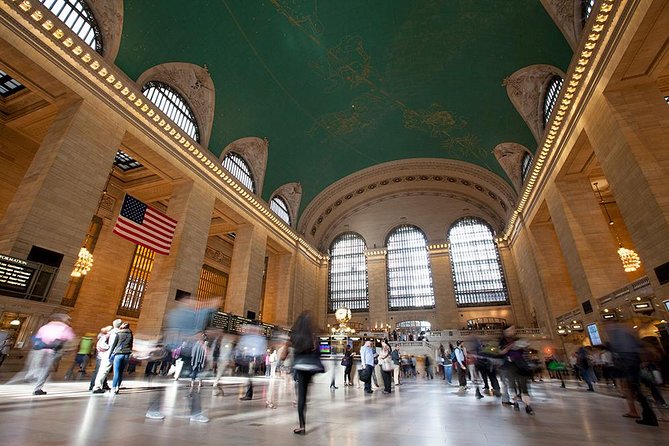
- Grand Central is the visual centerpiece: You get time inside its huge main space, where the scale and ceiling make a strong first photography lesson.
- The guide works with your skill level: Zim is noted for patient, attentive teaching and for adjusting recommendations to your interests.
- Times Square requires technique: The guide helps you handle intense lights, movement, and crowded visual information.
- You’ll practice composition, not just camera settings: Past instruction included better use of angles and removing dull empty space from an image.
- The group is capped at eight: That is a useful size for questions and individual feedback.
- You must bring your own camera: A digital camera is not supplied, so check your equipment before leaving home.
Why this tour is useful for photographing New York
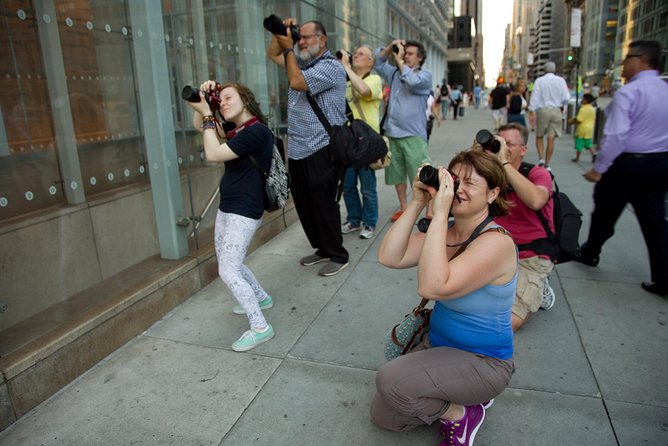
The best reason to book this experience is that it turns Midtown into a practical photography class. You are not only told that a building is important. You are shown how to frame it, where to stand, and how to deal with the visual problems that make city photography tricky.
That matters in Manhattan. Buildings are tall, streets are narrow, signs compete for attention, and the best viewpoint is often not the most obvious one. A professional guide can point out angles you might miss while moving from one attraction to the next.
The teaching also appears suited to mixed ability levels. If you are new to photography, you can ask basic questions without needing to know technical terms in advance. If you already use a camera often, the session can help you think harder about composition, empty space, perspective, and the way a familiar building reads in a photograph.
The tour is offered in English and lasts about three hours. Because the group is limited to eight people, you should have more access to the guide than on a large sightseeing walk. Still, three hours is not a long time for five major Midtown stops. Expect focused visits, not a slow architectural study at each location.
Other buildings people go and look at in New York City:
- Manhattan Architecture Yacht Cruise
★ 5.0 · 1,395 reviews - NYC: Around Manhattan Official NYC Architecture Cruise
★ 4.8 · 402 reviews - Art Deco and Architecture Midtown Landmarks Tour
★ 5.0 · 142 reviews
Starting at Pershing Square near Grand Central
The meeting point is Pershing Square at 90 East 42nd Street, close to Grand Central Terminal. This is a sensible place to begin because the first major stop gives you a dramatic indoor subject and a chance to settle into the lesson before tackling the harsher light of Times Square.
Grand Central Terminal receives about 20 minutes on the route. That may sound brief, but the main concourse gives you plenty to work with. The guide can help you make sense of a very large space, where the ceiling, clock, balconies, staircases, and moving people all compete for attention.
I would use this opening stop to listen carefully to the guide’s advice about composition. The concourse is easy to photograph badly because it contains so much. A wide image can show scale, while a tighter frame may give you a cleaner pattern or a stronger architectural detail.
Admission to Grand Central Terminal is included. This does not mean you receive a private entry or special access. It simply removes the need to pay a separate admission charge for this part of the experience.
Finding the Chrysler Building’s best angle
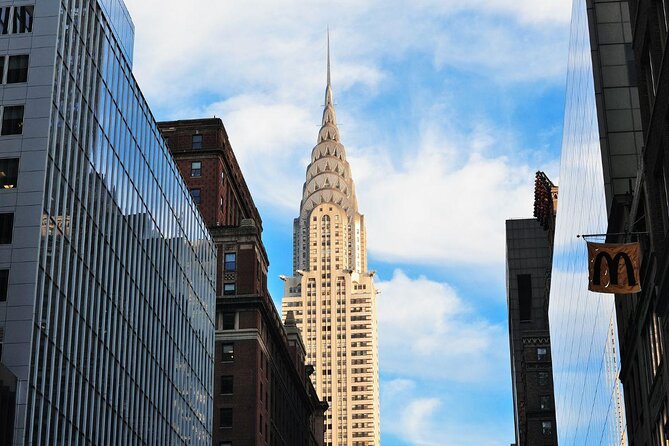
The Chrysler Building stop lasts about 10 minutes. That is short, but the building is a natural lesson in viewpoint. Its famous crown is easy to recognize, yet the photograph can feel ordinary if you simply aim straight up from the nearest street.
This is where the guide’s local eye can help. You’ll learn where to position yourself for a more pleasing view and how to fit the tower into the surrounding Midtown setting. The emphasis is on finding the best angle, not spending a long time inside or exploring the building.
There is no separate admission charge for this stop. Since the tour is focused on exterior photography, you should think of it as a quick field exercise. The guide may help you make a fast decision about framing, which is useful practice for the rest of your trip.
Working through the lights of Times Square
Times Square receives about 15 minutes, and this is likely the most technically demanding stop. Its screens, signs, traffic, pedestrians, and changing light can produce exciting images, but they can also leave your photograph looking confused or overexposed.
The guide helps you capture both the lights and the movement. That may include advice on where to point, how to simplify the frame, and how to keep bright signs from swallowing the rest of the image. The exact camera settings you need can vary, so this is a good place to ask questions about your own equipment.
Times Square is also useful for learning timing. A city scene changes every second. You may need to wait for the right arrangement of people, signs, and traffic rather than pressing the shutter immediately. The guide’s role is to help you see those opportunities.
The stop is listed as included, but it is not an enclosed attraction with a formal ticket process. You are photographing in the public area around one of Manhattan’s most famous sights. Keep your belongings close and stay aware of the group while working.
A few more architecture walks in New York City worth a look
- Tribeca Architecture And History Walking Tour
★ 5.0 · 141 reviews - 3 Hour Midtown Manhattan Architectural Tour
★ 5.0 · 81 reviews - New York City: Art Deco and Architecture Landmarks Tour
★ 5.0 · 76 reviews - New York City: Flatiron Food, History, and Architecture Tour
★ 4.8 · 43 reviews
Framing the New York Public Library
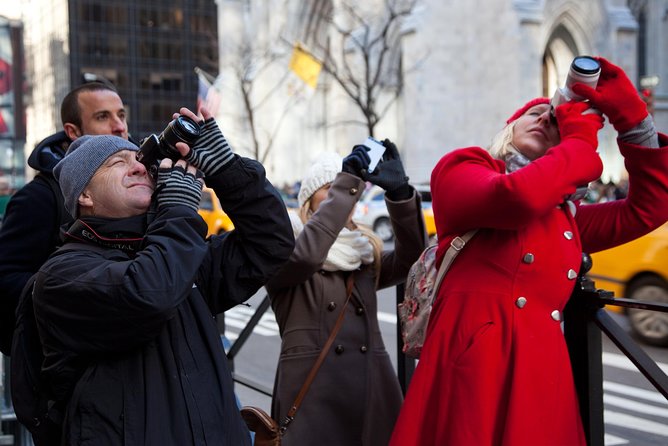
The New York Public Library stop lasts about 15 minutes and focuses on the exterior. The building gives you a more formal architectural subject after the visual overload of Times Square.
You can use this stop to practice symmetry, repeated columns, straight lines, and the relationship between the building and the space in front of it. The goal is not only to record the library but to make the photograph feel intentional.
The exterior is also a useful contrast with Grand Central. Grand Central asks you to manage a huge interior and human movement. The library offers a more orderly facade, so you can concentrate on shape and balance.
The tour information includes admission for the library, though the stated inclusions specifically identify Grand Central Terminal, Bryant Park, and Times Square. Since the focus here is the exterior, you should not assume that the visit includes a full indoor tour or access to reading rooms.
Using Bryant Park to photograph the Empire State Building
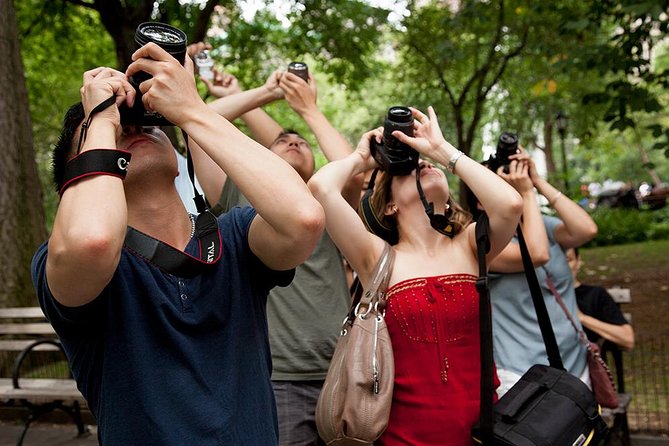
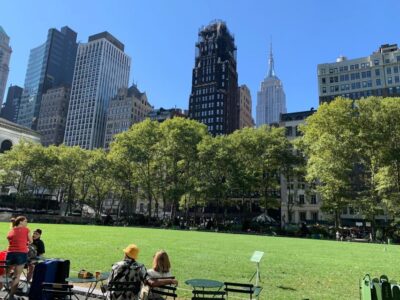
Bryant Park receives about 15 minutes and offers one of the route’s clearest chances to work on a distant skyline subject. The park is described as a strong location for photographing the Empire State Building.
Here, the guide can help you handle distance and scale. A famous tower can look small when surrounded by tall buildings, or it can dominate the frame without any sense of place. The park gives you room to consider how much foreground and surrounding city detail to include.
Bryant Park is listed among the included admissions, although it is a public park rather than a conventional ticketed attraction. The practical value is the location itself. You are given a planned viewpoint instead of having to search for a useful Empire State Building composition on your own.
This is also a good point to apply the lesson about eliminating boring space. Empty sky can either create a clean architectural image or weaken it. Your guide can help you decide which one is happening in your frame.
What the photography instruction is really like
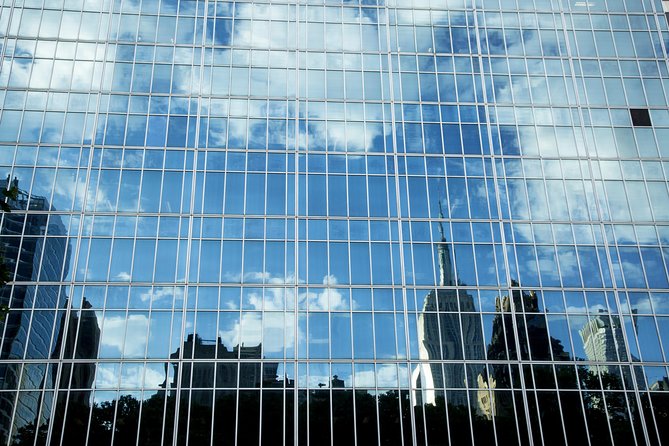
The strongest part of this experience is the direct teaching. The comments from past sessions point to specific help with camera abilities, angles, and removing dull space from a picture. Those are practical improvements that can carry over to every city you photograph later.
Zim is singled out as a patient and attentive instructor who gives recommendations based on a person’s interest and skill level. Another session included local New York facts alongside photography advice. That combination makes the walk more than a technical class, while still keeping photography at its center.
Do not expect a formal classroom with a long presentation. The useful lessons happen while you are standing in front of a building, adjusting your view, and deciding what belongs in the frame. If you want the guide to help you with a particular camera mode or setting, ask directly and bring the camera you actually plan to use.
You should also be ready to explain what you want from the session. Beginners may need help learning how to use their camera’s abilities. More experienced photographers may want sharper composition, more original viewpoints, or better ways to handle difficult city light.
The walking pace, group size, and timing
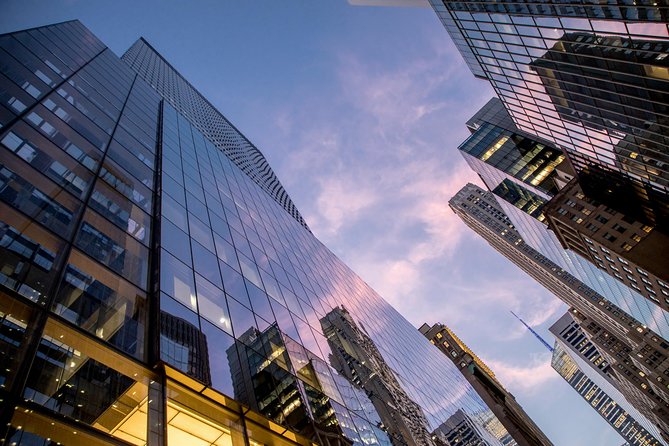
The tour lasts approximately three hours, but the named stops account for only about 75 minutes of scheduled stop time. The remaining time will be used moving between locations and working through the route. That makes the experience active rather than slow.
A moderate level of physical fitness is requested, and one piece of direct advice is simple: be prepared for walking. Wear comfortable shoes and avoid carrying more camera gear than you can manage for several hours.
The maximum group size is eight. That is small enough for the guide to notice what you are trying to photograph, though the experience will still depend on how many questions the group asks and how quickly everyone moves.
The starting point is clear, but the ending point is described only as a different location, with no specific final address supplied. Plan your day with that in mind. Do not schedule a tight appointment immediately afterward unless you have confirmed the final location and allowed extra time.
Is $125 a fair price?
At $125 per person, this is not a cheap way to see Midtown. You are paying for a professional photographer’s time, personal instruction, a small group, and a planned route through several high-value subjects.
The price makes more sense if you want to improve your photography rather than simply visit the landmarks. A standard sightseeing walk might show you the same buildings, but it would not necessarily teach you why one angle works better than another or how to handle Times Square’s difficult light.
The value is also stronger for visitors carrying a camera they do not fully understand. If the guide helps you use features you have been ignoring, that lesson can be worth more than a single set of New York photographs.
The price is harder to justify if you already know exactly how to compose architecture, control difficult exposure, and find Midtown viewpoints on your own. In that case, you may be paying mainly for company and a convenient route.
Who should book this experience?
I would recommend it to beginners, enthusiastic hobby photographers, and visitors who want a more focused way to see Midtown. It also suits someone who has recently bought a camera and wants practical help rather than a technical manual.
The tour can work well for a parent and child, but children must be accompanied by an adult. Service animals are allowed, and the route is near public transportation.
You may enjoy it less if you dislike walking, need a slow pace, or want to spend a long time inside each building. It is also not the right choice if you need to borrow a digital camera, since one is not provided.
Weather matters because the experience requires good conditions. If poor weather cancels the tour, you are offered another date or a full refund. You can also cancel for a full refund up to 24 hours before the start time. Changes or cancellations made later are not accepted for a refund.
Should you book the Manhattan Architecture Photography Tour?
Book this tour if you want to come home with better photographs and a clearer understanding of how to make them. The small group, professional instruction, and range of subjects give the session real purpose, especially if you are still learning your camera.
Skip it if your priority is a leisurely architectural walk, indoor sightseeing, or a flexible schedule. At $125, the best value comes from asking questions, bringing your own camera, and treating each stop as a short lesson in seeing New York differently.
FAQ
How long is the Manhattan Architecture Photography Tour?
The tour lasts approximately three hours.
How much does the tour cost?
The listed price is $125 per person.
Where does the tour start?
It starts at Pershing Square, 90 East 42nd Street, New York, NY 10017, USA.
Where does the tour end?
The activity ends at a different location, but a specific final address is not provided.
What landmarks are included?
The route includes Grand Central Terminal, the Chrysler Building, Times Square, the New York Public Library, and Bryant Park.
Is a professional photographer included?
Yes. A professional photographer guide is included.
Is a camera provided?
No. A digital camera is not included, so you need to bring your own camera.
How large is the group?
The maximum group size is eight people.
Is the tour suitable for children?
Children must be accompanied by an adult.
What happens if bad weather cancels the tour?
You will be offered a different date or a full refund if the experience is canceled because of poor weather.
Newly added in New York City
- Midtown North NYC Architecture Walking Tour★ 5.0 · 28 reviews
- Financial District NYC Architecture Walking Tour★ 5.0 · 26 reviews
- Holdouts: A NYC Architecture Walking Tour★ 5.0 · 31 reviews
- Midtown Manhattan Art and Architecture Walking Tour★ 5.0 · 32 reviews
- TriBeCa Architecture & History Walking Tour★ 5.0 · 37 reviews
- New York City: Flatiron Food, History, and Architecture Tour★ 4.8 · 43 reviews
- New York City: Art Deco and Architecture Landmarks Tour★ 5.0 · 76 reviews
- 3 Hour Midtown Manhattan Architectural Tour★ 5.0 · 81 reviews
New York City Architecture Tours, compared.

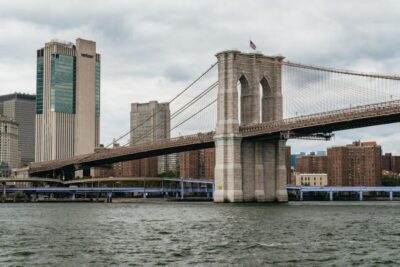
Around Manhattan Official NYC Architecture Cruise
Read our review →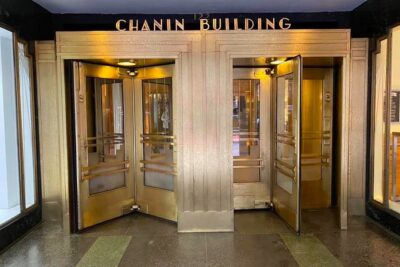
Art Deco and Architecture Midtown Landmarks Tour
Read our review →
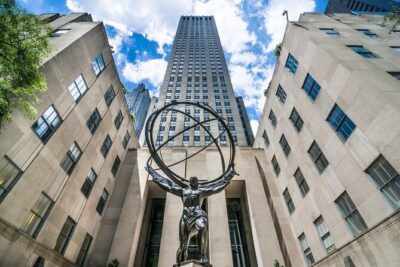
New York City The Official Rockefeller Center Tour
Read our review →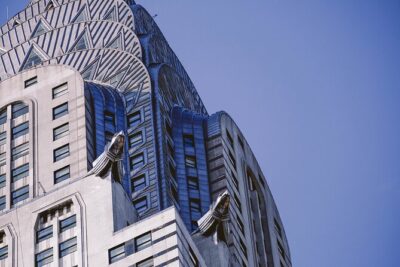

Browse the lists this tour appears in