
Review · WALKING TOURS
Private Harajuku Omotesando Architecture Walking Tour
Harajuku and Omotesando pack an astonishing range of architecture into one walk. You’ll move from the wooded approach to Meiji Jingu to Kenzo Tange’s sweeping Yoyogi Gymnasium, then along designer stores by architects such as Tadao Ando, Jacques Herzog, Pierre de Meuron, and Toyo Ito. The route gives Tokyo’s fashion center a proper architectural frame.
I like the private, adjustable format, which lets your guide spend more time on modern design, local history, or interiors. I also like the short cafe pause on a quieter backstreet, plus the guides’ preparation: Yoshi and Taka have used photos, plans, and architect portraits to make buildings easier to understand. The main consideration is the pace: three and a half hours on foot can feel long in heat, and one guide received a lower score because communication in English was difficult.
Key points
- See major works close together: The route includes Yoyogi Gymnasium, Prada, Dior, Louis Vuitton, Tod’s, SunnyHills, and other notable buildings.
- Start at Meiji Jingu: The shrine provides a calm cultural opening before the tour shifts toward fashion and contemporary design.
- Use the private format well: Ask to focus on interiors, famous architects, neighborhood change, or lesser-known buildings.
- Expect prepared guiding: Guides including Yoshi and Taka have used photos, floor plans, and background material to explain what you are seeing.
- Take a cafe break: Drinks and conversation are included during a pause on a backstreet.
- Plan for a real walk: The tour lasts about 3 hours 30 minutes and requires moderate physical fitness.
Why this Tokyo architecture walk works
This is not simply a stroll past expensive shops. It is a lesson in how Tokyo uses architecture to create identity.
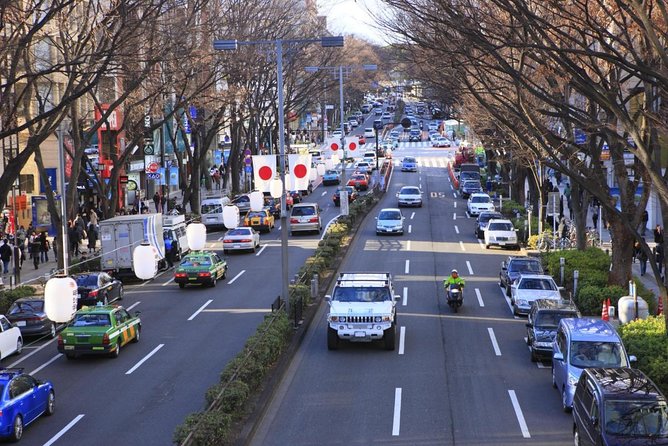
Harajuku brings youth culture, street fashion, and local side streets. Omotesando brings polished storefronts, international brands, and some of the city’s boldest modern buildings. The transition between the two is the point. In a few blocks, you can compare a shrine precinct, postwar civic architecture, small neighborhood buildings, and high-fashion structures designed to function as giant urban advertisements.
I find that private guiding matters here because much of the architecture is easy to miss. A glass facade may look attractive, but your guide can explain its shape, materials, architect, and place in Tokyo’s development. The route also gives you time to ask questions rather than follow a fixed group schedule.
The experience has a 4.9 rating from 67 reviews, with 99 percent recommending it. The strongest praise centers on the guides’ preparation and their ability to adjust the walk to a visitor’s interests. That makes this a particularly good choice if you care about design but do not want a technical lecture with no connection to daily life.
More Walking Tours in the world:
- Lecce: Baroque Architecture and Underground Walking Tour
★ 4.6 · 1,248 reviews - Chicago in a Day: Food, History & Architecture Walking Tour
★ 5.0 · 1,153 reviews - Ramblas, Old Town, Gothic and Gaudi Architecture Walking Tour
★ 5.0 · 723 reviews
Starting beside Meiji Jingu
The meeting point is in front of Meiji Jingu near Harajuku Station. That is a practical start because the shrine gives you an immediate sense of Tokyo’s contrasts.
Meiji Jingu is not a modern building, but it helps set the scene. You begin among one of Tokyo’s best-known religious and cultural landmarks, then move toward the contemporary city. Your guide can use that shift to discuss how Harajuku developed from a shrine and residential area into an international center for fashion, design, and retail.
The tour does not promise a full shrine visit, so you should not treat this as a dedicated Meiji Jingu sightseeing tour. Its real focus is the architecture that follows. Still, beginning here helps you understand the neighborhood before the luxury storefronts take over.
You should arrive ready to walk. The start point is near public transportation, but hotel pickup and drop-off are not included. If you are staying elsewhere in Tokyo, allow time to reach Harajuku Station and locate the shrine entrance.
Yoyogi Gymnasium and the Olympic connection
One of the first major architectural sights is Yoyogi Gymnasium, designed by Kenzo Tange. You admire it from a distance rather than entering for a formal tour.
That viewing point still matters. The building is one of the clearest signs of Tokyo’s Olympic-era ambition. Its dramatic suspended form helped show how engineering and architecture could work together on a huge public scale. The guide also connects the area to Olympic history, giving context to the city’s long relationship with international sporting events.
If you have already seen photographs of Yoyogi Gymnasium, the walk helps turn a famous image into a place within the city. You can study its silhouette, position, and relationship to the surrounding streets. Guides such as Taka have used photographs and supporting material to explain architects and projects, which can be useful when the building is viewed from outside.
Do not expect an indoor tour of Yoyogi Gymnasium. This stop is about the exterior view and the story behind it. Architecture students, photographers, and anyone interested in postwar Tokyo will likely get the most from this part.
Omotesando’s designer buildings
The walk then follows Omotesando, often compared with the Champs-Élysées or Tokyo’s Rodeo Drive. The comparison is easy to understand: broad streets, luxury retail, polished facades, and international fashion houses.
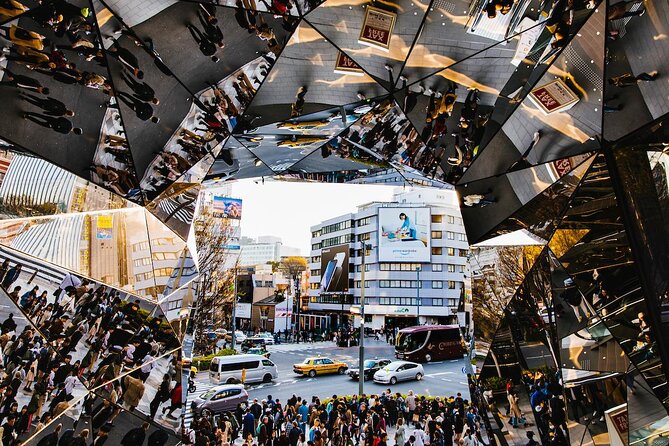
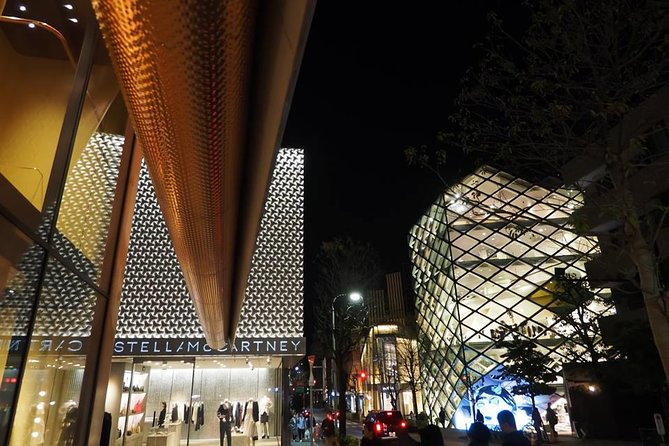
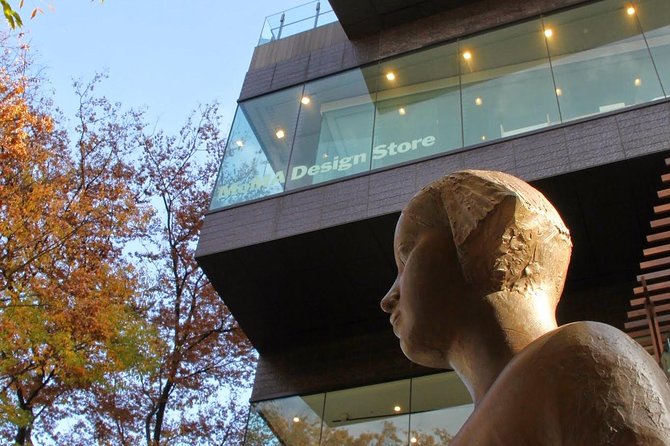
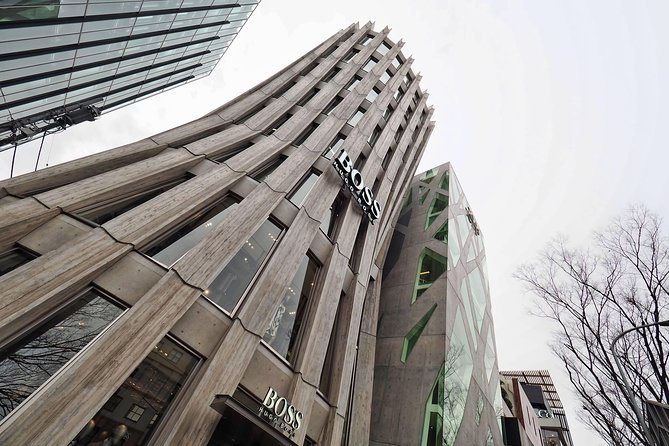
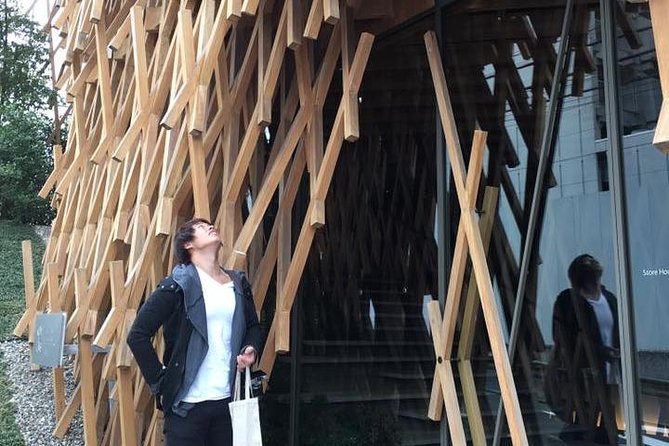
The valuable part is looking beyond the brands. The stores become a gallery of contemporary architecture. You may see the Iceberg building, Dior, Louis Vuitton, Tod’s, SunnyHills, and Prada, along with other structures your guide selects according to your interests.
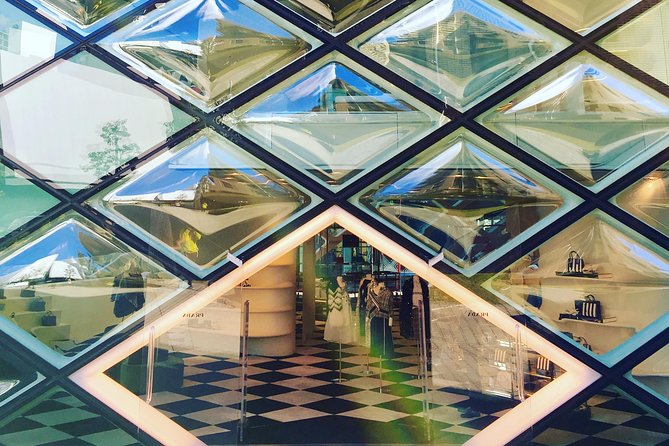
Prada is one of the most memorable stops because of its convex and concave glass surfaces. The facade changes as you move past it, making the building feel less like a box and more like a shifting optical object. The tour can examine both the outside and, when possible, selected interior spaces.
Tadao Ando’s Collezione is another important example. Much of the building is underground, a solution that creates a quiet presence despite its urban setting. This is the kind of detail you might miss on a shopping walk. Your guide can point out how the structure meets the street and why the building feels different from the brighter retail spaces nearby.
Tokyo Plaza Harakado, associated with Akihisa Hirata, adds another recent architectural idea to the route. Its planted rooftop and vertical garden bring greenery into a dense commercial district. The building shows how newer Tokyo projects can combine retail, public appeal, and planted space without copying older styles.
These stops are not all equal in scale or visual impact. Some are best appreciated from the pavement. Others may offer a chance to go inside. The exact interiors and buildings can depend on opening hours, access, and the route agreed with your guide, so treat the walk as an architectural survey rather than a guaranteed building-entry program.
More Private Tours in the world:
- Best of Chicago: Architecture & Highlights City Private Tour
★ 5.0 · 94 reviews - Private Santa Barbara History and Architecture Walking Tour
★ 5.0 · 56 reviews - Private Barcelona Modernism and Gaudí Walking Tour
★ 4.7 · 54 reviews - Chicago in a Day: Food and Architecture Private Walking Tour
★ 5.0 · 53 reviews
Side streets that change the picture
The best part of the tour may be the move away from Omotesando’s polished main avenue.
Your guide takes you into a backstreet neighborhood where the mood changes quickly. The architecture becomes more varied, and the area feels less arranged for international shopping. You may see smaller homes, local businesses, unusual structures, and the everyday spaces that sit behind the luxury brands.
This detour gives the tour balance. Without it, Omotesando could seem like a line of expensive storefronts. The side streets show how the district grew and how different building types exist within a short walk of one another.
I would pay close attention here and ask questions. The main road supplies famous names and easy photographs, but the backstreets reveal how residents experience the area. Guides Yoko and Yuki have been praised for adjusting the pace and route to personal interests, and this is where that flexibility can be especially useful.
The route may also include interiors or less obvious architectural details. You should not assume every stop is a major landmark. That is part of the appeal. A small building with an unusual entrance or clever use of space can make the neighborhood easier to read.
The cafe pause and the human side of the tour
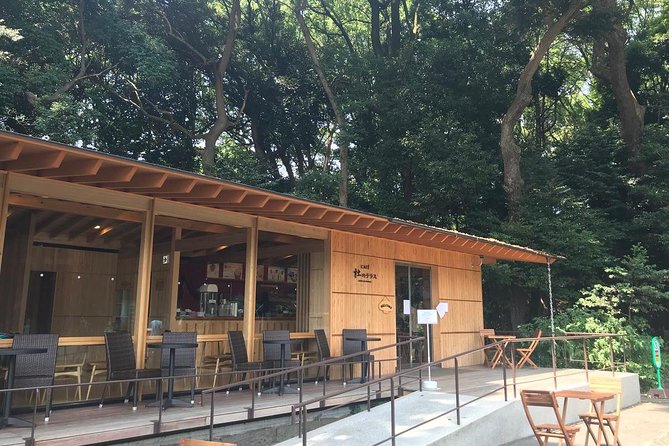
A short pause with drinks is included. It takes place at a cafe on an atmospheric backstreet rather than as a formal meal stop.
This break matters more than it may seem. Three and a half hours of city walking is easier when you can sit down, cool off, and talk through what you have seen. It also gives you a chance to tell the guide what you want from the remaining route.
One person had a guide extend the indoor portion because the weather was very hot. That is a good example of how to use the private format: speak up about heat, pace, design interests, or the need for more time inside. The tour is not fully rigid, and a thoughtful guide can adjust the balance when circumstances allow.
The cafe stop is not a major food experience. Think of it as a comfortable pause with a drink and conversation. If you want a full lunch, you will need to arrange that separately.
What the guides bring to the experience
Guide quality is central to this tour. The strongest guides do more than identify buildings. They explain architects, construction choices, neighborhood change, and the connection between Tokyo’s past and present.
Yoshi has been praised for arriving well prepared, with photographs of buildings and architects. Taka, a retired architect, has used an iPad with architect portraits, floor plans, background notes, and advice on the best photography positions. Those tools can make a major difference, especially when a building is difficult to understand from street level.
Yoko has been described as strong on design and the way architectural styles changed from the 1960s onward. Aki has been praised for adjusting the route, relating buildings to other places in Japan, and leading visitors through streets they would not have found alone. Mari and Eriko have also received praise for clear English, warmth, humor, and strong preparation.
You should still remember that guide performance can vary. One person found it hard to understand a guide’s English and felt some information was lost. If architecture is the main reason you are booking, it is sensible to state that clearly when arranging the tour and to explain how technical you want the discussion to be.
Price, pace, and who gets the best value
The listed price is $132.14 per person. For a private 3.5-hour tour, that price can be reasonable if your group is genuinely interested in architecture and makes active use of the guide’s flexibility.
You are paying for a licensed local guide, a private experience, route planning, and a drink break. You are not paying for entrance tickets, hotel transfers, or a full meal. The value rises for a couple or family that wants a focused introduction to Tokyo design and can ask detailed questions throughout the walk.
Group discounts are available, so check the final price for your party. A private tour also avoids the slower rhythm of a large group. You can stop for photographs, ask about one architect, or spend less time on a building that does not interest you.
The physical demand is moderate. The route is on foot and lasts about three hours, with a short seated pause. Comfortable shoes are essential. In hot weather, the lack of a longer indoor component could be tiring, although the private format may allow some adjustment.
Best for architecture fans and curious first-time visitors
Architecture enthusiasts are the obvious audience. You will get the most from the experience if names such as Kenzo Tange, Tadao Ando, Jacques Herzog, and Pierre de Meuron mean something to you, or if you want to learn why their work matters.
You do not need professional training. The tour can also suit first-time visitors who want a strong introduction to Harajuku, Omotesando, local etiquette, city growth, and Tokyo’s mix of old and new. One guide was especially effective at tailoring explanations to a visitor’s background, from complete beginner to architecture professional.
It is also a useful early-trip activity. The route helps you get your bearings, and a guide may offer practical help with onward subway travel. Still, do not book it expecting a general Harajuku shopping tour. The fashion stores are part of the story, but the main subject is the buildings and the people who designed them.
Practical details before you book
The tour begins at Meiji Jingu near Harajuku Station and ends at the Omotesando and Aoyama-dori intersection, in front of Mizuho Bank. That one-way route is convenient because you finish in a major commercial area rather than returning to the start.
Confirmation is provided at booking, and the tour operates near public transportation. The activity is private, so only your group participates. Hotel pickup and drop-off are not included.
The cancellation terms are simple: cancel at least 24 hours before the local start time for a full refund. Cancellations or changes made later are not accepted for a refund.
I would ask your guide to focus on the buildings you most want to see. You might prefer famous designers, interior spaces, Olympic history, neighborhood development, photography, or the contrast between luxury retail and ordinary side streets. The more specific you are, the more useful the private format becomes.
Should you book this Harajuku architecture tour?
Book it if you want to understand why Harajuku and Omotesando look the way they do, rather than simply pass through their shops. The combination of Yoyogi Gymnasium, landmark boutiques, lesser-known streets, and a cafe pause gives the walk a good range.
I would especially recommend it to architecture fans, design students, photographers, and first-time Tokyo visitors who like a guided introduction with room for questions. The preparation described from guides such as Yoshi and Taka is a real strength.
Think twice if you dislike long walks, want a full shrine tour, or expect guaranteed access inside every building. For everyone else, the private format, strong guide record, and concentrated mix of Tokyo architecture make the $132.14 price easier to justify.
FAQ
How long does the tour last?
The tour lasts approximately 3 hours 30 minutes.
Where does the tour begin?
It begins in front of Meiji Jingu near Harajuku Station at 1 Yoyogikamizonocho, Shibuya, Tokyo.
Where does the tour end?
It ends at the intersection of Omotesando and Aoyama-dori, in front of Mizuho Bank.
Is this a private tour?
Yes. Only your group participates in the activity.
What is included in the price?
A local licensed tour guide and a cafe-style pause with drinks are included.
Is hotel pickup included?
No. Hotel pickup and drop-off are not included.
Which buildings can I expect to see?
The route includes Yoyogi Gymnasium by Kenzo Tange and notable architecture connected with The Iceberg, Dior, Louis Vuitton, Tod’s, SunnyHills, Prada, and other buildings selected along the route.
Does the tour include a break?
Yes. The walk includes a short pause with drinks at a cafe on a backstreet.
What happens if I need to cancel?
You can receive a full refund if you cancel at least 24 hours before the local start time. Cancellations or changes made less than 24 hours before the start are not accepted for a refund.
Newly added in the world
- Barcelona: Guided tour e-bike Barcelona historical and modernist Barcelona★ 4.5 · 5 reviews
- Barcelona Architecture Walking Tour With Casa Batlló Upgrade★ 4.8 · 11 reviews
- Astana: Old City Tour, Imperialistic and Soviet Architecture★ 5.0 · 4 reviews
- Barcelona Beyond Gaudí: Modernism, Rooftops, and Hidden Gems★ 5.0 · 2 reviews
- An Architect’s Tour of Downtown Santiago★ 5.0 · 7 reviews
- Architecture Tour: Old Historic Madrid with an architect★ 4.3 · 3 reviews
- London: Architecture Tour of Benjamin Franklin House★ 5.0 · 5 reviews
- Architectural Wonders of KAFD, An Iconic Destination★ 5.0 · 3 reviews
Walking Tours, compared.
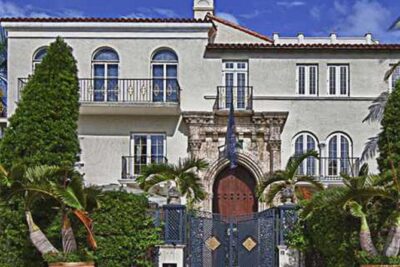
The Official Art Deco Walking Tour by The Miami Design Preservation League
Read our review →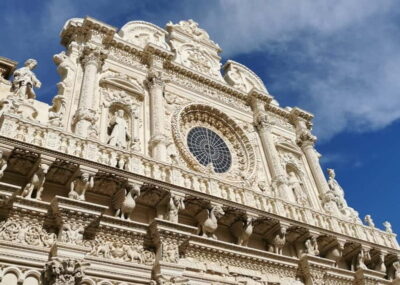
Baroque Architecture and Underground Walking Tour
Read our review →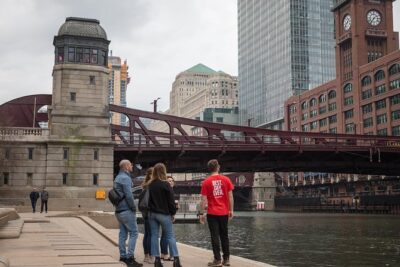
Chicago in a Day: Food, History & Architecture Walking Tour
Read our review →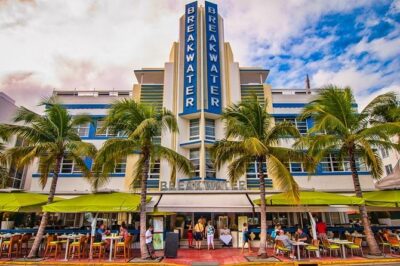

Ramblas, Old Town, Gothic and Gaudi Architecture Walking Tour
Read our review →
Chicago’s Secret Interiors Architectural Walking Tour
Read our review →
Browse the lists this tour appears in