
Review · WALKING TOURS
Tokyo Architecture and Contemporary Art Walking Tour with a local guide
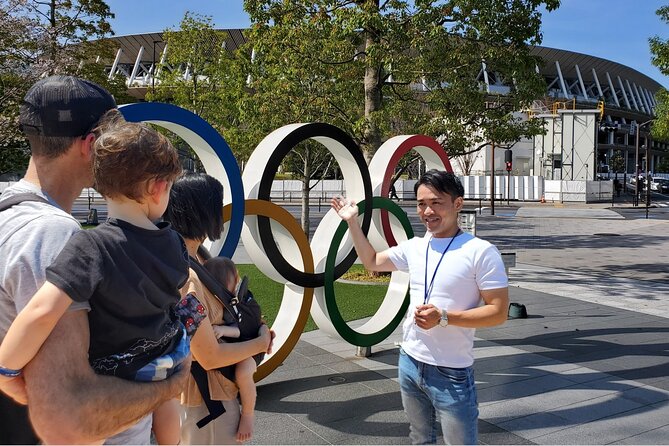
Tokyo’s best architecture is scattered across the city, and this private walking tour gives you a smart way to connect the pieces. You’ll move from Ginza’s polished boutiques to the Tokyo International Forum, Roppongi’s art museums, Omotesando’s designer buildings, and the busy streets of Shibuya and Harajuku. The real treat is seeing how Tokyo uses buildings, shops, public spaces, and fashion as one large urban gallery.
I like the private format, which lets your guide adjust the pace and respond to your interests. I also like the mix of major sights and quieter districts, especially Daikanyama and Nakameguro, where stylish cafés and shops replace the roar of Shibuya. The main caution is physical: this can mean 13,000 to 20,000 steps, with plenty of subway time between stops.
Key points at a glance
- A full day of Tokyo design: Plan on 6 to 8 hours across seven very different districts.
- Private for up to nine people: Your guide can shape the pace and respond to your group’s requests.
- Architecture with city context: You’ll see buildings alongside fashion, youth culture, galleries, cafés, and public spaces.
- Public transport is part of the experience: Expect local trains and subway travel, with IC cards useful for moving around town.
- Strong guide feedback: Guides including Tomoya, Riley, Richie, and Masa are praised for clear English, flexible planning, and detailed explanations.
- A serious walking day: Comfortable shoes, water, and a realistic sense of your stamina matter here.
Why this tour makes sense for architecture fans
Tokyo is not a city you understand from one viewpoint. Its architecture is spread through commercial streets, museum districts, railway areas, and residential neighborhoods. A private guide can connect those dots more clearly than a standard bus tour, where you mostly look through glass and follow a fixed script.
This experience focuses on buildings, but it does not treat them as isolated objects. In Ginza, architecture appears beside luxury stores and small galleries. In Harajuku, buildings become part of youth fashion and street culture. In Daikanyama, a bookstore and cafés show a quieter side of modern Tokyo.
That combination is the tour’s strongest idea. You are not simply checking off famous structures. You are looking at how design changes from one district to the next.
The route is long and ambitious. It is designed for a group that wants a full day rather than a gentle two-hour stroll. You will use public transport often, and the train rides take time. One particularly useful point from the experience is that the subway can mean a lot of time underground. If you prefer seeing the city between stops, ask about using a bus or taxi for part of the route.
More Walking Tours in the world:
- Lecce: Baroque Architecture and Underground Walking Tour
★ 4.6 · 1,248 reviews - Chicago in a Day: Food, History & Architecture Walking Tour
★ 5.0 · 1,153 reviews - Ramblas, Old Town, Gothic and Gaudi Architecture Walking Tour
★ 5.0 · 723 reviews
Ginza: Tokyo’s polished architectural showroom
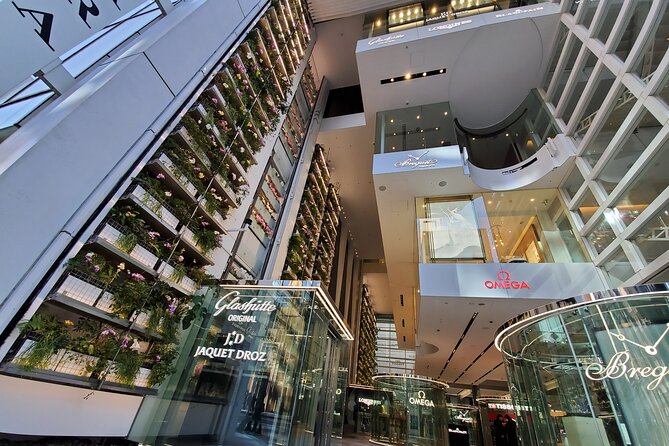
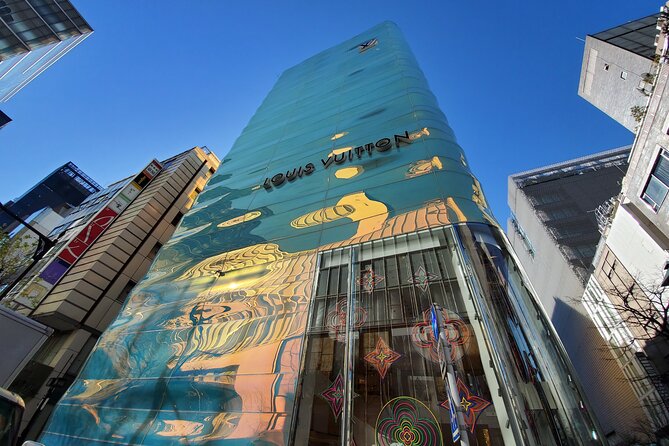
The day begins in Ginza, one of Tokyo’s best areas for seeing architecture in a commercial setting. Its streets bring together high-end fashion, Japanese department stores, intimate galleries, and striking contemporary buildings.
Ginza works well as a first stop because the district makes architecture easy to compare. A guide can point out how international designers and Japanese firms use glass, metal, unusual shapes, and carefully controlled storefronts to attract attention. The buildings are not sitting in a museum park. They are working shops, offices, and retail spaces woven into daily city life.
You will have about an hour here, with no admission charge listed for the stop. That does not mean the area is quick to absorb. Your guide’s commentary is useful because the best details may be above eye level, tucked into a façade, or easy to miss among the signs and shoppers.
Ginza is also a good place to tell your guide what you want more of. If you care about large-scale design, ask for attention to the major buildings. If small galleries and Japanese retail design interest you more, the private format makes that adjustment possible.
Tokyo International Forum: a short stop with a big visual payoff
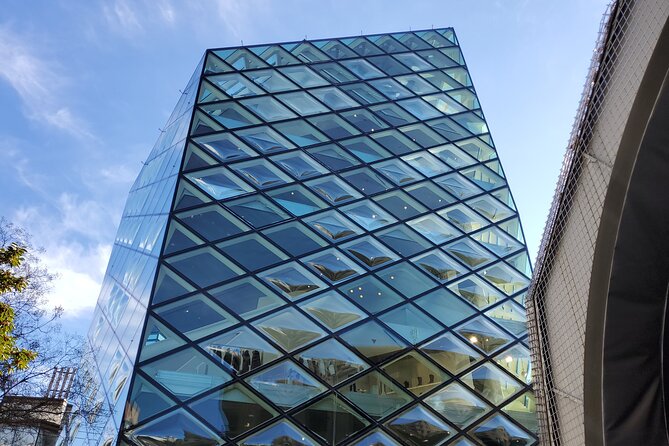
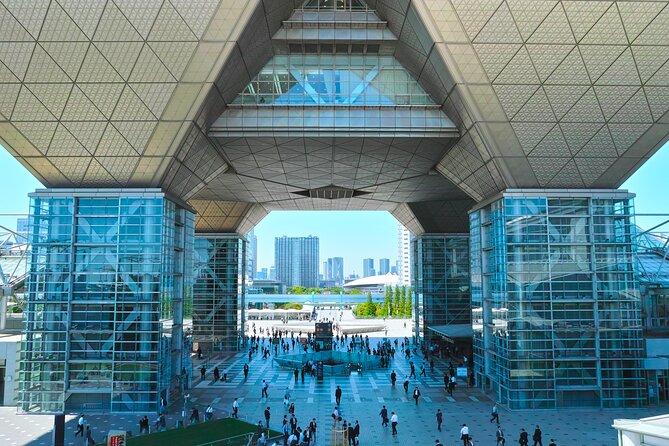
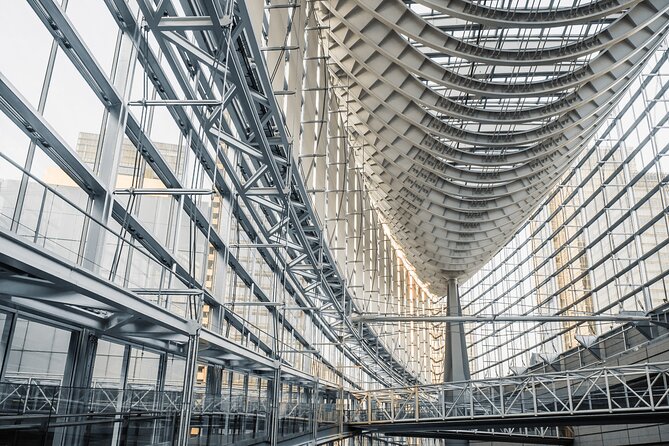
The Tokyo International Forum receives about 15 minutes on the route, but it is one of the most memorable architectural stops. Designed by Rafael Viñoly, the postmodern complex is known for its huge glass and steel form.
A brief visit can still work here because the building makes an immediate visual impression. Its vast interior is very different from the close-packed streets of Ginza. You can look up, study the structural lines, and get a sense of how a convention and art center can become a public architectural event in its own right.
The short timing is also a limitation. Fifteen minutes is enough for a look and an explanation, not an extended exploration. If this building is your main reason for booking, tell the guide early so you can make the most of the stop.
Roppongi: Tokyo’s art triangle
Roppongi shifts the focus from commercial design to contemporary art. The area is home to three major institutions known together as the Art Triangle Roppongi: the National Art Center, Mori Art Museum, and Suntory Museum of Art.
The route also includes art galleries and the Fuji Film area. That gives you a chance to see how galleries and cultural institutions fit into a district known for large developments and nightlife. Your guide can help you read the area as a collection of architectural choices rather than just a museum stop.
You have about an hour here, and admission to the walking stop is listed as free. The tour data does not promise museum entry, so do not assume that exhibition tickets are included. If you want time inside a particular museum, confirm that before booking or ask how the schedule can be adjusted.
Roppongi is especially useful for visitors who want art but do not want a tour focused only on galleries. You get the setting, the buildings, and the relationship between art institutions and the city around them.
More Guided Tours in the world:
- Chicago River: 1.5-Hour Guided Architecture Cruise
★ 4.8 · 8,046 reviews - Charleston: History and Architecture Guided Walking Tour
★ 4.8 · 349 reviews - Vienna: Spanish Riding School Guided Architectural Tour
★ 4.8 · 333 reviews - Charleston History, Homes, and Architecture Guided Walking Tour
★ 5.0 · 267 reviews
Omotesando: designer stores turned into architecture lessons
Omotesando is one of the strongest sections for people who enjoy contemporary buildings. Its high-end fashion and jewelry stores compete for attention not only with merchandise, but also with the structures that house them.
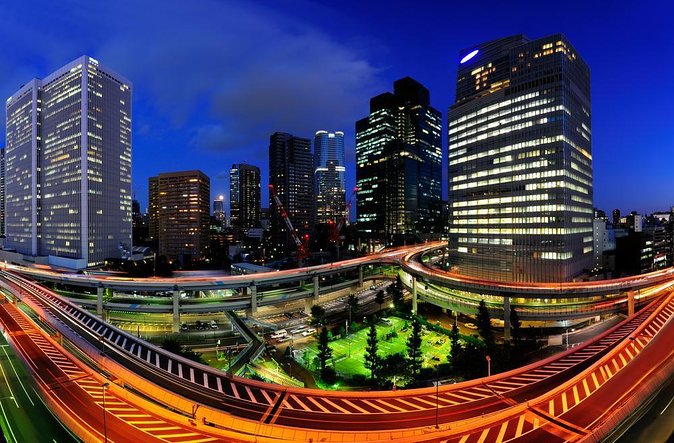
The route begins with the Prada flagship store, designed by Swiss architects Herzog and de Meuron. Even if you are not interested in shopping, the building gives you a clear lesson in how a global brand uses architecture to shape its identity.
The wider avenue offers more examples of design in a commercial setting. Here, you can compare different approaches to façades, scale, glass, and street presence. The guide’s role matters because a quick walk can otherwise turn into a series of impressive but disconnected storefronts.
You spend about an hour in Omotesando. It is a good place for photos, but try not to treat it as a photo stop only. Look at how buildings frame the sidewalk and how the retail spaces change the feel of the avenue.
Takeshita Street: architecture meets youth culture
Takeshita Street brings a sharp change of mood. Harajuku is known for youth culture, unusual fashion, and bold design, so this stop adds social context to the architecture.
The buildings here may not have the formal polish of Omotesando. That contrast is the point. You see how color, signage, shop fronts, clothing, and street behavior combine into a different kind of urban design. The area can help you understand Tokyo beyond its famous towers and refined commercial avenues.
The planned hour gives you time to notice the details rather than simply pass through. Your guide can explain the connection between fashion trends and the buildings that support them. You might also find this section more crowded and visually intense than Daikanyama later in the day.
If you prefer quiet streets, Takeshita Street may feel tiring. If you want a look at modern Japanese youth culture, it is one of the most useful stops on the route.
Shibuya Crossing: a brief stop at maximum energy
The Shibuya section lasts about 30 minutes and centers on the famous crossing. It is a short stop, but it supplies one of Tokyo’s clearest public-space experiences.
The crossing is not an architectural masterpiece in the same way as the Tokyo International Forum. Its importance comes from movement, scale, signs, screens, and the way people share a huge intersection. The surrounding buildings create a wall of commercial information, making Shibuya feel more like a constantly changing urban display.
Your guide can help you take in the scene without reducing it to a quick photograph. Thirty minutes is enough to watch the flow and get oriented, though it is not enough for a detailed tour of the whole district.
The comparison with Times Square is easy to understand, but Shibuya has its own rhythm. It is more useful to notice the choreography of the crossing and the relationship between the streets and surrounding buildings than to chase a record for the busiest intersection.
Daikanyama and Nakameguro: the day’s calmer finish
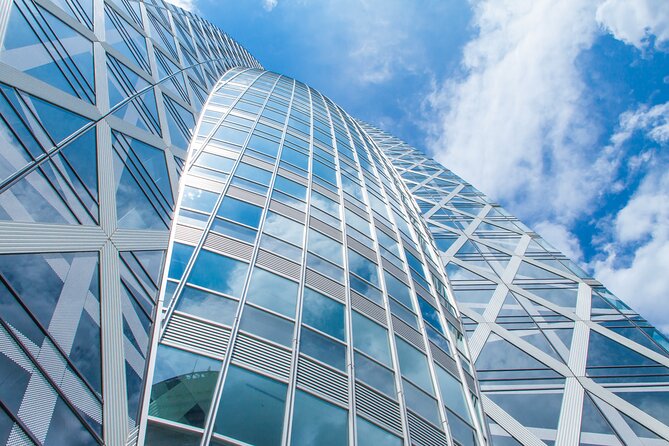
Daikanyama and Nakameguro provide a welcome change after Shibuya and Harajuku. These neighborhoods are known for boutiques, cafés, and a slower pace, giving the tour a more relaxed final chapter.
The Tsutaya bookstore is a key local design reference. It shows how a bookstore can become part of a neighborhood’s identity rather than simply a place to buy books. The surrounding area lets you see a smaller-scale version of contemporary Tokyo, with shops and cafés integrated into streets that feel less hectic than the better-known districts.
You have about an hour here. That is enough for your guide to explain the area and let you absorb the contrast. It is also a useful place to discuss which parts of Tokyo’s design feel most successful to you. Do you prefer the grand glass structures of the city center, the fashion-driven architecture of Omotesando, or the more human-scale streets of Daikanyama?
This section may be the most appealing for visitors who want a break from major attractions. It still fits the architecture theme, but it gives you more room to observe everyday patterns.
The guides and the value of a private day
Several guides are associated with this experience, including Tomoya, Riley, Richie, and Masa. The strongest praise centers on clear English, detailed explanations, thoughtful planning, and the ability to listen to a group’s requests.
That flexibility is important because the route covers a lot. One guide arranged a full day with a strong itinerary, while another adapted well to suggestions despite rainy weather. Another tour included time to buy chopsticks and eat ramen, showing that the schedule can sometimes make room for personal interests. Those extras are not guaranteed, but they show why a private format can be more useful than a fixed group tour.
The group limit is nine people. For a couple or family, that means direct access to the guide without the distance of a large coach group. For a full group of nine, the price becomes easier to assess, but the walking pace still needs agreement among everyone.
The price is $424.58 per group. Split nine ways, that is about $47 per person before any personal spending, which is reasonable for 6 to 8 hours of private guiding if the group is large. For two people, the per-person cost is much higher, so you are paying for customization and private attention rather than a low-cost sightseeing circuit.
Public transport, walking, and the real pace
Public transport is not just a transfer method here. It is how the route links districts that are too far apart for one continuous walk. You may use local trains and the subway, and IC cards are useful for moving through the system.
Expect time underground. That is the clearest tradeoff in the route. You cover more of Tokyo, but you lose some street-level scenery between stops. If you want a more visual journey, ask whether a bus or taxi can replace part of the subway travel.
The walking total can be substantial. One full day reached roughly 13,000 to 20,000 steps, and a hot day made the effort more demanding. Wear reliable shoes and keep your expectations realistic. Bottled water is provided, which helps, but it does not remove the need to pace yourself.
Pickup is offered, and the tour information describes meeting your guide outside your hotel or at a central meeting point. Confirm the exact arrangement after booking. The activity ends back at the meeting point, and the listed operating hours are 8:30 AM to 3:00 PM for the stated date ranges.
Who should book this Tokyo architecture tour?
I would recommend it to anyone who wants to understand Tokyo through buildings, design, fashion, and public life rather than through temples and traditional sights alone. It is particularly suitable for architecture students, design fans, photographers, urban planners, and curious first-time visitors who want a guide to explain what they are seeing.
It also suits families or small private groups that want control over the day. You can ask for more time at a favorite district, respond to weather, or make room for a personal shopping or food interest when the schedule allows.
I would hesitate if you want a slow, restful walk or a tour with very little transit. The route is ambitious, and the subway rides can feel like downtime. It is also not the right choice if you expect admission to museums or a formal gallery program, since the supplied details list the stops as free but do not promise museum entry.
The experience is best treated as a guided survey of Tokyo’s design culture. You will see many places, hear why they matter, and leave with a better sense of how the city changes from district to district.
Should you book it?
Book this tour if you want a private, guide-led day that links Tokyo’s major architecture areas with contemporary art and street culture. The mix of Ginza, Roppongi, Omotesando, Harajuku, Shibuya, and Daikanyama is broad, and the guides can shape the experience around your interests.
Think twice if your group dislikes long walks, frequent train rides, or a packed schedule. For everyone else, the value improves sharply with a larger group, especially near the nine-person limit. Free cancellation is available up to 24 hours before the start time, giving you some room to watch the forecast and confirm that the route suits your group.
FAQ
How long does the Tokyo architecture tour last?
The experience lasts approximately 6 to 8 hours.
How many people can join the private tour?
The private activity is available for your group only, with up to nine people.
What areas does the tour visit?
The route includes Ginza, Tokyo International Forum, Roppongi, Omotesando, Takeshita Street in Harajuku, Shibuya, and Daikanyama, with Nakameguro also noted in the Daikanyama section.
Is transportation included?
The tour uses public transportation to move between districts. The information also mentions pickup being offered, but you should confirm the exact meeting and pickup arrangement.
Are museum admission tickets included?
No museum admission is specifically listed. The itinerary gives the stops as free admission, so confirm with the provider if you want to enter a particular museum or exhibition.
Is bottled water provided?
Yes, bottled water is provided during the experience.
Can I cancel for a full refund?
Yes. You can cancel at least 24 hours before the experience start time for a full refund. Changes or cancellations made less than 24 hours before the start time are not accepted for a refund.
Newly added in the world
- Washington, DC: Georgetown Architecture Walking Tour★ 5.0 · 8 reviews
- Washington DC: Dupont Circle & Embassy Row Architecture Tour★ 5.0 · 6 reviews
- New Orleans : Garden District Architecture Walking tour★ 4.8 · 5 reviews
- Wilmington History and Architecture Tour★ 4.8 · 18 reviews
- Unveiling Brno: History, Culture & Architectural Delights★ 5.0 · 2 reviews
- Vicenza: Palladian Architecture Private Walking Tour★ 3.3 · 3 reviews
- Walk & Discover KL’s Architectural and Heritage Gems★ 5.0 · 7 reviews
- Private Colonial Williamsburg Architectural Tour★ 5.0 · 5 reviews
Walking Tours, compared.
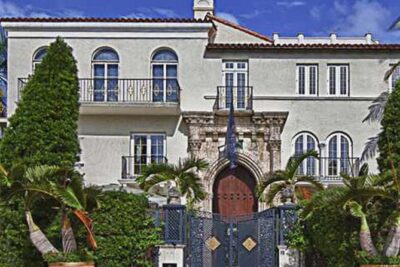
The Official Art Deco Walking Tour by The Miami Design Preservation League
Read our review →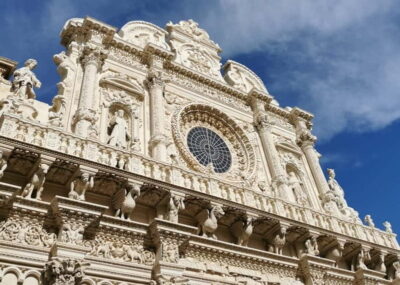
Baroque Architecture and Underground Walking Tour
Read our review →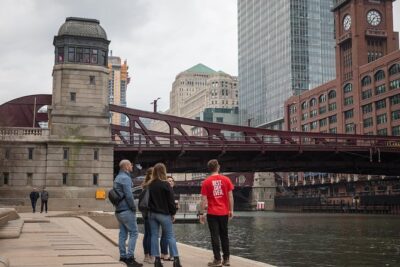
Chicago in a Day: Food, History & Architecture Walking Tour
Read our review →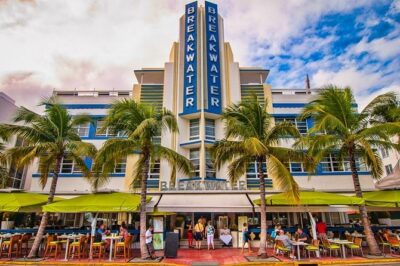

Ramblas, Old Town, Gothic and Gaudi Architecture Walking Tour
Read our review →
Chicago’s Secret Interiors Architectural Walking Tour
Read our review →
Browse the lists this tour appears in