
Review · WASHINGTON DC ARCHITECTURE TOURS
Embassy Row: Architecture, Mansions & International Intrigue
Washington’s Embassy Row is more than a line of grand buildings. It is a stage where old money, presidential power, international diplomacy, and private ambition meet. This two-hour walking tour takes you from Dupont Circle along Massachusetts Avenue, past mansions and diplomatic missions, then into Kalorama and back to the Metro.
I like the route for two clear reasons: you get a close look at Gilded Age mansions that are easy to miss on a standard monument tour, and the stories give the streets a human edge through scandals, fortunes, and diplomatic drama. Guides such as Dan and Eli have earned especially warm praise for being fun and easy to follow.
The main drawback is value. At $49 per person, this is not a cheap stroll, and one earlier participant felt the tour offered too few stories for a price above $40. If you want grand interiors or a long historical lecture, you may find the cost hard to justify.
Key points at a glance
- Dupont Circle Fountain: Begin at the 1921 fountain, a useful central meeting point surrounded by cafés, parks, and city life.
- More than 20 diplomatic missions: See embassies and ambassador residences along Massachusetts Avenue, generally from the sidewalk.
- Millionaire’s Row: Compare Beaux-Arts and Italian Renaissance Revival mansions built for Washington’s wealthiest families.
- Anderson House and Cosmos Club: See two especially grand private or institutional buildings tied to America’s social, intellectual, and diplomatic elite.
- Kalorama and the Spanish Steps: Leave the main avenue for quieter residential streets and one of Washington’s prettiest small stairways.
- Woodrow Wilson House: Finish the neighborhood portion at a preserved former presidential home, then return to the Dupont Circle Metro.
Why Embassy Row makes a good walking tour
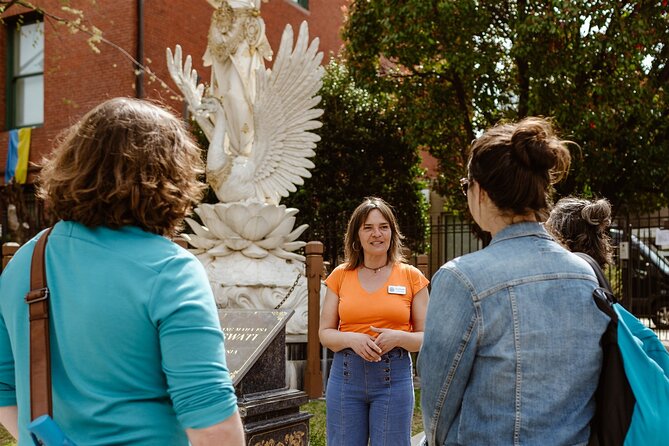
Many Washington tours focus on the government buildings downtown. This one takes you into a residential and diplomatic district where power is less obvious but just as important. The streets are lined with embassies, private clubs, former mansions, and houses linked to presidents and international figures.
I like that the tour uses architecture as its starting point but does not stop at façades. The guide ties buildings to the people who commissioned them, the fortunes that paid for them, and the diplomatic world that later moved in. That approach gives you something to watch as you walk instead of asking you to absorb a long list of dates.
The route also offers a useful change of pace. Dupont Circle feels social and open, Massachusetts Avenue feels formal and grand, and Kalorama becomes quieter and more residential. In two hours, you see several different sides of central Washington without needing a taxi or a museum reservation.
The experience is conducted in English with a licensed guide. It is usually offered in the morning, which is sensible for a walking tour, especially during Washington’s warmer months. The group is described as small, so you should have a better chance of hearing the guide than on a large bus tour.
A few more architecture walks in the USA worth a look
- Chicago Architecture River Cruise
★ 5.0 · 15,756 reviews - Chicago River 90-Minute Architecture Tour
★ 4.5 · 9,629 reviews - Chicago River: 1.5-Hour Guided Architecture Cruise
★ 4.8 · 8,046 reviews
Starting at Dupont Circle Fountain
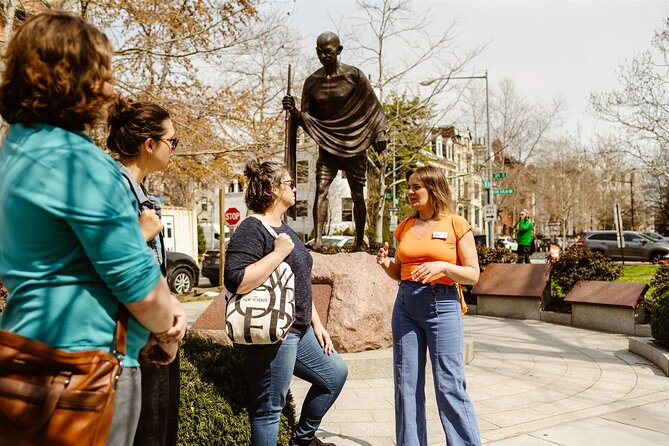
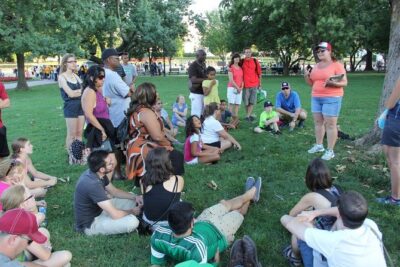
Meet at the fountain in the center of Dupont Circle and look for the guide wearing orange. That color matters in a crowded public space, since the circle has several entrances, paths, and busy streets around it.
The fountain was designed in 1921 by Daniel Chester French and Henry Bacon, the same broad era when much of the surrounding neighborhood was taking shape. It gives the guide a natural opening: Dupont Circle is not just a traffic circle, but a place where residents, office workers, artists, and visitors cross paths.
This is one of the tour’s more pleasant features. You do not begin beside a bland hotel entrance or an anonymous storefront. You start in a public park with cafés, local activity, and room to get oriented.
Give yourself a few extra minutes before the meeting time. The instructions are simple, but a central city circle can be confusing if you arrive at the last moment. Comfortable shoes are important, since the route covers several neighborhoods on foot and includes streets, sidewalks, and the Spanish Steps.
Massachusetts Avenue and the Millionaire’s Row mansions
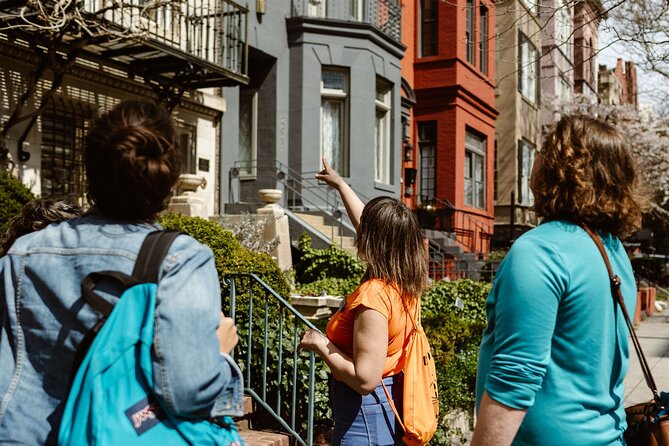
From Dupont Circle, the walk follows Massachusetts Avenue toward Embassy Row. This is where the tour’s strongest visual material begins.
The avenue is famous for its large early 20th-century homes, many built when Washington’s richest residents wanted houses that looked more like European palaces than ordinary city residences. You can expect a mix of Beaux-Arts and Italian Renaissance Revival design, with heavy stonework, formal façades, grand entrances, and carefully arranged details.
These houses tell you something about Washington before the city became dominated by modern office buildings and government complexes. Wealthy families used architecture to announce status. Later, some of those same buildings found new lives as diplomatic missions, cultural centers, or private institutions.
I find this part especially useful for readers who enjoy architecture but do not want a technical lecture. You can compare styles as you go. One mansion may emphasize symmetry and classical restraint, while another leans into carved decoration and theatrical scale.
The drawback is that most buildings are viewed from outside. You should not expect to walk through every mansion or pause in private gardens. The value comes from seeing a large number of notable façades while the guide explains what happened behind them.
Embassies, ambassador residences, and diplomatic life
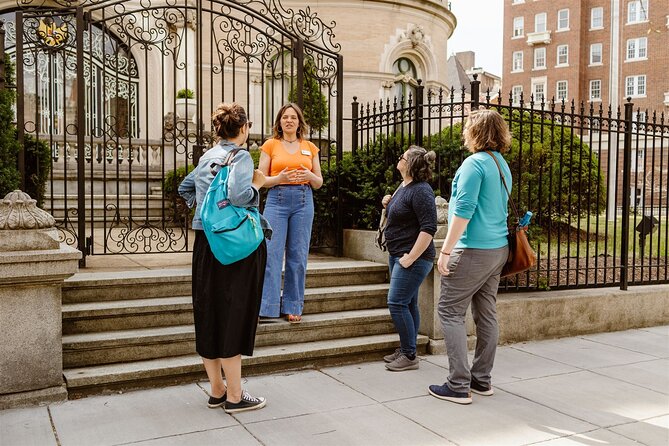
Massachusetts Avenue places more than 20 embassies and ambassador residences within the walking route. Each building offers a small visual clue to the country it represents, though the real appeal is the contrast between diplomacy and ordinary city life.
You may see official buildings occupying former private mansions, purpose-built diplomatic offices, and residences that still look like family homes. The guide explains how these addresses function and adds stories about diplomatic disputes, social life, and scandals connected with Washington’s international set.
This is not an embassy-entry tour. The normal experience is to view the buildings from public sidewalks. On occasion, the group may be invited inside an embassy or residence, but that is not guaranteed. Treat any interior visit as a lucky extra, not part of the ticket’s basic value.
That distinction matters when you compare this tour with museum visits. You are paying for the route and the guide’s interpretation, not guaranteed access to diplomatic interiors. The outside views are still worthwhile, but your expectations should be realistic.
Same city, a different facade:
- Chicago Architecture Center River Cruise aboard First Lady
★ 5.0 · 5,536 reviews - Chicago: Architecture River Cruise Skip-the-Ticket Line
★ 4.8 · 4,325 reviews - Chicago River 45-Minute Architecture Tour from Magnificent Mile
★ 4.5 · 2,924 reviews - Chicago Lake and River Architecture Tour
★ 4.5 · 2,308 reviews
The Cosmos Club and Washington’s private elite

The Cosmos Club dates to 1878 and occupies a grand mansion with a long connection to intellectual and cultural life. Its members have included people from the worlds of academia, government, science, and the arts.
From the street, you get the building’s formal exterior rather than a full tour of the club. That limitation is understandable, since it remains a private institution. Still, its presence helps explain the social structure of old Washington. Embassy Row was not only a place for diplomats. It was also a meeting ground for people who shaped public debate and national culture.
The guide’s stories are important here. A building such as the Cosmos Club can seem like another impressive façade if you see it alone. With context, you begin to understand why this part of town attracted people with money, influence, and international connections.
Anderson House and the style of Larz and Isabel Anderson

Anderson House is one of the route’s most striking stops. It was the winter residence of Larz and Isabel Anderson and is now the headquarters of the Society of the Cincinnati.
The house reflects the Andersons’ travels and taste through ornate decoration, Italian murals, carved woodwork, and a formal interior. Even if your visit only includes the exterior, the building gives the tour a strong architectural focal point.
This is where the Gilded Age theme becomes especially clear. The house was not designed to blend in. It was meant to display wealth, education, travel, and social rank. The contrast between the private mansion and the nearby embassies also shows how Washington’s buildings changed purpose over time.
If you are most interested in interiors, check what is open separately before booking the walking tour. This experience does not promise an interior visit to Anderson House. The guide may explain the building well, but the regular route should be understood as an exterior architecture walk.
Sheridan Circle and the shift toward Kalorama
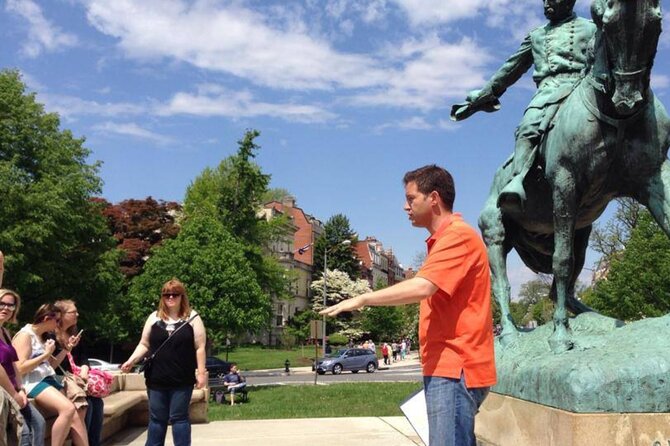
The route continues to Sheridan Circle, another formal space surrounded by important residences and institutional buildings. It is a good point to notice how the mood changes as you leave the most heavily trafficked section of Massachusetts Avenue.
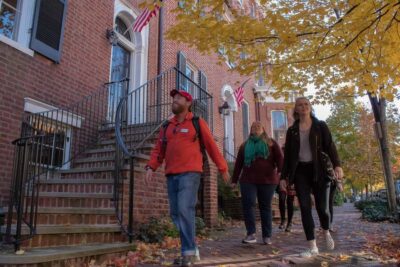
From there, the walk heads toward Kalorama. The neighborhood has a calmer feel, with historic homes and quieter streets. This section gives you a break from the avenue’s grand diplomatic façades and shows the residential side of Washington’s old elite district.
I like this change in rhythm. A tour made up only of mansion fronts can start to blur together. Moving through Kalorama gives your eyes a rest and lets the guide connect the neighborhood’s homes with presidential and political life.
The route’s length also explains why sensible footwear matters. Two hours is not a full-day hike, but you will be walking continuously enough that dress shoes or thin sandals may become uncomfortable.
The Spanish Steps, a small pause with a big setting
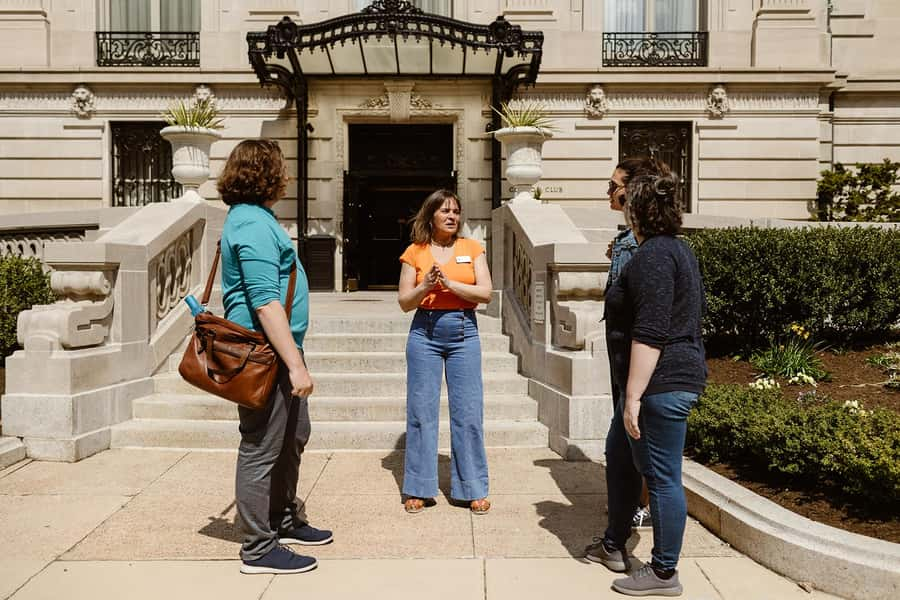
The Spanish Steps offer one of the route’s quieter stops. Inspired by Rome’s famous staircase, this small Washington feature is surrounded by greenery and historic homes.
It is not a major monument, and that is exactly why it works. The steps provide a pause from formal avenues and large institutions. You get a more intimate view of the neighborhood, with a picturesque setting that makes a good photo stop.
Do not expect a Roman-scale attraction. The appeal is local and modest. It is a short scenic interlude that helps the walk feel like a neighborhood tour rather than a parade of official buildings.
Woodrow Wilson House and the final return
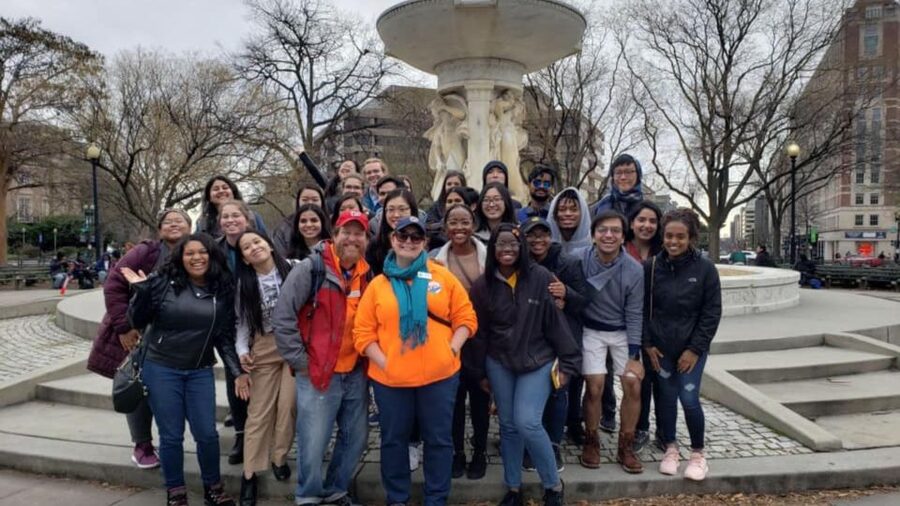
The route visits the Woodrow Wilson House in Kalorama, a preserved former home filled with period furnishings, personal objects, and displays about Wilson’s presidency and legacy.
The house gives the tour a useful closing subject. You move from wealthy families and diplomats to a former president’s private life. Its preserved rooms help you picture how an influential Washington resident lived after leaving office.
The building is described as a visit point on the route, but the tour details do not promise a full interior admission. Ask your guide what the group will see on your particular morning. If you want a detailed museum visit, plan to confirm whether separate admission or extra time is needed.
After this stop, the tour winds back toward the Dupont Circle Metro. Ending near the starting point is practical. You can continue to a café or market in Dupont Circle, connect to the Metro, or use the area as a base for another Washington activity.
Guide quality and the right amount of storytelling
The guide makes or breaks this experience. The route contains plenty to see, but the buildings are not labeled like museum exhibits. You need clear explanations and well-chosen stories to understand why a façade matters.
Dan received particularly strong praise for making the experience enjoyable, while Eli was described as fun, relatable, and well informed. Those names are useful when choosing a departure, if the booking calendar identifies your guide. The best guides on this route should keep the pace moving, point out details you might miss, and connect architecture with personal stories.
The feedback is not uniformly enthusiastic about the quantity of material. One person found most of the stories interesting but felt there were not enough of them for the price. I would take that as a fair warning: this is a compact neighborhood tour, not a two-hour nonstop account of every scandal in Washington.
You will probably enjoy it most if you prefer a conversational guide and a clear route over a dense academic presentation. If you want every building, date, and political episode covered, the format may feel light.
Is $49 a fair price?
At $49, the tour sits in the paid walking-tour range rather than the casual neighborhood stroll category. The price includes a two-hour guided small-group walk, live English commentary, and photo opportunities at historic mansions. Gratuity is not included.
The value depends on what you would otherwise do. If you would walk Embassy Row alone, you can see many façades for free, but you would miss the connections between the buildings and the stories about their owners, clubs, and diplomatic roles.
I think the price is easier to defend for first-time visitors who want structure and context. It is harder to defend for local residents who already know Dupont Circle and are comfortable researching the buildings themselves. The earlier comment about the cost is worth keeping in mind, especially if your main goal is simply to take photos.
Free cancellation up to 24 hours ahead and the reserve-now, pay-later option reduce some booking risk. Still, flexibility does not change the basic calculation: book this for interpretation, not for guaranteed access indoors.
Who should book this walk?
I would recommend it to:
- First-time Washington visitors who have already seen, or plan to see, the major monuments
- Architecture fans interested in Beaux-Arts and Italian Renaissance Revival buildings
- People who enjoy stories about wealthy families, diplomacy, clubs, and political life
- Local residents who want a guided look at a familiar neighborhood
- Visitors who prefer a two-hour walk instead of a bus or e-cart tour
I would think twice if you have limited time in Washington and have not yet visited the National Mall, Capitol Hill, or the major memorials. Those sights are more central to a first visit.
I would also hesitate if you expect guaranteed embassy entry. The tour normally stays outside, and any invitation inside is occasional rather than promised.
My verdict: book it for the stories, not the doors
This is a good choice when you want Washington away from the standard monument circuit. The mansions, embassies, Cosmos Club, Anderson House, Spanish Steps, and Woodrow Wilson House create a varied route, while guides such as Dan and Eli add the personal stories that make the neighborhood easier to read.
At $49, I would book it if architecture and local history are high on your list, especially on a first visit or during a morning when you want a focused activity. I would skip it if you only want free sightseeing or if indoor access is essential.
The most useful expectation is simple: you are paying for two hours of guided context along one of Washington’s most impressive residential avenues. With that in mind, the tour offers a pleasant and distinctive look at the city’s old money and international side.
FAQ
Where does the Embassy Row walking tour meet?
Meet at the fountain in the center of Dupont Circle. Look for the guide wearing orange.
How long does the tour last?
The walking tour lasts two hours and is usually available in the morning.
What language is the tour conducted in?
The tour is conducted in English with a live licensed guide.
Does the tour enter the embassies?
No embassy entry is included as a standard part of the tour. Groups may occasionally be invited into an embassy or residence, but this is not guaranteed.
How many embassies can you see?
The route includes views of more than 20 embassies and ambassador residences.
What is included in the price?
The price includes a two-hour guided small-group walking tour, live commentary from a licensed guide, and photo opportunities at historic mansions. Gratuity is not included.
Newly added in the USA
- Washington, DC: Georgetown Architecture Walking Tour★ 5.0 · 8 reviews
- Washington DC: Dupont Circle & Embassy Row Architecture Tour★ 5.0 · 6 reviews
- New Orleans : Garden District Architecture Walking tour★ 4.8 · 5 reviews
- Wilmington History and Architecture Tour★ 4.8 · 18 reviews
- Tulsa: Art Deco Walking Tour of Tulsa★ 5.0 · 8 reviews
- Private Colonial Williamsburg Architectural Tour★ 5.0 · 5 reviews
- Castle to Capitol: Museums of the National Mall Architecture Tour★ 4.5 · 9 reviews
- Monuments and Memorials Architectural Walking Tour★ 5.0 · 17 reviews
Washington DC Architecture Tours, compared.
Historic Georgetown: History, Gossip, & Architecture Walking Tour
Read our review →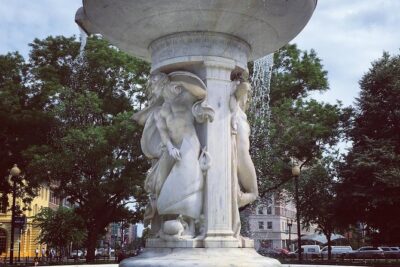
Dupont Circle and Embassy Row Architectural Walking Tour
Read our review →
DC: Georgetown History & Architecture Tour with Local Guide
Read our review →
Embassy Row: Architecture, Mansions & International Intrigue
Read our review →
Monuments and Memorials Architectural Walking Tour
Read our review →
Castle to Capitol: Museums of the National Mall Architecture Tour
Read our review →Browse the lists this tour appears in