
Review · FRANCE ARCHITECTURE TOURS
Marseille Belvedere: The city through architecture
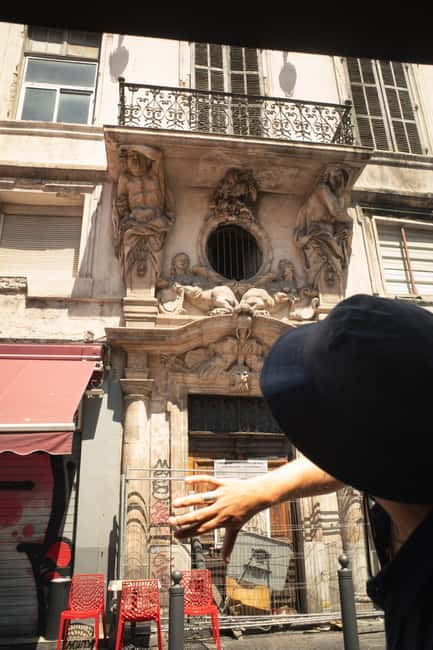
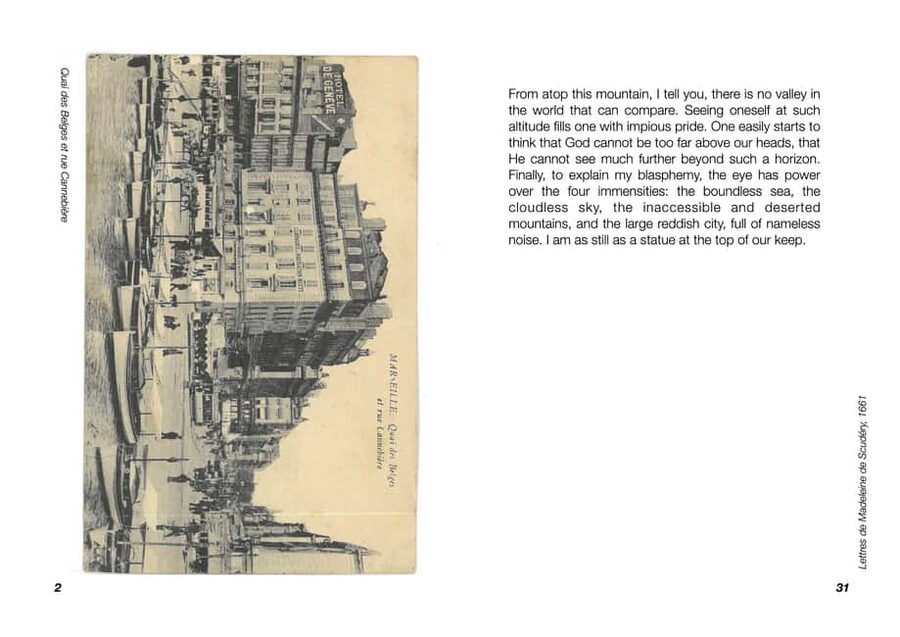
Marseille makes more sense when you stop looking only at monuments and start reading the city itself. On this three-hour walk, architect Louis Leroy uses old postcards, selected texts, and small details in the streets to show how the Phocaean city has changed. You move from the Old Port toward the Panier and Cours Belsunce, with each stop acting as a different belvedere, a place to see the city from a fresh angle.
I like the way the tour connects archive images with what is in front of you now. I also like its small scale: with no more than eight people, Louis can adjust the discussion to your questions and curiosity. The main consideration is pace. This is a walking seminar with regular reading and discussion, not a quick checklist of Marseille’s sights.
Key points at a glance
- Old postcards bring change into focus: You compare earlier views of Marseille with the streets and buildings you see today.
- An architect leads the walk: Louis Leroy explains urban form, architectural details, topography, and the city’s ongoing changes.
- The route covers central Marseille: Follow the path from the Fish Market and Old Port through the Cathedral, Panier, Rue de la République, and Cours Belsunce.
- Texts shape each stop: Read passages by researchers, sociologists, historians, and novelists as part of the walk.
- Small groups make discussion useful: The tour is limited to eight people and is offered in French, English, and Italian.
- You receive an illustrated booklet: It gives you material to follow during the walk and helps tie the stops together.
Reading Marseille at the Old Port
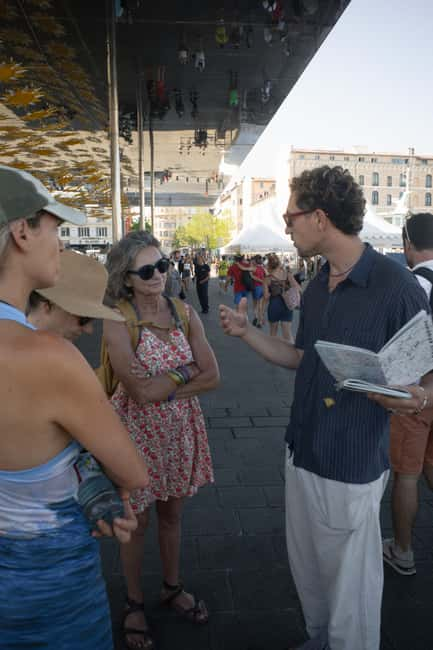
The meeting point is at the Vieux-Port metro exit by the platform. Look for Louis in a navy-blue hat. The walk begins at the Marché aux Poissons, a practical starting point because the Old Port is both Marseille’s postcard view and a record of how the city works.
Here, Louis sets up the central idea of the experience. A city is not fixed. Its meaning changes as buildings are replaced, streets are reshaped, and daily life moves through the same spaces in new ways. Instead of giving you a list of dates and names, he asks you to notice clues.
The Italian word belvedere means a beautiful place to see from, or a viewpoint. This tour uses that idea in a broad way. Some viewpoints come from the physical setting. Others come from a photograph, a passage of writing, or an architectural detail that changes how you understand a familiar street.
The Old Port is a strong place to begin because you can connect water, roads, buildings, and movement in one view. You may find yourself looking less at the harbor as a pretty scene and more at how the port has shaped the city around it.
A few more architecture walks in the world worth a look
- Chicago Architecture River Cruise
★ 5.0 · 15,756 reviews - Chicago River 90-Minute Architecture Tour
★ 4.5 · 9,629 reviews - Chicago River: 1.5-Hour Guided Architecture Cruise
★ 4.8 · 8,046 reviews
From the Ancient Port toward La Canebière
The route includes the Port Antique and La Canebière, with walks of about 20 minutes between several stops. That timing gives Louis room to use the streets as part of the lesson rather than rushing from one named attraction to another.
The Port Antique offers a useful contrast with the active modern harbor. The point is not only to identify an ancient site. It is to consider what survives, what disappears, and how a city builds new layers over old ones.
La Canebière then brings you into one of Marseille’s best-known urban corridors. It links the Old Port to the center of town and helps show how Marseille extends beyond the water. Look closely at the buildings, street alignments, and changes in scale as you walk. The tour encourages you to ask why the city looks the way it does, rather than treating each building as an isolated object.
The walk may suit you especially well if you like to understand a place through its structure. You do not need architectural training, but you should be ready to pause, read, compare, and discuss. Louis has lived in Marseille for several years and brings the viewpoint of someone who knows the city as both a professional and a resident.
City Hall and the Saint-Laurent quarter
The route continues toward City Hall, then to Saint-Laurent Church and Fort Saint-Jean. These stops bring together civic power, religious buildings, defensive architecture, and the port’s position at the edge of the city.
City Hall is more than another historic facade in this walk. It gives you a chance to think about how public buildings help define a city center. Saint-Laurent Church and Fort Saint-Jean add another layer, linking the waterfront to faith and defense.
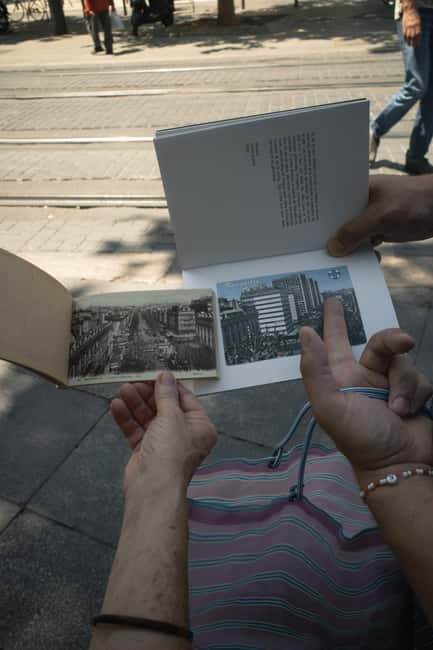
At each stop, Louis presents a text and an image he has selected. The reading may come from a researcher, sociologist, historian, or novelist. The old postcard may show a street or building at a different moment. You then compare the words and picture with the scene in front of you.
That format keeps the walk active. You are not simply listening while Louis talks. You are asked to look and interpret. The approach also leaves room for different reactions, since a postcard can reveal a change that is not obvious from a present-day view alone.
Marseille Cathedral and the Vieille Major
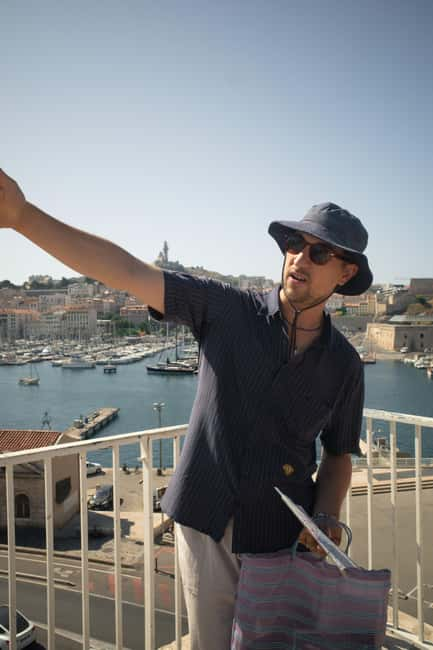
One of the major stops is Marseille Cathedral, also known as Sainte-Marie Majeure or La Vieille Major. Its scale and setting make it a natural point for discussing the city’s relationship with the waterfront and the surrounding streets.
A standard sightseeing visit might focus on the cathedral as a single monument. This walk places it inside a wider urban story. You consider how the building fits into its surroundings, how its details communicate its role, and how the nearby area has shifted over time.
The tour’s strength here is its habit of moving between close and distant views. You might examine a building detail, then step back to consider its position in the city. You might also use an older image to see whether the space once felt more open, more crowded, or simply different in its public life.
The cathedral stop is also a good example of the tour’s limits. You are not promised an interior-focused visit or a long guided explanation of every religious feature. The subject is Marseille through architecture and change, so the focus stays on the building as part of the city.
Same city, a different facade:
- Chicago Architecture Center River Cruise aboard First Lady
★ 5.0 · 5,536 reviews - Chicago: Architecture River Cruise Skip-the-Ticket Line
★ 4.8 · 4,325 reviews - Chicago River 45-Minute Architecture Tour from Magnificent Mile
★ 4.5 · 2,924 reviews - Barcelona: Sant Pau Recinte Modernista Entry Ticket
★ 4.6 · 2,567 reviews
Entering the Panier through La Vieille Charité
The walk continues to La Vieille Charité and the Panier neighborhood. This part of Marseille is especially suited to an urban walk because streets, buildings, slopes, and views come together in a compact area.
La Vieille Charité gives Louis another strong place to discuss architecture and social life. Its form and setting invite questions about who a building was designed for, how its purpose has changed, and what its presence means for the surrounding neighborhood.
The Panier section includes a 20-minute break. That pause matters. Three hours of walking and discussion can be mentally demanding, and the break gives you time to absorb the material before the route moves on. It also keeps the experience from becoming one long stream of explanation.
The Panier is not treated only as a picturesque maze. Louis encourages you to notice clues in the streets and buildings. Watch for details in walls, openings, changes in level, and the way one view leads to another. You may find that the neighborhood becomes more interesting when you stop trying to photograph everything and instead look for evidence of how it developed.
Rue de la République and the changing city
After the Panier, the route heads toward Rue de la République. This section adds a different kind of urban story. Here, the street can help you think about planning, redevelopment, and the way large interventions alter older parts of a city.
The walk does not present Marseille as a finished work. That is one of its more useful ideas. Louis asks you to observe changes that have already happened and those that are still taking shape. The city is treated as something in motion, with layers that can be read through its streets and buildings.
This is where the old postcards become particularly useful. A historic image gives you a fixed view from another moment, while the present-day street shows what remains and what has been altered. The comparison can make ordinary details feel important.
If you prefer guides who keep things moving and deliver a polished speech, this may feel slower than expected. If you enjoy asking why a street is arranged in a certain way, or what a building tells you about the people who used it, the stop should reward your attention.
Finishing at Cours Belsunce
The final section reaches Cours Belsunce. By this point, you have moved through the port, central streets, religious buildings, the Panier, and a major urban corridor. Ending here gives the tour a broad view of Marseille’s center rather than finishing at a single monument.
Cours Belsunce helps bring the different parts of the walk together. You have seen the city from several viewpoints, both literal and interpretive. The route has also shown how Marseille can contain very old features beside more recent forms of planning and construction.
This ending is useful because it leaves you with a method you can keep using. After the walk, you can look at another street and ask what its position, materials, scale, and surrounding buildings reveal. You can also use old photographs or written accounts to compare past and present.
The experience is therefore less about collecting facts than learning a way to look. That makes it a strong choice for a repeat visit to Marseille, or for anyone who wants more than a standard introduction.
What the $76 price gets you
At $76 per person, this is not a low-cost orientation walk. You are paying for a small group, a three-hour route, an architect’s interpretation, selected readings, postcard material, and an illustrated booklet.
The value depends on what you want from a guided visit. If you mainly want a list of top attractions and quick background facts, a cheaper general walking tour may suit you better. If you want to understand how Marseille has evolved, the format offers more depth and personal attention.
The group limit of eight is important. Louis can respond to questions and adapt the discussion to what interests you. That flexibility is less likely on a large city tour. The three-hour length also gives the route enough time to connect separate areas rather than treating each stop as a brief photo opportunity.
The booklet adds practical value after the walk. It gives you something to follow during the route and provides a visual thread for the readings and images. It is not just an included extra. It supports the tour’s central method of comparing text, photographs, and present-day streets.
Who will enjoy this Marseille walk
I would choose this experience if you like architecture, urban planning, social history, photography, or close observation. It also suits you if you have already seen Marseille’s main sights and now want to understand how they relate to one another.
The tour is a good fit for curious adults and older children who can manage a three-hour walking route with regular stops. Since the group is small, it should be easier to ask questions and follow up on a point that catches your interest.
You should think twice if you want a fast-paced tour, extensive free time at each monument, or a focus on food, shopping, or nightlife. The walk is built around interpretation. You will spend time reading and discussing, not only moving from one attraction to the next.
It is offered in French, English, and Italian, and the activity is listed as wheelchair accessible. The route includes multiple walking sections of about 20 minutes, so you may still want to confirm that the route suits your own mobility needs when booking.
Practical details before you book
Plan to arrive at the Vieux-Port metro exit by the platform and look for the navy-blue hat. The finish is at Cours Belsunce, so you do not return to the meeting point.
The stated duration is three hours, with starting times available according to the date you choose. Bring comfortable shoes and allow yourself enough attention for a discussion-based walk. The experience includes written and visual material, and some content is shown in its original language.
The tour has free cancellation up to 24 hours before departure for a full refund. You can also reserve now and pay later, which helps if you are still arranging your Marseille schedule.
Should you book Marseille Belvedere?
Book it if you want to see Marseille through an architect’s eyes and are happy to slow down. Louis Leroy’s use of postcards, texts, and street details gives the walk a clear point of view, while the small group keeps it personal.
Skip it if you want only the fastest route through the city’s headline sights. For $76, the value comes from the interpretation, not the number of attractions checked off. If that sounds like the kind of Marseille you want to meet, this is a thoughtful and distinctive choice.
FAQ
How long does the Marseille Belvedere walk last?
The experience lasts three hours.
Where does the tour begin?
It begins at the Marché aux Poissons, with the meeting point at the Vieux-Port metro exit by the platform.
How will I recognize the guide?
Louis Leroy will be wearing a navy-blue hat.
Where does the tour finish?
The walk finishes at Cours Belsunce.
Which places are included on the route?
The route includes the Old Port, La Canebière, City Hall, Saint-Laurent Church, Fort Saint-Jean, Marseille Cathedral, La Vieille Charité, the Panier neighborhood, Rue de la République, and Cours Belsunce.
Who leads the experience?
The walk is led by Louis Leroy, a trained architect who has lived in Marseille for several years.
What languages are available?
The tour is offered in French, English, and Italian.
How large is the group?
The group is limited to eight participants.
Is an illustrated booklet included?
Yes. You receive an illustrated booklet to follow during the urban walk.
Can I cancel for a full refund?
Yes. You can cancel up to 24 hours in advance for a full refund.
Newly added in the world
- Washington, DC: Georgetown Architecture Walking Tour★ 5.0 · 8 reviews
- Washington DC: Dupont Circle & Embassy Row Architecture Tour★ 5.0 · 6 reviews
- New Orleans : Garden District Architecture Walking tour★ 4.8 · 5 reviews
- Wilmington History and Architecture Tour★ 4.8 · 18 reviews
- Unveiling Brno: History, Culture & Architectural Delights★ 5.0 · 2 reviews
- Vicenza: Palladian Architecture Private Walking Tour★ 3.3 · 3 reviews
- Walk & Discover KL’s Architectural and Heritage Gems★ 5.0 · 7 reviews
- Private Colonial Williamsburg Architectural Tour★ 5.0 · 5 reviews
France Architecture Tours, compared.
Bastille’s Architecture & Artisans Self-Guided Walking Tour
Read our review →
Private Art Nouveau and Art Deco tour near Opera
Read our review →

Neoclassical Paris Architecture 2-Hour Private Walking Tour
Read our review →
Discover the hidden architecture gems of Le Marais
Read our review →
Contemporary Architecture in Bordeaux city center!
Read our review →Browse the lists this tour appears in