
Review · WALKING TOURS
British Architecture Walk, an immersive walking tour in Chennai
Chennai’s grandest colonial buildings make more sense when you see them as a connected story. This 2.5-hour walk links two railway stations, Ripon Building, Napier Bridge, the University of Madras, and other landmarks shaped by British rule and local Indian design.
I like the small maximum group of 15, which gives you a better chance to hear the guide than on a large city tour. I also like the included tea or coffee and snacks, a simple touch that fits the street-level feel of Chennai. The main drawback is that this is a walking tour with several outdoor stops, and admission to some buildings is not included.
Key points to know before booking
- Start at Chennai Egmore: The tour opens with a century-old railway station and its Indo-Saracenic design.
- See two landmark railway stations: Egmore and Chennai Central show different sides of colonial-era architecture.
- Follow a useful city route: The walk ends near the University of Madras after passing Ripon Building, Napier Bridge, and the War Memorial.
- Expect personal guiding: Groups are capped at 15, with guides such as Hareesh and Satish leading the walk.
- Tea and snacks are included: You do not need to budget extra for the listed coffee or tea.
- Plan for a 2.5-hour outdoor outing: Some stops include entry, while others are viewed from outside.
Why this Chennai architecture walk is worth your time
I like this tour because it treats architecture as a way to read Chennai. You are not simply ticking off old buildings. You are following the city’s growth through railways, public halls, government offices, military memorials, bridges, and university buildings.
The $55 price is reasonable if you want a guided look at several important landmarks in one outing. A casual self-guided walk could cost little, but you would need to research the architects, dates, styles, and political setting yourself. Here, a local guide connects the details as you go.
The small-group format matters. With no more than 15 people, you should have a better view of the buildings and a clearer chance to ask questions. The experience is particularly useful if you enjoy architecture, railways, urban history, or the way British design mixed with Indian building traditions.
The route also gives you a practical introduction to central Chennai. It begins at Egmore and finishes near the University of Madras, so you see a broad slice of the city rather than spending the full tour around one monument.
More Walking Tours in the world:
- Lecce: Baroque Architecture and Underground Walking Tour
★ 4.6 · 1,248 reviews - Chicago in a Day: Food, History & Architecture Walking Tour
★ 5.0 · 1,153 reviews - Ramblas, Old Town, Gothic and Gaudi Architecture Walking Tour
★ 5.0 · 723 reviews
Starting at Chennai Egmore railway station
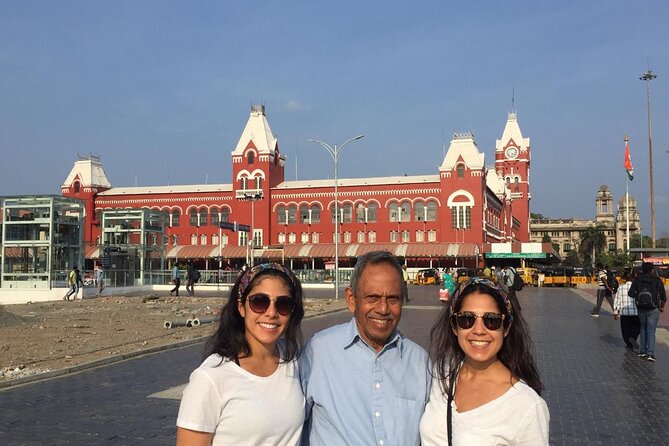
The first stop is Chennai Egmore, where you get an early lesson in the city’s Indo-Saracenic style. The station is more than 100 years old and was designed by Henry Irwin, a major name in British-era architecture in India.
The design aimed to create a station larger than London’s Charing Cross station, which gives you a useful sense of the ambition behind these public buildings. This was not plain railway infrastructure. It was meant to project importance, order, and civic pride.
You have about 20 minutes here, with admission included. That is enough time for the guide to point out the main architectural features and explain why Egmore matters before the route moves on.
For me, this is a strong opening because a railway station is also a city gateway. You begin by looking at a working piece of Chennai, not a detached museum object. The practical point is to arrive ready to walk, since the tour starts at Gandhi Irwin Road in Egmore.
Comparing Egmore and Chennai Central
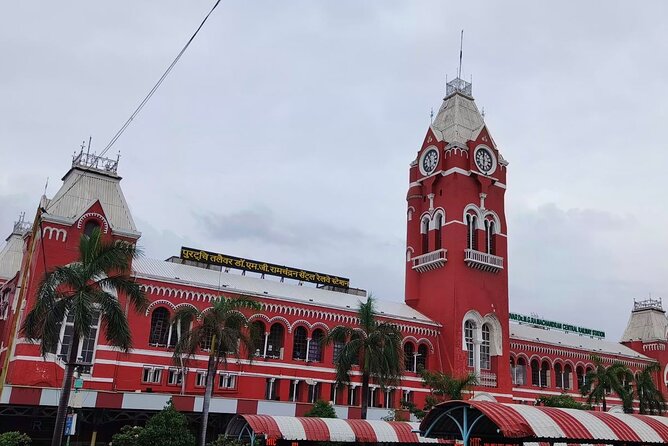
The next stop is Chennai Central Railway Station, built in 1873 in the Gothic Revival style by British architect George Harding. The building was later modified by Robert Chisholm, who added the central clock tower and Travancore-style caps on the main towers.
This contrast with Egmore is one of the best parts of the route. Egmore introduces Indo-Saracenic design, while Central lets you consider Gothic Revival forms and later changes made for an Indian setting.
You get about 30 minutes here, the longest stop on the walk. That extra time makes sense. Railway stations can be busy and visually complex, so you need a little longer to take in the structure, the tower, and the layers added over time.
Admission is included at this stop. You should still expect the experience to focus on exterior architecture and guided explanation rather than a long indoor visit. The value comes from seeing how transport shaped Chennai and how different architectural ideas were adapted for the city.
Victoria Public Hall and Chennai’s civic life
Victoria Public Hall opened in 1887 to mark Queen Victoria’s Golden Jubilee. It was named after the queen and served as a venue for public meetings, events, and entertainment.
You spend about 20 minutes here. Admission is not included, so you should treat this as a guided exterior stop unless your tour arrangements provide another option. The building is still important because it shows how colonial architecture was tied to public life, not just administration.
I like this stop for the change of subject. After two railway stations, you move from transport to civic culture. The guide can help you see the building as a place where Chennai’s public life took shape, rather than just another ornate façade.
This is also a good point to pay attention to the difference between a building’s official purpose and the way local people used it. The tour’s value is not only in naming dates and architects. It is in showing how these places fitted into the city.
A few more architecture walks in the world worth a look
- Chicago Architecture River Cruise
★ 5.0 · 15,756 reviews - Chicago River 90-Minute Architecture Tour
★ 4.5 · 9,629 reviews - Chicago River: 1.5-Hour Guided Architecture Cruise
★ 4.8 · 8,046 reviews - Chicago Architecture Center River Cruise aboard First Lady
★ 5.0 · 5,536 reviews
Ripon Building and the Greater Chennai Corporation
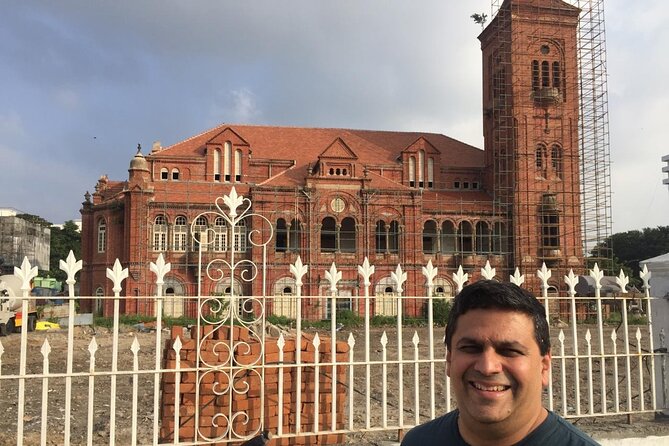
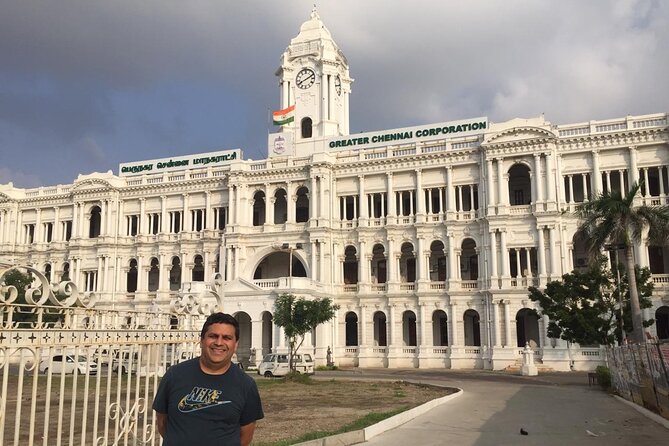
The walk continues to the Ripon Building, commissioned in 1913. It was designed by G.S.T. Harris and built by Loganatha Mudaliar. The building was named after Lord Ripon, a Governor-General of India.
This stop lasts about 15 minutes, and admission is not included. The building represents municipal power and the practical work of running a growing city. That makes it a useful counterpoint to Victoria Public Hall and the railway stations.
I like the way this part of the tour broadens the story. British architecture in Chennai was not limited to grand imperial monuments. It also appeared in offices that managed roads, public services, and urban administration.
Since this is a short stop, you will want to keep your attention on the guide’s explanation. The architectural details may be easier to appreciate after you understand why the building was commissioned and who used it.
Southern Railway Headquarters and Indo-Saracenic style
The Southern Railway Headquarters comes next. It was built in the Indo-Saracenic style, designed by N. Grayson, and built by Samynada Pillai. Construction was completed in 1921.
You spend about 15 minutes here, with no admission included. The building adds another railway chapter, but it is not simply a repeat of Egmore or Central. Its style shows a deliberate combination of European planning and Indian architectural references.
This is one of the places where a guide adds real value. If you are not familiar with Indo-Saracenic architecture, the term can sound vague. At the building itself, you can see how the style differs from the Gothic Revival approach associated with Chennai Central.
The stop also helps you place the railway network in a larger setting. Railways were a major part of the British administration and economy, and these headquarters buildings gave that system a permanent civic presence.
Napier Bridge across the Coovum River
Napier Bridge was built in 1869 across the Coovum River. It is named after Francis Napier, the British governor of Fort St George, and connects the Marina area with Fort St George.
You spend about 15 minutes here, and admission is included. The bridge gives you a break from looking at façades and lets you consider infrastructure on a larger scale. Bridges connect districts, but they also show how the city’s roads and river crossings developed.
The bridge was later broadened from its earlier narrow form, an important reminder that old structures can change as the city grows. Ask the guide to explain the bridge’s role in the route between the Marina and Fort St George.
This section may feel less formal than the railway stations or public buildings. That is part of its appeal. You see how colonial-era planning extended into everyday movement through Chennai.
The University of Madras and Senate House
The route reaches the University of Madras, where the Senate House serves as the university’s administrative center. It sits along Marina Beach and was constructed by Robert Chisholm.
The building is regarded as a major example of Indo-Saracenic architecture, making it a fitting late stop after you have already seen several styles. By now, you can compare the ideas introduced at Egmore and Southern Railway Headquarters with a university building designed for education and administration.
You spend about 15 minutes here. Admission is not included, so the visit may focus on the exterior and the setting. The tour ends at the University of Madras on Navalar Nagar in Chepauk, which is useful if you plan to continue around Marina or central Chennai afterward.
I like ending here because the route finishes with a building connected to learning rather than government or transport. It gives the walk a calmer final chapter and leaves you with a clear sense of how varied Chennai’s colonial-era architecture can be.
Victory War Memorial and the final stop
The Victory War Memorial was first known as Cupid’s Bow. It was built to commemorate the Allied victory in World War I from 1914 to 1918, and was later renamed the Victory War Memorial.
The stop lasts about 15 minutes, with admission included. It adds a military and memorial layer to the tour, showing how public monuments were used to mark imperial victories and later remembered through changing names.
This is a compact stop, but its meaning is larger than its size. You can consider who created the memorial, what event it marked, and how the place was understood after India’s political situation changed.
The inclusion of a memorial at the end keeps the tour from becoming a simple parade of attractive buildings. It asks you to think about the power and purpose behind the architecture.
What the guide and group size add
The tour is led by a local guide, and guides named Hareesh and Satish have led this experience. Hareesh is noted for explaining the history of the buildings and for buying an Indian coffee during the walk. That coffee is not just a free drink. It reflects the sort of local pause that can make a city walk feel connected to daily life.
Satish is described as informative and enthusiastic about Chennai’s history and buildings. If you are interested in architecture, that energy can make a big difference, especially at stops that might otherwise look like government offices or railway facilities.
The group limit is 15 people. That is not a private tour, but it is small enough to feel more manageable than a large coach group. You can usually stay close to the guide, hear the explanations, and ask about details that catch your eye.
Coffee or tea is included, and snacks are provided at no extra cost. The precise snack selection is not specified, so do not book this as a food tour. Think of the refreshments as a welcome break during a walking route.
Price, timing, and practical tradeoffs
At $55 per person, this tour costs more than walking between the buildings on your own. The price makes more sense if you value the guide’s research, the connected route, the small group, and the included refreshments.
The total duration is about two hours and 30 minutes. The listed stop times add up to roughly that length, so the schedule is fairly structured. You will not have long free periods at each building, but you will cover a lot of ground without giving up half a day.
Hotel transfers are optional. If you select that option, it can simplify the start of the day, but hotel pickup and drop-off are not included in the standard tour. The meeting point is Chennai Egmore, and the endpoint is the University of Madras.
The tour is near public transportation, and most people can take part. Wear comfortable walking shoes and plan for an outdoor outing. Some stops include admission, while Victoria Public Hall, Ripon Building, Southern Railway Headquarters, and the University of Madras do not.
You can cancel for a full refund up to 24 hours before the start time. Changes or cancellations made inside that 24-hour window are not refunded.
Who should book this walking tour
I would choose this tour if you have a strong interest in architecture, railways, public buildings, or Chennai’s colonial-era development. It also suits you if you want a guided introduction to central Chennai without committing to a full-day city tour.
The route works well for first-time visitors who want context. It also has value for repeat visitors who have seen the main sights but have not paid close attention to the city’s buildings.
You may want to skip it if you dislike walking, prefer long indoor visits, or want a tour centered on food, temples, or modern Chennai. The focus is firmly on architecture and history, with snacks and tea as small additions rather than the main event.
Should you book the British Architecture Walk?
Book it if you want a focused, well-paced look at Chennai’s British-era buildings with a local guide and a small group. The combination of Egmore, Central, Ripon Building, Napier Bridge, the University of Madras, and the Victory War Memorial gives you a strong range of styles and purposes in one outing.
The clearest reason to book is the guide’s role. Names such as Hareesh and Satish, the included coffee or tea, and the group limit of 15 suggest a more personal experience than a basic sightseeing transfer. Just keep your expectations practical: some buildings are viewed from outside, hotel transfers cost extra, and the walk is best for people who enjoy looking closely at urban design.
FAQ
Where does the British Architecture Walk start?
The tour starts at Chennai Egmore railway station, on Gandhi Irwin Road in Egmore, Chennai, Tamil Nadu 600008, India.
Where does the tour finish?
The tour ends at the University of Madras, Navalar Nagar, Chepauk, Triplicane, Chennai, Tamil Nadu 600005, India.
How long does the walking tour last?
The experience lasts approximately two hours and 30 minutes.
How much does the tour cost?
The listed price is $55 per person.
How large is the group?
The tour has a maximum of 15 travelers.
Is hotel pickup included?
Hotel pickup and drop-off are not included unless you select the optional hotel transfer option.
Is food or drink included?
Coffee or tea is included, and snacks are provided at no extra cost.
Which buildings are included in the route?
The route includes Chennai Egmore, Chennai Central Railway Station, Victoria Public Hall, the Greater Chennai Corporation Office at Ripon Building, Southern Railway Headquarters, Napier Bridge, the University of Madras, and the Victory War Memorial.
Are admission tickets included at every stop?
No. Admission is included at Chennai Egmore, Chennai Central Railway Station, Napier Bridge, and the Victory War Memorial. Admission is not included at Victoria Public Hall, Ripon Building, Southern Railway Headquarters, or the University of Madras.
Can I cancel for a refund?
Yes. You can cancel up to 24 hours before the experience starts for a full refund. Cancellations or changes made less than 24 hours before the start time are not refunded.
Newly added in the world
- Venice Art and Architecture Private Walking Tour★ 4.5 · 11 reviews
- Basilica San Marco and the Pala d’Oro with Architect Guide★ 4.5 · 19 reviews
- Walking tour in Venice with an architect★ 5.0 · 16 reviews
- Lesser Poland Wooden Architecture Trail UNESCO Private Tour from Krakow★ 5.0 · 15 reviews
- Lisbon Contemporary Architecture★ 5.0 · 3 reviews
- Private Munich Tour for History Buffs with Architectural Gems and WWII sites★ 5.0 · 3 reviews
- Neoclassical Paris Architecture 2-Hour Private Walking Tour★ 5.0 · 7 reviews
- Street Art and Architecture:Porto Speaks Through Its Streets★ 3.0 · 2 reviews
Walking Tours, compared.

The Official Art Deco Walking Tour by The Miami Design Preservation League
Read our review →
Baroque Architecture and Underground Walking Tour
Read our review →
Chicago in a Day: Food, History & Architecture Walking Tour
Read our review →

Ramblas, Old Town, Gothic and Gaudi Architecture Walking Tour
Read our review →
Chicago’s Secret Interiors Architectural Walking Tour
Read our review →
Browse the lists this tour appears in