

Review · WALKING TOURS
British Architecture Walk in Chennai by Wonder tours
Chennai’s British past is easiest to understand on foot, where grand railway buildings, war memorials, churches, bridges, and government offices appear one after another. I like that this walk brings together Gothic Revival and Indo-Saracenic architecture, rather than treating colonial Chennai as one uniform style. I also like the visit to Fort St. George, where St. Mary’s Church and a colonial museum add more than quick photo stops.
The main consideration is the pace and setting. You have about three hours to cover several sites, and much of the experience takes place outdoors in a busy city. The listed meeting point is at the Greater Chennai Corporation Office, while the route description begins at Chennai Central Railway Station, so confirm the exact starting instructions before you go.
Key points to know

- Seven landmarks in about three hours: The route includes Ripon Building, Chennai Central, Southern Railway Headquarters, Victory War Memorial, Fort St. George, Napier Bridge, and the University of Madras.
- A private walking experience: Only your group participates, which gives you more room to ask questions and set the pace within the tour schedule.
- Two guides receive repeated praise: Rajesh and Nanda are specifically named for clear historical explanations, friendly manners, and professional guiding.
- Architecture with a local twist: You’ll see British Gothic Revival buildings alongside Indo-Saracenic designs that combine European and Indian features.
- Tea, coffee, and a local snack are included: This is a small but welcome pause during a warm Chennai walk.
- Important booking detail: The experience is non-refundable, and camera or video fees are not included.
Why this Chennai walk is worth your time
I like this tour because it shows how Chennai was shaped as an administrative and transport center, not just as a collection of old buildings. The route links railway architecture, military power, civic government, education, religion, and public memory.
That range gives the walk a useful structure. You begin with the city’s transport network, move through official and military landmarks, and finish at the University of Madras. By the end, you have seen how British rule left its mark on several parts of city life.
The strongest part of the experience is likely to be the guide’s storytelling. Rajesh and Nanda are the guides named in the available feedback, and both are repeatedly described as friendly, clear, and good at explaining Chennai’s colonial past. That matters here. Many of the buildings are still used as offices or transport facilities, so a guide helps you understand what you are looking at rather than simply photographing an attractive facade.
This is a private activity, meaning only your own group takes part. That setup is useful if you want to ask about architectural details, local history, or the continued use of these buildings. It also avoids the stop-and-start feel of a large group. The tradeoff is that a private tour at $49 per person may be less appealing for a solo visitor than for a couple, family, or small group, especially if a group discount applies.
More Walking Tours in India:
- British Architecture Walk, an immersive walking tour in Chennai
★ 5.0 · 60 reviews - Mumbai heritage walk- Story of Gothic and Art Deco buildings
★ 5.0 · 33 reviews - Victorian Gothic Heritage Quarter and Art Deco Walking Tour
★ 4.9 · 14 reviews
Ripon Building and Chennai Central: the opening pair
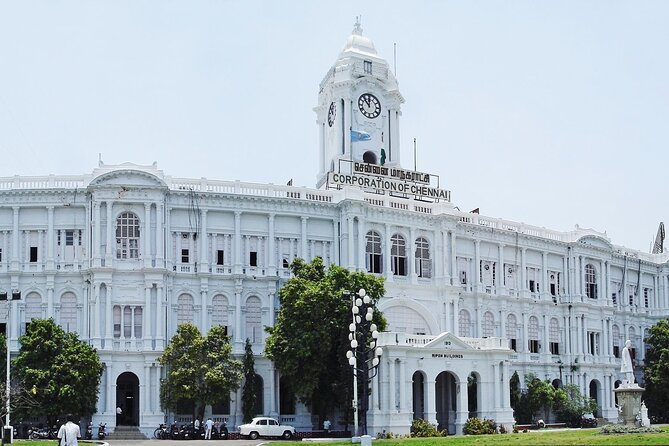
Ripon Building is one of the clearest examples of the civic ambition behind colonial Chennai. Designed by G.S.T. Harris and built by Loganatha Mudaliar, it was named for Lord Ripon, a Governor-General of British India associated with local self-government.
You have about 15 minutes here. That is enough for an introduction and exterior viewing, but not a long architectural study. I would use the stop to look at the building as a symbol of municipal administration and to ask your guide how its original role connects with Chennai’s city government today.
The next stop is Chennai Central Railway Station, built in 1873 in the Gothic Revival style by British architect George Harding. Robert Chisholm later modified the station, adding another layer to its design history.
The station now handles more than 350,000 passengers each day, so this is not a quiet heritage site. It remains part of the city’s working transport system. That makes it one of the more useful stops on the route: you see colonial-era design beside a major modern railway hub.
The scheduled time is 30 minutes, and admission is included. Expect a more active city setting here than at the university or memorial stops. Keep your belongings close in crowded public areas, and stay alert to the guide’s meeting instructions around the station.
One small oddity in the published route is the order. The overview says the walk begins at Central Railway Station, while the detailed stop list places Ripon Building first. The stated meeting point is also the Greater Chennai Corporation Office on Raja Muthiah Road. I would confirm whether the group meets at that office or proceeds to the station before the walk begins.
Southern Railway Headquarters and the story of style
The Southern Railway Headquarters was completed in 1921. Designed by N. Grayson and built by Samynada Pillai, it uses the Indo-Saracenic style.
This is an important contrast with Chennai Central. Gothic Revival borrowed heavily from medieval European forms, while Indo-Saracenic architecture used Indian decorative ideas alongside European planning and construction. The result is a building style tied to the politics and taste of British India, not simply imported British design.
The stop lasts about 15 minutes. That makes it a quick look, so you will want to listen closely while the guide points out features. If architecture is your main interest, this is a place where the quality of the explanation matters more than the amount of time spent on site.
I especially like the sequence of these three buildings. Ripon Building introduces civic government, Chennai Central shows transport and public movement, and Southern Railway Headquarters brings you back to the railway system from an administrative angle. The walk is doing more than collecting famous facades.
Victory War Memorial and Chennai’s public memory
The Victory War Memorial was first known as Cupid’s Bow. It was created to commemorate the Allied victory in World War I from 1914 to 1918, and it later became known as the Victory War Memorial.
You have 30 minutes here, which gives the guide more time to explain the memorial’s changing name and purpose. This stop also adds a military and political layer to the walk. Colonial architecture can look polished and grand, but memorials remind you that British rule was connected to wars, imperial administration, and the lives of people drawn into those conflicts.
The memorial is not only about design. Ask your guide how its meaning changed after the original commemoration. The supplied tour information gives the basic story, but a personal explanation can help you connect the site to Chennai’s changing public identity.
As with several stops, admission is included. The experience does not include camera or video camera fees, so check before taking photographs inside any site where charges apply.
A few more architecture walks in India worth a look
- The Hipster Chandigarh Architecture History Tour
★ 5.0 · 54 reviews - Jaipur City Heritage and Architecture Tour
★ 5.0 · 32 reviews - Le Corbusier’s Chandigarh : A Complete Architecture Tour
★ 4.7 · 25 reviews - Day trip from Bangalore to Lepakshi for Temple architecture & paintings
★ 5.0 · 15 reviews
Fort St. George, St. Mary’s Church, and the colonial museum
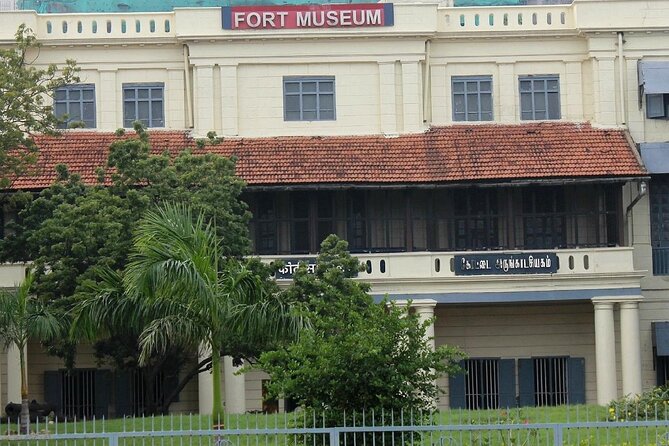
Fort St. George is the historical center of the walk. Here you visit St. Mary’s Church, described as the oldest Anglican church in India, along with a museum containing colonial-era relics.
This is the stop I would give the most attention. Buildings can tell you about style, but a church and museum add objects, institutions, and personal stories. The museum visit should help you move beyond the broad label of British architecture and see the material culture connected with colonial rule.
The scheduled time is 30 minutes. That is enough for an introduction and a focused visit, although anyone who likes museums may wish for longer. Since this is a guided walk rather than a full museum tour, ask your guide to point out the most important objects and explain how Fort St. George fits into Chennai’s growth.
Fort St. George also gives the tour a change of mood. Earlier stops focus mainly on public buildings and railway administration. Here, the route turns toward military power, religion, and colonial government. That change keeps the walk from becoming a long parade of similar government facades.
The practical point is to stay with the group and follow the guide’s instructions. Fort areas can have their own entry rules, and the tour information does not spell out every photography restriction. Admission is listed as included, but camera and video fees are not.
Napier Bridge and the city’s familiar image
Napier Bridge is a shorter stop, with about 15 minutes scheduled. The original narrow bridge was later widened and converted into a concrete structure, opening to the public in July 1943.
The bridge is often used by media to represent Chennai, so you may recognize it from images of the city. Its value on this route is partly visual and partly practical. It shows how infrastructure changed as Chennai grew, and it gives you a chance to see a well-known city feature in context.
Do not expect a long architectural visit here. This is a brief pause between Fort St. George and the University of Madras. Use the time for photographs and for asking how the bridge fits into the city’s transport network.
A bridge is also a useful reminder that heritage is not limited to palaces and churches. Roads, railways, and public crossings help explain how a city functions. That wider view is one of the better reasons to choose this tour over a simple list of historic building exteriors.
The University of Madras and Senate House finale
The walk finishes with the University of Madras, including the Senate House. The masterpiece was built between April 1874 and 1879 and includes a convocation hall, porticos, a parapet, meeting halls, and a library.
The scheduled time is 30 minutes, making this one of the longer stops. That feels right for a final visit. After seeing civic, railway, military, and religious buildings, you end with an institution linked to education and public life.
The Senate House is described as the administrative center of the University of Madras. Its architectural details are worth taking slowly, especially the porticos and formal halls. Ask your guide to explain which features reflect European planning and which draw on Indian design traditions.
Ending here also gives the walk a more reflective finish. The route begins with railway movement and ends with an institution devoted to learning. That is a satisfying way to frame Chennai’s colonial-era development, even if the tour itself stays focused on buildings rather than broader social history.
The experience ends back at the meeting point, according to the tour details. Since the route description also says the walk finishes at the University of Madras, confirm how the return to the original meeting point is handled. Do not assume you can simply leave from the university without checking.
What the $49 price includes
At $49 per person, this is not the cheapest way to look at Chennai’s public buildings, but the price can make sense if you value context and a private guide. You receive a local guide, admission tickets for the listed stops, taxes, handling charges, and a local snack with tea or coffee.
The private format is the key value. If two or more people share the experience, you can ask questions freely and avoid paying for transport between separate attractions. Group discounts are also listed, though the exact discount is not provided.
The price does not include porterage, tips, incidental expenses, hotel pickup, or drop-off. Camera and video camera fees are also excluded. Those costs may be small, but you should carry some extra money and ask about photography rules before taking pictures inside sites.
The tour lasts about three hours, which makes it a manageable introduction to colonial Chennai. It is long enough to cover seven important places but not long enough for extended museum time or detailed interior study at every stop. I see it as a city orientation with architectural depth, not as a specialist conservation tour.
Who should choose this walking tour
I would choose this experience if you enjoy architecture, urban history, railways, public buildings, or guided city walks. It also suits a first visit to Chennai when you want to understand the central historic area before exploring more of the city on your own.
You will get the most from it if you are willing to listen as you walk. The buildings are the main attraction, but the guide’s explanations make the route meaningful. Rajesh and Nanda are specifically praised for their friendly approach and clear accounts of Chennai’s history, so request one of them if the operator allows guide preferences, though no guarantee is stated.
This is less suitable if you want a relaxed stroll with long stops, hotel transportation, or a full museum experience. The schedule is compact, the tour is outdoors for much of its length, and several stops receive only 15 minutes.
Wear comfortable walking shoes and bring water. Those are sensible choices for any three-hour city walk, especially when the route includes busy transport areas and outdoor memorials. The tour includes tea or coffee and a snack, but that should not be treated as a full meal.
Should you book the British Architecture Walk in Chennai?
Book it if you want a focused, private introduction to Chennai’s colonial-era buildings and prefer explanation over sightseeing alone. The route has a strong mix of railway architecture, civic design, Indo-Saracenic style, a war memorial, Fort St. George, a church, a museum, a bridge, and the University of Madras.
I would be especially comfortable recommending it to couples, families, and small groups who can share the $49-per-person cost and make use of the private format. The repeated praise for Rajesh and Nanda also makes the guide element a clear strength.
Before paying, confirm the exact meeting point, the order of the first stops, and any photography charges. Also remember that the booking is non-refundable and cannot be changed. If those terms suit you, this is a practical way to see Chennai’s British-era core without spending a full day on a single fort or museum.
FAQ
How long does the British Architecture Walk in Chennai last?
The walk lasts approximately three hours.
What landmarks are included?
The route includes Ripon Building, Chennai Central Railway Station, Southern Railway Headquarters, Victory War Memorial, Fort St. George, Napier Bridge, and the University of Madras.
Is this a private tour?
Yes. Only your group participates in the activity.
Are admission tickets included?
Admission tickets are listed as included for the scheduled stops. Camera and video camera fees are not included.
Is hotel pickup or drop-off provided?
No. Hotel pickup and drop-off are not included. The listed meeting point is the Greater Chennai Corporation Office at 53 Raja Muthiah Road, Chennai.
What is included with the tour?
The price includes a local guide, a local snack, tea or coffee, and all listed taxes, fees, and handling charges.
Newly added in India
- New Delhi: Mughal’s architecture tour with transfers★ 4.0 · 7 reviews
- 2 day tour from Mumbai to architectural wonder of Mandu★ 5.0 · 2 reviews
- Goa Walking tour: History, Culture, Art and architecture★ 4.5 · 2 reviews
- South India Tour- Temple Architecture and Backwaters★ 5.0 · 7 reviews
- Day trip from Bangalore to Lepakshi for Temple architecture & paintings★ 5.0 · 15 reviews
- Old & New Delhi Culture & Architecture City Private Tour★ 4.9 · 9 reviews
- Kanchipuram: Temple Architecture & Silk Weaving from Chennai★ 4.8 · 3 reviews
- Victorian Gothic Heritage Quarter and Art Deco Walking Tour★ 4.5 · 13 reviews
Walking Tours, compared.

The Official Art Deco Walking Tour by The Miami Design Preservation League
Read our review →
Baroque Architecture and Underground Walking Tour
Read our review →
Chicago in a Day: Food, History & Architecture Walking Tour
Read our review →

Ramblas, Old Town, Gothic and Gaudi Architecture Walking Tour
Read our review →
Chicago’s Secret Interiors Architectural Walking Tour
Read our review →

Browse the lists this tour appears in