
Review · HISTORICAL TOURS
Buda Castle Tour: History and Architecture
Buda Castle is not one neat royal building waiting to be toured. It is a hilltop city built, destroyed, patched, and rebuilt over many centuries. This walking tour makes that complicated past readable, from the Royal Palace and medieval merchant streets to the Jewish prayer house and the breach where Buda fell in 1686. The archaeology is the real attraction.
I like the small group, limited to 12 people, and the way the route moves beyond the famous postcard sights. I also like the guide’s use of historical images on an iPad, which helps you picture buildings that no longer exist. The main drawback is simple: you do not tour inside the Royal Palace, Matthias Church, or the upper level of Fisherman’s Bastion, and the walk is not suitable for people with limited mobility.
Key things to know before booking
- A walking history lesson, not an indoor palace tour: Most of the experience takes place outdoors in the Castle District.
- The medieval Jewish prayer house is included: This is one of the tour’s most distinctive stops, but it is closed on Saturdays and Mondays.
- Small groups matter: With a maximum of 12 people, it is easier to ask questions and examine details.
- The route covers more than the main sights: Expect merchant houses, noble streets, siege walls, monasteries, archives, and reused medieval ruins.
- Several famous interiors cost extra: Matthias Church, the Royal Palace, and the upper terrace of Fisherman’s Bastion are not part of the $43.25 price.
- Plan for a serious walk: The tour lasts about three and a half hours and requires moderate physical fitness.
Why Buda Castle makes sense on foot
The Buda Castle District is often treated as a quick photo stop. You see Matthias Church, pose at Fisherman’s Bastion, and move on. That approach misses the best part. The hill is a layered record of royal ambition, trade, religion, war, and rebuilding.
This tour spends time on the streets between the headline sights. You learn why one lane served merchants while another attracted nobles, how medieval walls were folded into later homes, and how a modern hotel was built around the remains of a Dominican monastery.
That focus suits you if you like places explained through their physical remains. It is less suitable if your first priority is entering grand interiors. The tour gives you context for those buildings, then leaves you free to visit selected interiors afterward.
The English-speaking guide is identified in the tour feedback as Matthew, also written as Máté. He has a background in history and archaeology, and the experience places strong emphasis on architecture, excavation, and reconstruction. His iPad images are useful here because so much of medieval Buda survives only as foundations, fragments, or altered walls.
More History Walks in the world:
- Chicago in a Day: Food, History & Architecture Walking Tour
★ 5.0 · 1,153 reviews - Charleston’s Best Highlights: History, Culture & Architecture
★ 5.0 · 422 reviews - Palm Springs Modernism Architecture & History Bike Tour
★ 5.0 · 359 reviews
From Prince Eugene to the Royal Palace
The meeting point is the Statue of Prince Eugene of Savoy, in the lower Buda Castle area. From there, the route begins with the Royal Palace, the district’s most powerful symbol.
The palace started as a medieval stronghold and changed repeatedly as rulers expanded it and political power shifted. Gothic, Baroque, and Neoclassical elements reflect different chapters rather than one unified design. You spend about 20 minutes looking at the palace area, but admission to the interior is not included.
That distinction matters. If you want to visit the palace museums or interior rooms, plan another visit after the walk. The tour’s value lies in explaining how the complex developed and why its form is so hard to read at a glance.
Nearby are the remains of the medieval Sigismund Church. Only a few minutes are given to this stop, but the foundations point to the early 15th century, when King Sigismund was turning Buda into an imperial residence. It is a brief look at a major construction phase that would otherwise be easy to miss.
Tárnok and Úri Streets, medieval Buda in everyday form
Tárnok Street was the commercial spine of the medieval burgher town. Its cobbled surface and old façades offer a useful counterpoint to the palace above. Here, the discussion turns from kings to shopkeepers, storage rooms, domestic space, and the practical business of trade.
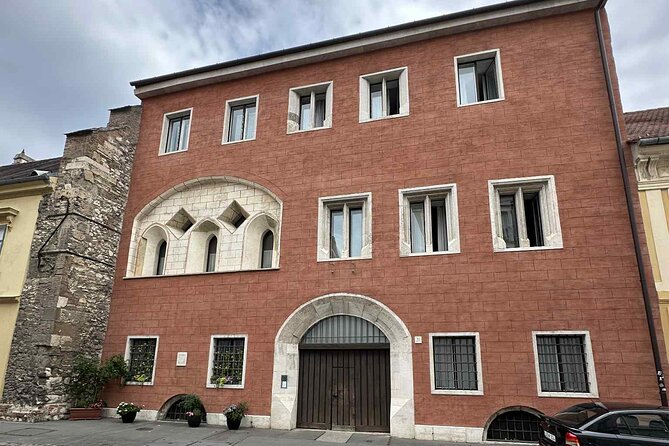
The tour visits three surviving buildings with medieval foundations. Fire, siege, and later urban changes did not erase every trace. Look closely at the façades and gateways. The important details are often low to the ground or tucked behind later surfaces.
Úri Street shifts the mood. This was the noble residential quarter, lined with aristocratic houses and town residences. The thick walls and elaborate gateways reveal social rank in a way that a textbook cannot. The street has some of the finest medieval doorways in the district, and the guide uses them to explain how Buda’s upper class lived and presented itself.
These stops are a strong reason to choose this experience over a short sightseeing circuit. You are not simply being shown attractive streets. You are learning what those streets did.
A vanished parish church and an Italian merchant street
The Church of Saint Mary Magdalene once served the Hungarian-speaking population of the Castle District. Its foundations reach back to the 13th century, and the church suffered severe damage during the 1686 siege. The communist government later ordered the ruined structure demolished in the 1950s.
Only the medieval tower survived. It is a stark stop, and its partial survival says as much about 20th-century politics and preservation as it does about medieval religion. Admission is not included, though the tour focuses on the exterior and surviving remains.
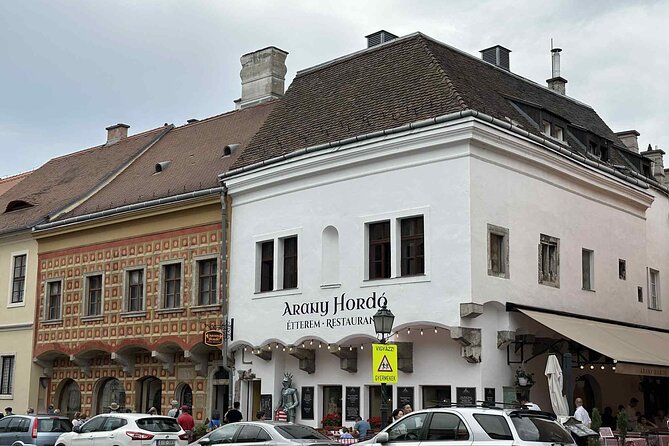
Országház Street was once called Italian Street. Italian merchants lived and worked here during the 14th and 15th centuries, adding an international note to Buda’s commercial life. The street also contains the Castle District’s only surviving 16th-century sgraffito decoration, a delicate Renaissance surface treatment among older Gothic structures.
This is where the tour’s architectural approach pays off. You begin to see Buda not as an isolated Hungarian court, but as a city shaped by trade, migration, and links with other parts of Europe.
A few more architecture walks in the world worth a look
- Chicago Architecture River Cruise
★ 5.0 · 15,756 reviews - Chicago River 90-Minute Architecture Tour
★ 4.5 · 9,629 reviews - Chicago River: 1.5-Hour Guided Architecture Cruise
★ 4.8 · 8,046 reviews - Chicago Architecture Center River Cruise aboard First Lady
★ 5.0 · 5,536 reviews
Neo-Gothic power and Matthias Church
The former Royal Hungarian Ministry of Finance is a striking Neo-Gothic building near the heart of the district. It was built in the early 20th century, and several medieval structures were removed to make room for it. World War II caused major damage, followed by a simplified postwar façade.
In recent years, much of the original façade was reconstructed. The work restored the building’s ornate appearance, but it also caused debate because part of an original wing was demolished. This is a useful reminder that heritage work is not always a clean victory. Preserving the past can involve difficult choices.
The tour then reaches the Church of the Assumption of the Buda Castle, commonly called Matthias Church. The official name is worth remembering, especially if you care about the church’s original role. It was built for Buda’s German-speaking community and reflects the changing religious and cultural makeup of the hill.
You spend only a few minutes at the church, and the interior admission is not included. If the patterned roof, stained glass, and interior history are high on your list, return independently after the tour. The walk gives you the setting and background, but it is not a substitute for an interior visit.
Printing, inns, and the old gate at Fortuna Street
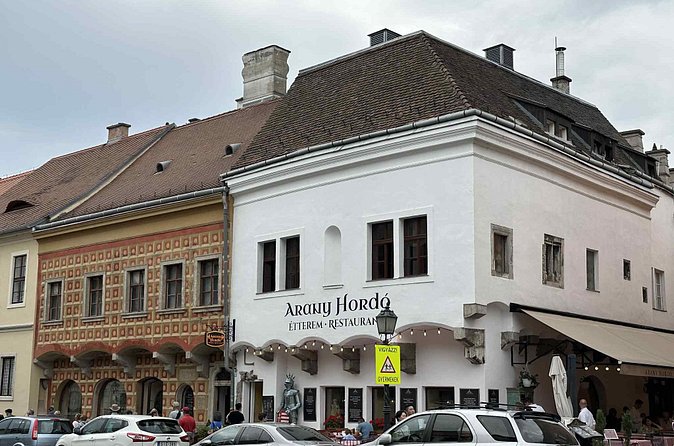
Fortuna Street is now associated with restaurants, but its medieval past was more aristocratic and innovative. In the 1470s, Andreas Hess, a German-born printer, produced Hungary’s first printed book here, the Chronica Hungarorum.
The street was also near the Red Hedgehog Inn, known in Hungarian as Vörös Sün. For centuries, it served as a meeting place for people passing through Buda. The contrast is appealing: printing presses and noble houses in the past, restaurant tables and wine glasses today.
At Becsi Kapu Square, the emphasis turns to public life. The square functioned as a marketplace and a principal entrance to medieval Buda. Hungarian townspeople and members of the local Jewish community met here to trade, talk, and worship.
The stop is short, but it helps connect the district’s buildings to the people who used them. A castle town was not only a royal stage. It was also a working community.
Archives, siege walls, and the fall of Buda
The National Archives of Hungary looks older than it is. Built in the early 20th century in a Neo-Romanesque style, it was designed to echo the medieval character of the district. Heavy stonework and arched windows give it the appearance of a much older institution.
Its purpose adds another layer. The building holds documents spanning Hungary’s written past, making it both an architectural imitation and a place devoted to national memory.
Along the outer walls, the tour reaches the story of the Siege of Buda in 1686. The route passes the place where Christian allied forces first breached the walls. Nearby is a memorial connected with Arnavut Abdurrahman Abdi Pasha, the Ottoman Pasha of Buda who died in the battle.
This section puts the city’s destruction into physical context. Siege history can feel abstract in a museum display, but wall breaches, slopes, and defensive positions help you understand why the Castle District changed so violently.
The medieval Jewish quarter and prayer house
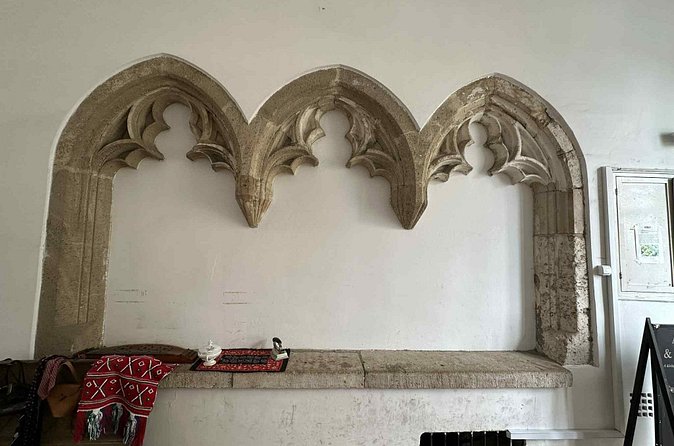
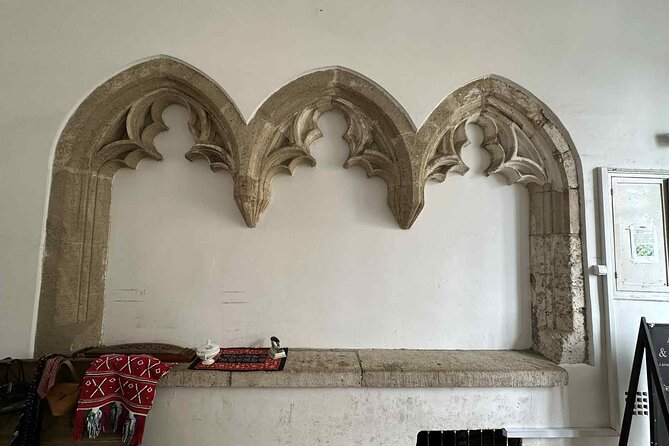
The medieval Jewish quarter is one of the most meaningful parts of the route. The tour pauses at the former Gothic synagogue site, then enters an excavated medieval Jewish prayer house.
The space is modest, but that is part of its force. It gives you a direct link to a community that lived, worshipped, and worked within the castle walls. Much of that world was later destroyed or silenced, so the surviving prayer house carries unusual weight.
Entrance to the prayer house is included. It is closed on Saturdays and Mondays, so check the day before booking. This is the one included interior that gives the tour a particularly strong sense of place.
Rebuilt streets and a Dominican monastery
On Táncsics Mihály Street, medieval walls and cellars survive inside later Baroque and residential buildings. The older structures were reused instead of fully cleared away. That makes the street a lesson in urban survival: post-Ottoman Buda rebuilt itself on top of its earlier city.
At Dominikánus Udvar, you see the remains of the Dominican monastery of Saint Nicholas. The Dominican order is linked with Friar Julianus, who set out on a notable 13th-century journey. The monastery ruins also show how religious sites changed after fire, siege, neglect, and modern redevelopment.
The Hilton Hotel was built around and alongside the ruins in the 20th century. The result is a noticeable meeting of medieval stone and modern architecture. Some people will find the contrast fascinating. Others may prefer a cleaner separation between old and new. Either way, it raises a real question about how a living city should handle fragile remains.
Fisherman’s Bastion and the practical finish
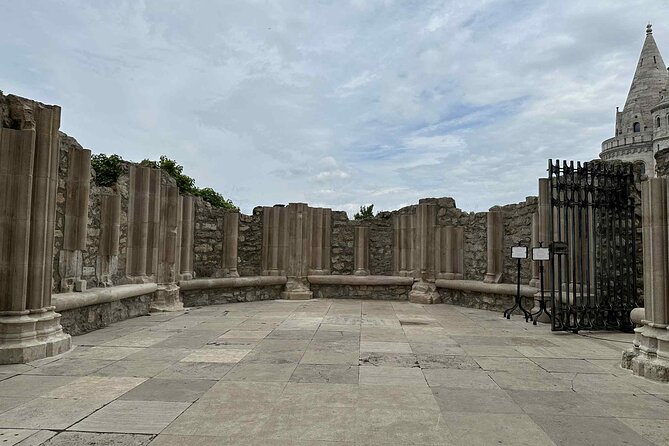
The walk ends at Fisherman’s Bastion, beside Matthias Church in Szentháromság Square. The main level and the statue of King Saint Stephen are included in the outdoor visit.
The upper panoramic terrace is not included. You can buy access separately on site if you want the higher views. This is a small but important cost detail, especially if you are comparing the tour price with a sightseeing pass or planning a full afternoon in the district.
The ending is convenient. You can continue around the square, visit Matthias Church independently, or explore the nearby sights at your own pace. The tour does not return you to the starting point, so allow for that when planning the rest of your day.
Is $43.25 a fair price?
At $43.25 per person, the tour is not the cheapest way to see Buda Castle. It is also not priced like a simple orientation walk. You receive about three and a half hours with a licensed English-speaking guide, a small group capped at 12, and admission to the medieval Jewish prayer house.
The value comes from interpretation. You are paying to understand foundations, reused walls, demolished churches, and competing architectural styles. If you only want exterior photos, you can explore the district on your own for less.
The price is easier to justify if you are interested in history or architecture and want to ask questions along the way. It is less compelling if you plan to spend most of your time inside the Royal Palace or Matthias Church, since both require separate admission.
The tour is offered in English and usually sells well in advance, with bookings averaging about 44 days ahead. That suggests you should reserve early if your Budapest dates are fixed, especially because the group is small.
Who should book this Buda Castle walk?
I would choose this tour if you want the Castle District explained through its streets, archaeology, and changing communities. It suits adults and children aged 10 and over who can manage a long walk and are interested in more than the main photo stops.
It is a good fit for:
- First-time visitors who want a clear framework for Buda Castle.
- Architecture fans who enjoy comparing Gothic, Baroque, Neo-Gothic, and Neo-Romanesque work.
- History-minded visitors interested in medieval trade, religious life, Ottoman rule, and the 1686 siege.
- Solo visitors who want a small group and a guide who can answer questions.
- Anyone who plans to visit Matthias Church or the Royal Palace separately and wants background first.
It is not a good fit if you have limited mobility, dislike extended outdoor walks, or expect a tour inside the Royal Palace. Children under 10 are not permitted.
Free cancellation is available up to 24 hours before the start time. Poor weather or failure to meet the minimum group size can lead to a new date or a full refund.
Should you book it?
Book it if you want to understand why Buda Castle feels less like one monument and more like a city built in layers. The medieval streets, Jewish prayer house, siege walls, and reused ruins give the tour a purpose beyond sightseeing.
Skip it if your main goal is an interior tour of Matthias Church or the Royal Palace. In that case, use the tour only if you want historical context, then budget extra time and money for those buildings afterward.
For most history and architecture fans, the small group, strong archaeological focus, and guide-led storytelling make the $43.25 worthwhile. Just wear comfortable shoes, check the prayer house schedule, and remember that the best parts of Buda Castle are often found in the fragments between the famous landmarks.
FAQ
How long does the Buda Castle Tour last?
The tour lasts approximately 3 hours and 30 minutes.
What language is the tour offered in?
The tour is offered in English with an officially licensed English-speaking guide.
Where does the tour begin?
The tour begins at the Statue of Prince Eugene of Savoy in Budapest.
Where does the tour end?
It ends at Szentháromság Square beside Matthias Church.
Is admission to Matthias Church included?
No. Admission to the interior of Matthias Church is not included. You may visit independently after the tour.
Is the Royal Palace interior included?
No. The tour visits the Royal Palace area, but admission to the interior is not included.
Is Fisherman’s Bastion included?
The tour includes the main level and exterior views of Fisherman’s Bastion. The upper panoramic terrace requires a separate ticket.
Is the medieval Jewish prayer house included?
Yes. Admission is included, but the prayer house is closed on Saturdays and Mondays.
Newly added in the world
- Venice Art and Architecture Private Walking Tour★ 4.5 · 11 reviews
- Basilica San Marco and the Pala d’Oro with Architect Guide★ 4.5 · 19 reviews
- Walking tour in Venice with an architect★ 5.0 · 16 reviews
- Lisbon Contemporary Architecture★ 5.0 · 3 reviews
- Private Munich Tour for History Buffs with Architectural Gems and WWII sites★ 5.0 · 3 reviews
- Neoclassical Paris Architecture 2-Hour Private Walking Tour★ 5.0 · 7 reviews
- Street Art and Architecture:Porto Speaks Through Its Streets★ 3.0 · 2 reviews
- Wrocław Architecture Cruise by Catamaran★ 4.7 · 25 reviews
Historical Tours, compared.
Chicago in a Day: Food, History & Architecture Walking Tour
Read our review →
Charleston’s Best Highlights: History, Culture & Architecture
Read our review →
Palm Springs Modernism Architecture & History Bike Tour
Read our review →
Historic Georgetown: History, Gossip, & Architecture Walking Tour
Read our review →
Charleston History, Homes, and Architecture Guided Walking Tour
Read our review →

Historical and Architectural Chicago Fireboat River & Lake Cruise
Read our review →Browse the lists this tour appears in