
Review · GUIDED
Copenhagen Architecture and Sustainability Tour with local Guide
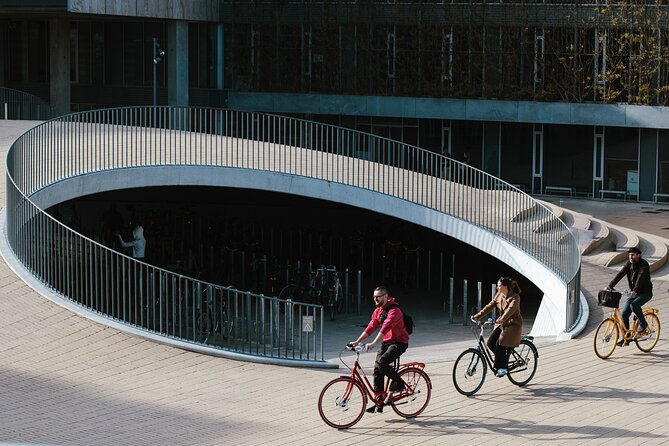
Copenhagen’s best city story may be told from a bicycle seat. This three-hour ride links modern buildings, former industrial land, harbor baths, green spaces, and cycle bridges into one clear picture of how the city is changing. It is not just a sightseeing loop. It is a look at urban design in daily use.
I like the way the route gets beyond the usual center, and I like the social side of the stops, especially Tietgen Residence Hall and Folkehuset Absalon. The small group, capped at 15, also gives the guide room to explain things without turning the ride into a moving lecture.
The main consideration is the physical side. You will cycle about 11 kilometers between stops, often on city roads, and the tour needs decent weather. A few central harbor areas can be packed in summer, so confident bike handling matters.
Key points to know before you book
- A city-development tour on two wheels: See how Copenhagen has reused its harbor, military land, old defenses, and industrial districts.
- About 11 kilometers of riding: The stops are short, but cycling between them takes about 65 minutes in total.
- A small English-speaking group: The maximum is 15 people, with local guides such as Jörn and Julia leading the ride.
- Strong focus on everyday sustainability: Expect discussion of shared housing, rain control, public swimming, clean transport, and reclaimed nature.
- Standard bike included: Helmets are free on request, while baskets, phone holders, e-bikes, cargo bikes, and child seats cost extra.
- Good value for active visitors: At $72.57 per person, you get a three-hour guided ride with a bike and many parts of Copenhagen that are easy to miss on foot.
Why this Copenhagen bike tour is different
Many city bike tours concentrate on palaces, old streets, and famous statues. This one uses architecture and public spaces to explain modern Copenhagen. You see what happens when a former harbor becomes a recreation area, when an old defense moat becomes a park, and when a waterlogged city redesigns a public garden to handle sudden rain.
That gives the ride a useful focus. You are not simply collecting photographs. You are seeing how design affects housing, transport, leisure, and climate planning.
The route also covers more ground than a walking tour. You begin at Vester Voldgade 2 and return there after visiting sites spread across several parts of the city. The pace is broken into short stops, usually five to 15 minutes, so you are rarely asked to stand still for long.
The tour is offered in English. The guides named in the tour’s public feedback include Jörn, praised for explaining recent city development clearly, and Julia, whose tour was described as especially interesting and lively. Guide quality always depends on the person leading your departure, but those details suggest that the human explanation is a central part of the experience.
More Guided Tours in the world:
- Chicago River: 1.5-Hour Guided Architecture Cruise
★ 4.8 · 8,046 reviews - Charleston: History and Architecture Guided Walking Tour
★ 4.8 · 349 reviews - Vienna: Spanish Riding School Guided Architectural Tour
★ 4.8 · 333 reviews
From Blox to Lille Langebro: Copenhagen opens toward the harbor
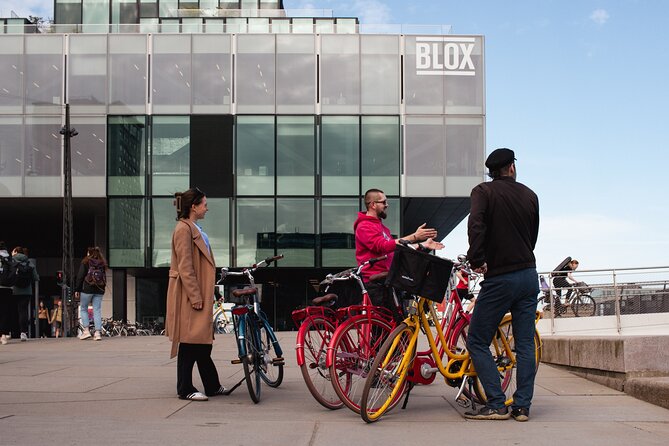
The first stop is Blox, a mixed-use building beside the harbor. Its design looks at sustainability in two ways: technical performance and social use. The building’s best-known tenant is the Danish Architecture Center, which hosts changing exhibitions about Copenhagen architecture.
You only have about 10 minutes here, so this is an introduction rather than a full museum visit. If a particular exhibition interests you, plan a separate visit another time. The value of the stop is that it sets up the tour’s main question: how should a modern city build for people, not just for traffic or offices?
A short ride brings you to Lille Langebro. This bridge carries pedestrians and cyclists across the harbor and belongs to a newer family of crossings that has helped turn the old merchant and naval harbor into a place for public life.
The bridge is a quick stop, but it makes the city’s transport priorities visible. Copenhagen’s harbor is no longer treated only as a working waterway. It is also a route for people on foot and on bikes. In busy summer periods, the harbor area can feel crowded, especially around the first stops. Keep that in mind if you prefer quieter riding.
Islands Brygge and Tietgen Residence Hall: public water and shared living
At Havnebadet Islands Brygge, you see a public swimming facility that changed how Copenhageners relate to the harbor. When the harbor bath opened in 2003, swimming in the city’s central water became part of everyday recreation.
The stop takes around 10 minutes. You are not given a swim session as part of the tour, but the site explains a major shift in the city: water that was once linked mainly to trade and industry became a place for exercise and leisure.
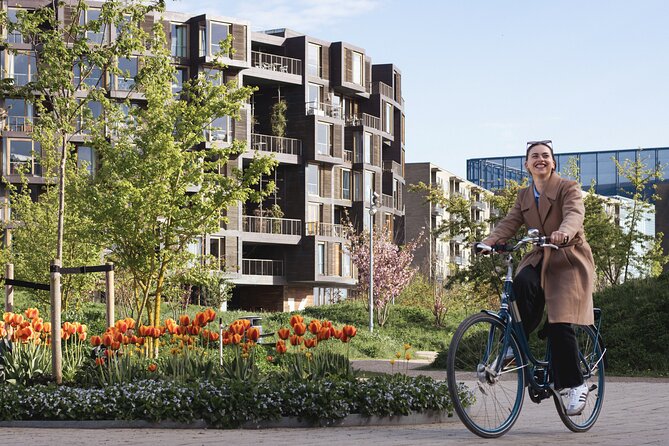
The next stop, Tietgen Residence Hall, gives the tour a more intimate angle. The circular building houses about 400 residents and is designed around a balance between private rooms and shared facilities. Individual rooms are compact and include a washroom, while kitchens, living rooms, and other amenities are shared by groups of residents or the whole building.
I find this one of the most useful stops because it gives social sustainability a real shape. You can see how a building might support privacy while encouraging people to meet. The tradeoff is clear too: shared living requires residents to accept smaller private spaces and common routines.
DR Koncerthuset and Amager Fælled: culture beside reclaimed nature
DR Koncerthuset provides a change of mood. The complex includes a concert hall with 1,800 seats, smaller stages, and recording studios. It is home to the Royal Symphony Orchestra.
The stop is brief, about 10 minutes, so you will mainly consider the building from the outside and hear how it fits into the city’s cultural infrastructure. It is a reminder that sustainable city planning is not only about bikes and parks. A livable city also needs places for music, performance, and shared events.
From there, the ride reaches Amager Fælled. This open area has an unusual past. It served as military training ground and shooting range from the 1700s until the 1950s, then became a dump. Copenhageners’ old nickname for Amager, lorteøen, or shit island, reflects that less-than-glamorous history.
Today, Amager Fælled offers a rare stretch of relatively untouched nature within Copenhagen, much of it on land reclaimed artificially. That tension makes the stop worthwhile. The area is not a pristine wilderness story. It is an example of a city carrying old industrial and military uses into a new role.
You spend about 15 minutes here, the longest stop on the route. Still, do not expect a long nature walk. This is a cycling tour, and the main point is to understand the area’s place in Copenhagen’s growth and environmental planning.
A few more architecture walks in the world worth a look
- Chicago Architecture River Cruise
★ 5.0 · 15,756 reviews - Chicago River 90-Minute Architecture Tour
★ 4.5 · 9,629 reviews - Chicago Architecture Center River Cruise aboard First Lady
★ 5.0 · 5,536 reviews - Chicago: Architecture River Cruise Skip-the-Ticket Line
★ 4.8 · 4,325 reviews
Cykelslangen and Enghave Park: practical design at street level
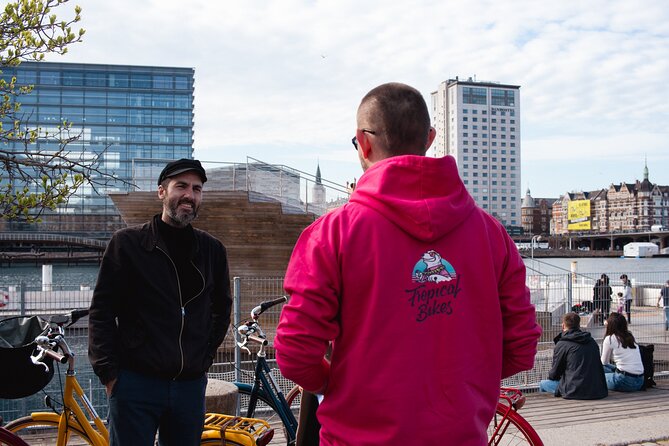
Cykelslangen is one of the tour’s clearest symbols. Together with Bryggebroen, it formed the first new harbor crossings built exclusively for cyclists. The elevated cycle bridge helps riders move through a busy part of the city without being forced into the same space as cars or pedestrians.
You will spend about 10 minutes here. The bridge is also a reminder that cycling infrastructure works best when it is designed as a connected network. A single bike lane helps. A route that carries you smoothly across obstacles is much better.
Enghave Park brings the discussion back to older public space. Built in the late 1920s on former allotment gardens, it was laid out in a neoclassical style with a bandstand, playground, and sports fields. Between 2017 and 2019, it received a major redesign.
The reason for that redesign is practical: the park now helps manage torrential rain. Instead of treating heavy downpours as a problem that can be pushed out of sight through pipes, the park plays a role in holding and directing water.
This stop is especially useful if you want to understand climate planning without visiting a technical facility. The park still serves ordinary purposes, including play and sports, while also working as part of the city’s water system. You get about 10 minutes here, enough for the guide to explain the idea and point out the public features.
Absalon and Kødbyen: community life in reused buildings
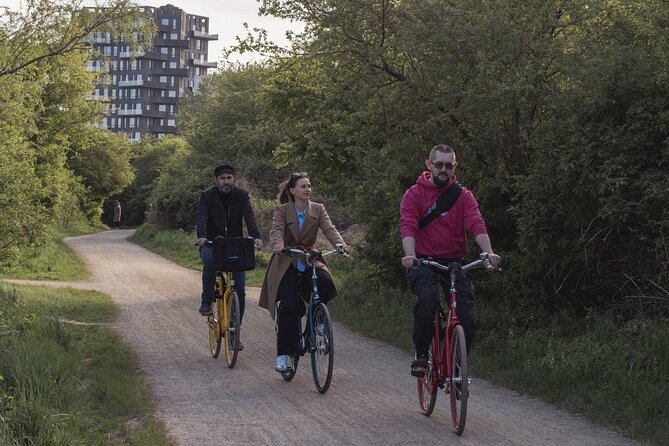
Folkehuset Absalon occupies a former church that has been converted into a privately run community center. It is a compact stop, lasting about five minutes, but it adds a human scale to the tour.
The building shows how an old religious space can take on a new public role. Instead of preserving the structure only as a monument, Copenhagen gives it another use connected to community life. You may find this stop more interesting if you pay attention to how the building’s original purpose has been adapted rather than erased.
The ride then continues to the Meatpacking District, known in Danish as Kødbyen. The district was planned by the city to provide more sanitary and healthier conditions for the meat trade as Copenhagen grew. It expanded through several additions, creating a large record of industrial architecture from the 19th and 20th centuries.
Kødbyen is now better known for food, nightlife, and creative businesses, but the tour keeps your attention on its original urban purpose and changing architecture. The stop lasts about 10 minutes. It is a good place to compare the strict needs of industry with the looser public uses that came later.
The district also helps connect the tour’s themes. Reuse is not limited to old churches or military land. Industrial buildings can change purpose too, keeping parts of the city’s physical memory while serving new needs.
Israel’s Square and Ørstedsparken: food, defenses, and public space
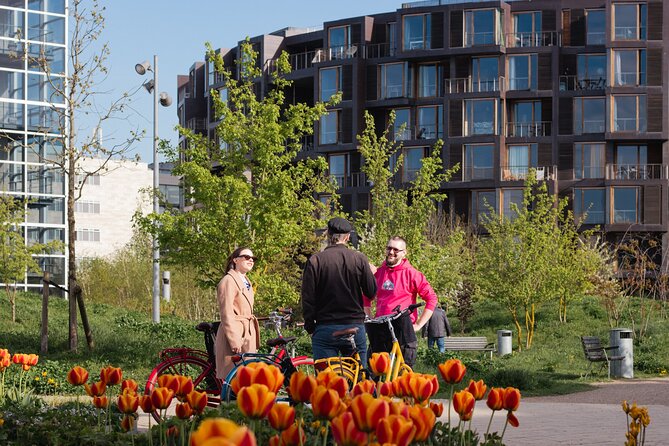
Israel’s Square, beside Torvehallerne, is now a meeting place for Copenhagen’s food crowd. Its past is less polished. A farmers’ market occupied the area from the 1890s until the 1950s, after the old walled city’s strict building restrictions ended. Later, the site became a huge parking lot.
That shift tells a familiar urban story: a public market, then a car-dominated space, then a renewed gathering place. The stop takes about 10 minutes, and its connection to Torvehallerne makes it a useful place to return for food after the tour, though buying food is not included.
Ørstedsparken offers a final lesson in reuse. The park was once part of Copenhagen’s defenses outside the city walls. After the walls were removed, the area became a public park, with parts of the old moat retained as a lake.
The result is a park with dramatic hills, crooked paths, and a shape determined partly by military history. It is a pleasant example of how old infrastructure can gain a second life. You spend about 10 minutes here before the ride returns to the starting point.
Time, effort, and what the $72.57 price buys
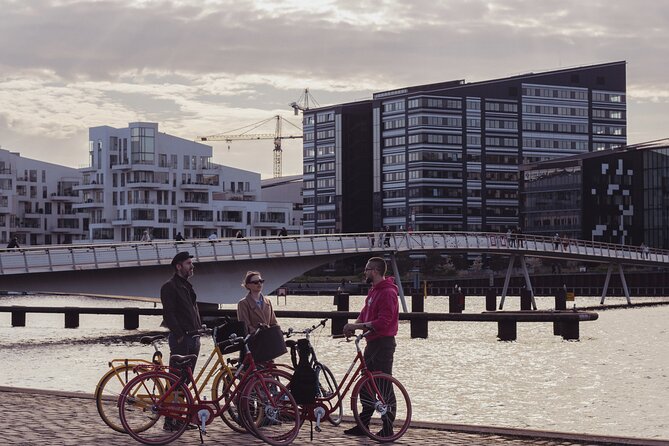
The tour lasts about three hours. Roughly 65 minutes are spent cycling between locations, with about 11 kilometers of riding in total. The remaining time is divided among 12 stops, from five-minute bridge and community-center visits to the longer 15-minute stop at Amager Fælled.
At $72.57 per person, this is not the cheapest way to rent a bike in Copenhagen. The value comes from the route and the explanation. You get a bicycle, a local guide, a planned sequence of sites, and access to a city story that would be difficult to assemble on your own in three hours.
The maximum group size of 15 is important. It keeps the ride smaller than a large coach-style excursion and should make it easier to hear the guide at stops. It does not mean the ride will always feel private, especially in crowded harbor areas.
A standard bike is included. Children’s bikes in different sizes may be available, but you need to contact the operator about availability. Helmets are free upon request. Phone holders and baskets cost 49 DKK each.
Upgrades cost extra: an e-bike is 249 DKK, a cargo bike or tandem is 449 DKK, an e-cargo bike is 649 DKK, and a child seat is 119 DKK. Reserve special bikes in advance. If you are comfortable on a normal bicycle, the included bike should be enough. If you need electric assistance or a child seat, factor that into the total price before booking.
Who should book this ride
I would choose this tour if you have already seen Copenhagen’s old center or want a second look at the city beyond the standard sights. It suits visitors interested in architecture, public planning, cycling, housing, parks, and practical responses to heavy rain.
It is also a good choice for a short visit. In three hours, you cover a wide area and get a useful orientation to districts you might not reach on foot.
You should be comfortable cycling in a city and able to manage a moderate level of physical activity. The route is not described as a hard workout, but the distance, traffic, stops, and weather all matter. Ask for a helmet if you want one, and consider reserving an e-bike if that would make the ride easier.
The tour requires good weather. If conditions are poor, the operator may offer another date or a full refund. You can cancel for a full refund up to 24 hours before the start time, but changes or cancellations inside that window are not accepted. A minimum number of participants is also required.
Should you book the Copenhagen Architecture and Sustainability Tour?
Book it if you want Copenhagen explained through its modern buildings and public spaces rather than only its historic center. The route is broad, the subject is focused, and the small group gives the guide a chance to add context.
Skip it if you want a slow architectural walking tour, a museum visit, or a relaxed ride with very little cycling. This is an active outing with about 11 kilometers on the bike.
For most visitors who are comfortable riding, the price is reasonable for a guided three-hour route that includes the bicycle and reaches harbor bridges, shared housing, reclaimed nature, industrial districts, and rain-management parks. It is a practical way to see how Copenhagen works, not just how it looks.
FAQ
How long does the Copenhagen Architecture and Sustainability Tour last?
The tour lasts approximately three hours, including cycling between the stops.
How much cycling is involved?
You will cycle roughly 11 kilometers between locations. About 65 minutes of the tour is spent riding from one stop to the next.
What language is the tour offered in?
The tour is offered in English.
What is included in the tour price?
The price includes use of a bicycle and a local guide. Toilets are available at the store, and bike helmets are free upon request.
Are children’s bikes available?
Children’s bikes in different sizes may be available. You should contact the operator to check availability before booking.
Are baskets and phone holders included?
No. Bike extras such as baskets and phone holders cost 49 DKK per item.
Where does the tour start and finish?
The tour starts at Vester Voldgade 2, 1552 København, Denmark, and returns to the same meeting point.
What happens if the weather is poor?
The experience requires good weather. If it is canceled because of poor conditions, you will be offered a different date or a full refund.
Newly added in the world
- Venice Art and Architecture Private Walking Tour★ 4.5 · 11 reviews
- Basilica San Marco and the Pala d’Oro with Architect Guide★ 4.5 · 19 reviews
- Walking tour in Venice with an architect★ 5.0 · 16 reviews
- Private Munich Tour for History Buffs with Architectural Gems and WWII sites★ 5.0 · 3 reviews
- Neoclassical Paris Architecture 2-Hour Private Walking Tour★ 5.0 · 7 reviews
- Street Art and Architecture:Porto Speaks Through Its Streets★ 3.0 · 2 reviews
- Wrocław Architecture Cruise by Catamaran★ 4.7 · 25 reviews
- Paris: Discover the hidden architecture gems of Le Marais★ 3.8 · 4 reviews
Guided, compared.

Chicago River: 1.5-Hour Guided Architecture Cruise
Read our review →
Park Güell: Guided Tour with Optional Gaudí Experience Entry
Read our review →
Vienna: Spanish Riding School Guided Architectural Tour
Read our review →
Charleston History, Homes, and Architecture Guided Walking Tour
Read our review →
Casa Vicens, Pedrera, and Casa Batlló Guided Tour
Read our review →Browse the lists this tour appears in