
Review · HISTORICAL TOURS
Private Taxi Tour City East & West History and Architecture 3-4h
Berlin makes more sense when you see its two halves together. This private taxi tour links the polished streets of former West Berlin with the Prussian heart, Nazi sites, Cold War landmarks, and rebuilt squares of the former East. You stay in a warm, air-conditioned vehicle for much of the ride, then step out for short walks and photos.
I like the door-to-door pickup within the S-Bahn ring, especially if you are traveling with older relatives or children. I also like Gunter Bauer’s personal approach: he asks about your interests, explains the city in fluent English, and has taken photos for guests to send afterward. The main drawback is pace. Three to four hours can show you a great deal, but it cannot give every major site the time it deserves.
Key points to know before booking
- Private vehicle and private guide: Only your group takes part, with Gunter Bauer serving as both driver and guide.
- A useful Berlin overview: The route covers West Berlin, the former East, government buildings, museums, Wall history, and old city quarters.
- Pickup included in the S-Bahn ring: Hotel or apartment pickup is included there, while airport and outer-city pickup costs extra.
- Strong choice in poor weather: Heated taxi time makes this practical in winter, rain, or for anyone who tires easily.
- Short stops, not long museum visits: You will see many major places, but most stops are brief photo opportunities or outdoor explanations.
- Flexible and family-friendly: Group discounts, child seats, service animals, and an English-language tour are available.
Why a private taxi works so well in Berlin
Berlin is spread out. The Brandenburg Gate, Ku’damm, Checkpoint Charlie, the Reichstag, East Side neighborhoods, and the Tiergarten do not sit in one tidy historic center. You can connect them by public transport, but each transfer costs time and each station adds another layer of navigation.
A private taxi changes the rhythm. Gunter can explain the city while driving, then stop when a building or square deserves a closer look. You get a broad introduction without spending half the morning finding platforms and deciphering signs.
This is not a formal walking tour with a fixed script. The experience is built around conversation, driving, and short visits. Gunter has been praised for answering questions, adjusting the focus to a group’s interests, and helping older passengers stay comfortable. One particularly useful detail is his habit of asking ahead of time what you want to see.
The route also works well for mixed-age groups. A teenager may lose interest during a long museum visit, but a taxi ride broken up by the Brandenburg Gate, Checkpoint Charlie, and other quick stops is easier to manage. Adults can keep asking questions while younger travelers get regular changes of scene.
More History Walks in the world:
- Chicago in a Day: Food, History & Architecture Walking Tour
★ 5.0 · 1,153 reviews - Charleston’s Best Highlights: History, Culture & Architecture
★ 5.0 · 422 reviews - Palm Springs Modernism Architecture & History Bike Tour
★ 5.0 · 359 reviews
West Berlin begins at the Kaiser Wilhelm Memorial Church
The western part of the route introduces the city through the Kaiser Wilhelm Memorial Church at Breitscheidplatz. The damaged tower and preserved entrance portal recall the Second World War, but the original church was built as a memorial to Wilhelm I, the first German emperor.
That distinction matters. The site is not simply a war monument. Its old entrance contains religious figures whose faces resemble Prussian rulers and emperors, linking the building to the power and ceremony of imperial Germany.
The modern church beside the ruined tower was designed by Egon Eiermann. Berliners gave the two buildings playful nicknames based on their shapes, a common local habit of making stern architecture feel less solemn. Inside the modern church, thousands of blue glass blocks create a quiet blue light. The double-wall construction also muffles the noise from the busy square outside.
The tour then moves past Berlin Zoological Garden, one of Germany’s oldest zoos. From the road, the elephant gate and lion gate are the main sights. You will not have time for a zoo visit, but the stop helps explain how Berlin’s western center grew around the park and the old Zoo station.
Nearby, the Theater des Westens recalls the early twentieth-century movement of Berlin’s wealthy residents toward the greener western districts. Its ornate exterior can look almost overdone, but that is part of the point. The theater was built to display prosperity, and its imperial box still reflects that world.
Ku’damm, Tauentzien, and Berlin’s shopping face

Kantstrasse leads toward Kurfürstendamm, usually shortened to Ku’damm. The boulevard was planned in part as Berlin’s answer to the Champs-Élysées. Its full length runs for nearly five kilometers toward Halensee, though this tour shows only a section.
Ku’damm once mixed grand villas, cafés, cinemas, and nightlife. Today, the emphasis is shopping. Farther west you find luxury names such as Versace, Bulgari, and Dolce & Gabbana, while flagship stores and large commercial buildings fill the central stretch.
The nearby Tauentzien adds a more accessible shopping strip and ends at Kaufhaus des Westens, better known as KaDeWe. The department store covers about 60,000 square meters and is one of Berlin’s most famous retail landmarks. You can step inside for a quick look, but the gourmet floor is the real draw, with bread, cheese, chocolate, oysters, and champagne.
I would treat KaDeWe as a short optional stop, not the reason to book the tour. Its value is that it shows the consumer culture of West Berlin and gives you a chance to stretch your legs. If shopping is not your interest, use that time for questions or photos around Breitscheidplatz.
Tiergarten, Urania, and the Pregnant Oyster
The route continues through parts of former West Berlin that are easy to miss on foot. Wittenbergplatz and the nearby U-Bahn stations reveal how Berlin’s rail lines developed as separate systems and how former city boundaries shaped transport.
At Urania, Gunter explains an organization founded to make science accessible to the public. The area also contains a striking French gift commemorating Berlin’s 750th anniversary. The broad green strip around Lützowplatz reflects an old plan to make Berlin friendlier to cars, with elevated routes cutting through the city. Thankfully, that vision was never fully carried out.
Tiergarten offers a different kind of history. It began as a royal hunting ground, then opened to the public under Frederick the Great. Peter Joseph Lenné later reshaped it into an English-style park, using the Landwehr Canal to drain wet ground and create ponds, paths, and views.
The park was badly damaged in the Second World War. Trees disappeared, and potatoes were planted in parts of the grounds. Replanting with Allied help restored much of the park you see today.
At the House of World Cultures, you will see the curved former congress hall known locally as the Pregnant Oyster. It was an American gift to West Berlin in the 1950s. The roof collapsed in 1980, killing a journalist, but the building was reconstructed and now hosts non-European arts and cultural events.
More Private Tours in the world:
- Best of Chicago: Architecture & Highlights City Private Tour
★ 5.0 · 94 reviews - Private Harajuku Omotesando Architecture Walking Tour
★ 5.0 · 67 reviews - Private Santa Barbara History and Architecture Walking Tour
★ 5.0 · 56 reviews - Private Barcelona Modernism and Gaudí Walking Tour
★ 4.7 · 54 reviews
Government Berlin around the Reichstag
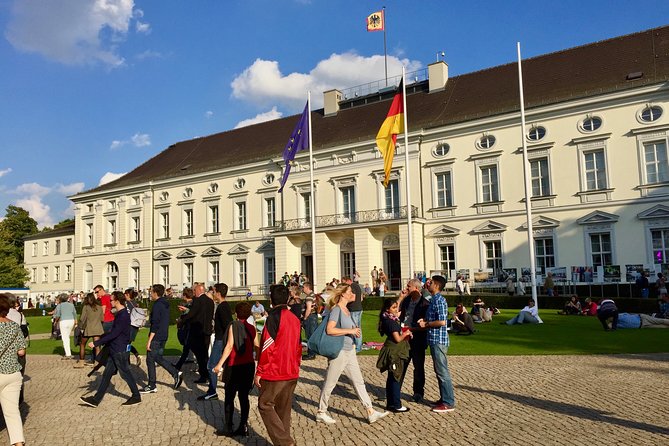
The route then turns toward Bellevue Palace, the official Berlin residence of the Federal President. The small palace was built for August Ferdinand, a younger brother of Frederick the Great, and originally had a view toward Charlottenburg Palace. That view is gone, but the building now represents the federal government’s presence in Berlin.
The nearby Victory Column is a reminder of nineteenth-century German wars. It originally had three sections, celebrating victories over Denmark, Austria, and France. Hitler later moved it from its original position near the Reichstag and added another section. The tour presents the monument in the wider story of German power, militarism, and changing political symbols.
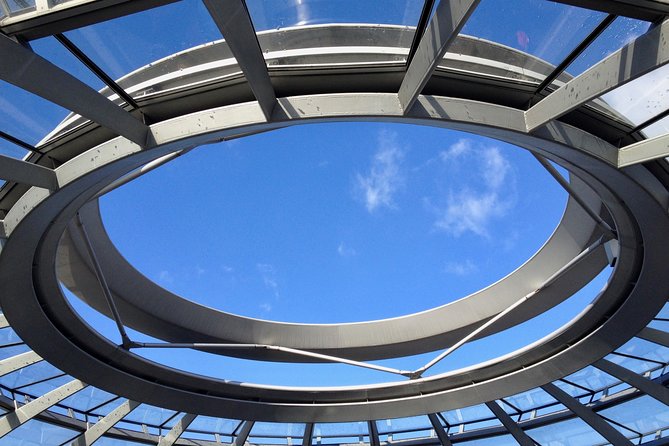
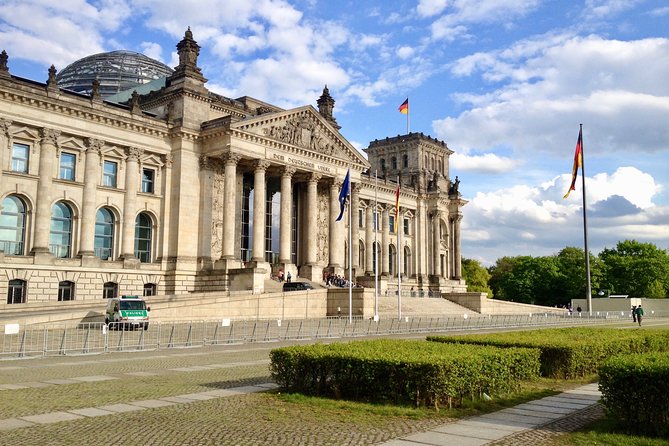
The Reichstag is one of the most important stops. Its grand nineteenth-century shell was damaged in war, ignored during the Cold War because it stood close to the Wall, and later rebuilt for the reunited German parliament. The glass dome now gives the building its modern identity.
You should understand the limits of this visit. The tour lets you see and discuss the Reichstag, but it is not a full parliamentary tour. The nearby Paul-Löbe Building is where much committee work takes place, while the Reichstag chamber is used for major debates and votes. The Chancellery, with its vast office block and large central rotunda, gives you a sense of the scale of modern German government.
Hackesche Höfe and the former East
After crossing into the former East, the Hackesche Höfe provide a pleasant contrast to the government quarter. These Art Nouveau courtyards were built in 1908 as a combined residential and working complex. Small factories, workshops, printing businesses, and homes shared the same blocks.
The courtyards deteriorated during the GDR period and were among the first major areas restored after the Wall fell. Today, shops and small businesses occupy spaces once used by workshops. You may also see Königliche Porzellan-Manufaktur items and the familiar East Berlin Ampelmännchen designs.
This is a short stop, around ten minutes, so think of it as an introduction rather than a shopping expedition. The architecture is the reason to visit. It also offers a glimpse of how Berlin reused old urban blocks instead of treating every historic building as a museum.
Berlin Hauptbahnhof follows, a huge modern station with tracks below and above ground. Its scale reflects the city’s attempt to create a true central rail hub after reunification. The old Berlin system was built around terminal stations serving different directions, so the central station changed the way people move through the city.
Jewish Berlin, Friedrichstrasse, and Unter den Linden
The tour continues through areas tied to Jewish life and Berlin’s nineteenth-century expansion. The New Synagogue’s surviving front building has Moorish design details and a golden dome. The main synagogue was destroyed in the war, but the restored entrance building now contains an exhibition about Jewish life in Berlin.
Security is strict, so do not expect a casual walk-in visit. Allow extra time if you plan to explore the exhibition.
Friedrichstrasse then leads south through one of Berlin’s best-known straight avenues. At Friedrichstrasse station, the Palace of Tears recalls the painful division of the city. During the Wall years, this was the main East Berlin station for rail travel to the West. Families said goodbye here under tight controls, often without knowing when they would meet again.
Unter den Linden offers a different kind of story. The avenue began as a route from the Berlin Palace to the royal hunting grounds. Linden trees eventually won out over the proposed nut trees, giving the street its name. Along the route are Humboldt University, the State Opera, the State Library, and the former royal palaces.
At the Neue Wache, a sculpture by Käthe Kollwitz now commemorates victims of war and tyranny. The building once housed guards for the royal palace. Its quiet interior provides a solemn pause amid the grand avenue.
Brandenburg Gate, Gendarmenmarkt, and Humboldt Forum
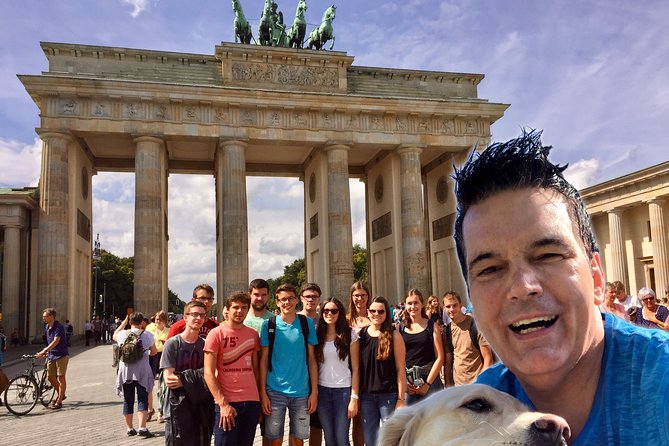
Pariser Platz and the Brandenburg Gate are Berlin’s best-known civic stage. The gate once stood beside a wall and a wide no-man’s land. War damage and postwar division left it isolated, but the surrounding buildings have since been rebuilt in a style that echoes the former square.
You will see the American and French embassies, the Academy of Arts, the Liebermann House, and the Hotel Adlon area. The stop is mainly for orientation and photos, but it also gives Gunter a chance to explain how Berlin turned a symbol of division into a symbol of reunification.
Gendarmenmarkt is another highlight. The German Cathedral, French Cathedral, and concert hall form one of the city’s most graceful squares. Neither cathedral is a bishop’s seat. The French building reflects the presence of Huguenot refugees, while the German building now contains an exhibition on German parliamentary history.
The Humboldt Forum occupies the former site of the Berlin Palace. The palace was damaged in the war and demolished during the GDR era. The newer building reconstructs much of the exterior and the Schlüter courtyard while housing non-European collections and university material inside.
About thirty minutes are allocated here, with admission included. This is one of the tour’s more substantial stops, though you should not expect to see every collection in that time.
Alexanderplatz, Nikolaiviertel, and the old city
Alexanderplatz shows the GDR’s vision of a socialist capital. The broad open space was designed for large public gatherings and framed by modern buildings. The television tower remains the clearest symbol of that period and is still Germany’s tallest building.
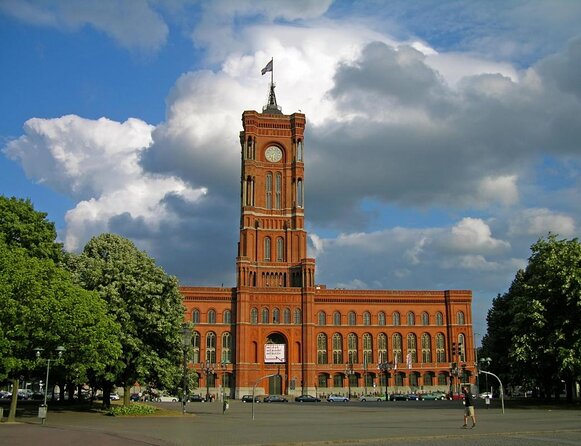
Nearby, the Red City Hall gets its name from its red brick, not from the political party of the mayor. It served East Berlin’s government during the division and remains the city’s main municipal building.
Nikolaiviertel offers a more intimate look at old Berlin. Much of what you see was reconstructed in the 1980s, since wartime destruction left only a few original buildings. The Nikolaikirche, the oldest church in Berlin, now houses a city museum. The Knoblauchhaus preserves a Biedermeier interior and illustrates how a prosperous cloth-making family lived.
The nearby bridge and lock mark the area where Berlin and Cölln grew around a crossing of the Spree. The names and street plan are easier to understand after Gunter explains the medieval settlements, mills, canals, and later rebuilding.
Checkpoint Charlie and the final western sights
Checkpoint Charlie is an important stop, but you should know what you are seeing. The guard hut and sign are replicas, not the original Cold War installations. They remain useful for photographs, but the historical value comes from the explanation of the 1961 tank confrontation between American and Soviet forces.
The Topography of Terror adds much more serious context. The site brings together Nazi institutions, wartime destruction, the former Gestapo and SS headquarters, an open-air display, and a remaining section of the Berlin Wall. The documentation center focuses on Nazi persecution and terror. A short visit can be sobering, so use the time for focused questions rather than trying to absorb every panel.
The tour may also pass the embassies along the Tiergarten, including the Italian, Japanese, Nordic, Indian, South African, Turkish, and Saudi Arabian missions. The buildings reveal how architecture is used to express national identity.
The final route can include the Berlin Aquarium and its unusual sandstone exterior. It is part of the DomAquarée complex, where a large aquarium tunnel and hotel lift create an entertaining piece of modern Berlin. You are not booking a full aquarium visit, but the building adds a lighter finish after the heavier political sites.
Price, comfort, and practical value
At about $150.18 per person, the cost is easiest to justify for a small private group. You are paying for the vehicle, driver, guide, hotel pickup within the S-Bahn ring, parking, WiFi, air conditioning, and a customized route rather than a seat on a large bus.
For one person, the price is high. For a family or group sharing the experience, the private format can be good value, especially if you would otherwise need several taxis and public transport trips. Group discounts may also help.
The tour runs about three to four hours, and the schedule is packed. Wear comfortable shoes for short walks, bring water, and keep your expectations clear: you will see many sights from the vehicle, with selected stops for closer viewing. Gunter has also provided child seats, including a toddler seat and booster, when requested.
Pickup inside the S-Bahn ring is included. BER airport and addresses outside the ring cost extra. You should be outside when Gunter sends the arrival SMS or WhatsApp message.
Free cancellation is available up to 24 hours before the start time. Most people can take part, service animals are allowed, and the tour is offered in English.
Should you book this Berlin taxi tour?
Book it if you want a fast, personal introduction to Berlin and care about connections between imperial Germany, Nazism, the Wall, reunification, and modern city life. It is especially useful for families, older visitors, first-time visitors with limited time, and anyone visiting in cold or wet weather.
Choose something else if you want long museum visits, a slow walking pace, or a tightly focused subject such as Jewish Berlin or the Cold War. The strength here is range. With Gunter Bauer behind the wheel, you can cover much of Berlin in a few hours and leave with a clearer map of the city and ideas for where to return on your own.
FAQ
How long does the private taxi tour last?
The tour lasts approximately three to four hours.
Is hotel pickup included?
Pickup is included from hotels or apartments within Berlin’s S-Bahn ring. Pickup from BER airport or outside the ring costs extra.
Is this a private tour?
Yes. Only your group takes part in the activity.
Is the tour offered in English?
Yes. The experience is offered in English, and Gunter Bauer guides and drives the tour.
What is included in the price?
Private transportation, WiFi, an air-conditioned vehicle, parking fees, pickup within the S-Bahn ring, the taxi fare, the city tour, and admission listed for the Humboldt Forum stop are included.
Is lunch included?
No. Lunch is not included.
Are child seats available?
A toddler seat for children from six months to three years and a booster seat for older children are available. A baby Maxi-Cosi seat can be brought on request.
Can service animals join the tour?
Yes. Service animals are allowed.
Can I cancel for a full refund?
Yes, if you cancel at least 24 hours before the experience start time. Cancellations or changes made less than 24 hours in advance are not refunded.
Newly added in the world
- Barcelona: Guided tour e-bike Barcelona historical and modernist Barcelona★ 4.5 · 5 reviews
- Barcelona Architecture Walking Tour With Casa Batlló Upgrade★ 4.8 · 11 reviews
- Astana: Old City Tour, Imperialistic and Soviet Architecture★ 5.0 · 4 reviews
- Barcelona Beyond Gaudí: Modernism, Rooftops, and Hidden Gems★ 5.0 · 2 reviews
- An Architect’s Tour of Downtown Santiago★ 5.0 · 7 reviews
- Architecture Tour: Old Historic Madrid with an architect★ 4.3 · 3 reviews
- London: Architecture Tour of Benjamin Franklin House★ 5.0 · 5 reviews
- Architectural Wonders of KAFD, An Iconic Destination★ 5.0 · 3 reviews
Historical Tours, compared.
Chicago in a Day: Food, History & Architecture Walking Tour
Read our review →
Charleston’s Best Highlights: History, Culture & Architecture
Read our review →
Palm Springs Modernism Architecture & History Bike Tour
Read our review →
Historic Georgetown: History, Gossip, & Architecture Walking Tour
Read our review →
Charleston History, Homes, and Architecture Guided Walking Tour
Read our review →
Historical and Architectural Chicago Fireboat River & Lake Cruise
Read our review →Browse the lists this tour appears in