
Review · BERLIN ARCHITECTURE TOURS
Berlin: Karl-Marx-Allee Tour of Life and Architecture in GDR
Karl-Marx-Allee is not just a broad Berlin avenue lined with old apartment blocks. It is a political document in stone. On this two-hour walk, you see how East Germany tried to turn housing, shopping, and monumental architecture into proof that socialism worked, then learn how the same street became linked to worker revolt, secret police surveillance, and present-day protests over rising rents.
I like the way this tour connects architecture with daily life, rather than treating the buildings as empty monuments. I also like the route’s clear beginning and end, from U Frankfurter Tor to U Strausberger Platz, plus the chance to see filming locations from The Lives of Others and The Queen’s Gambit.
The main consideration is pace. You cover a lot of political and architectural ground in two hours, with the core guided walk listed as 1.5 hours. Children under 10 cannot join, and the broad avenue may be less appealing if you want a traditional sightseeing tour filled with famous landmarks.
Key points about the Karl-Marx-Allee walk
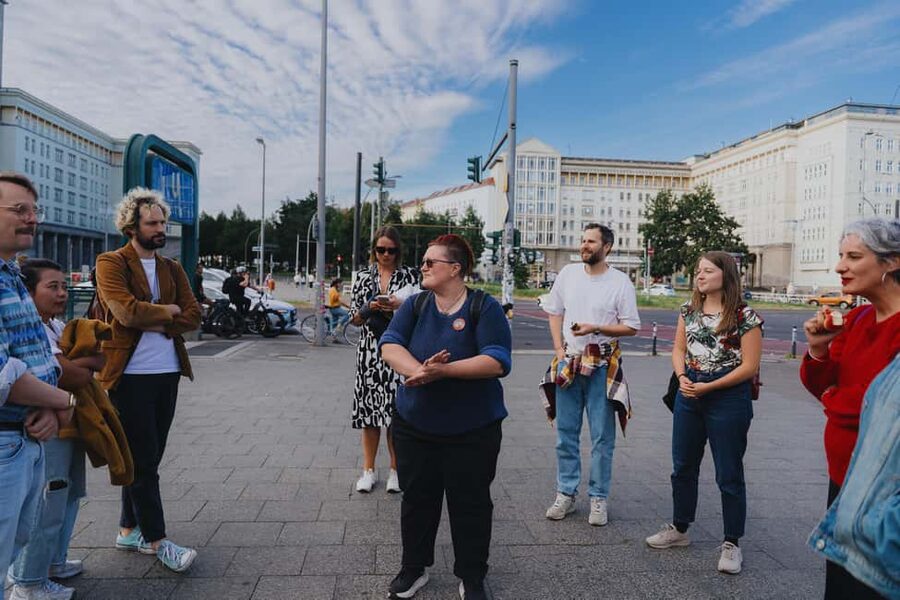
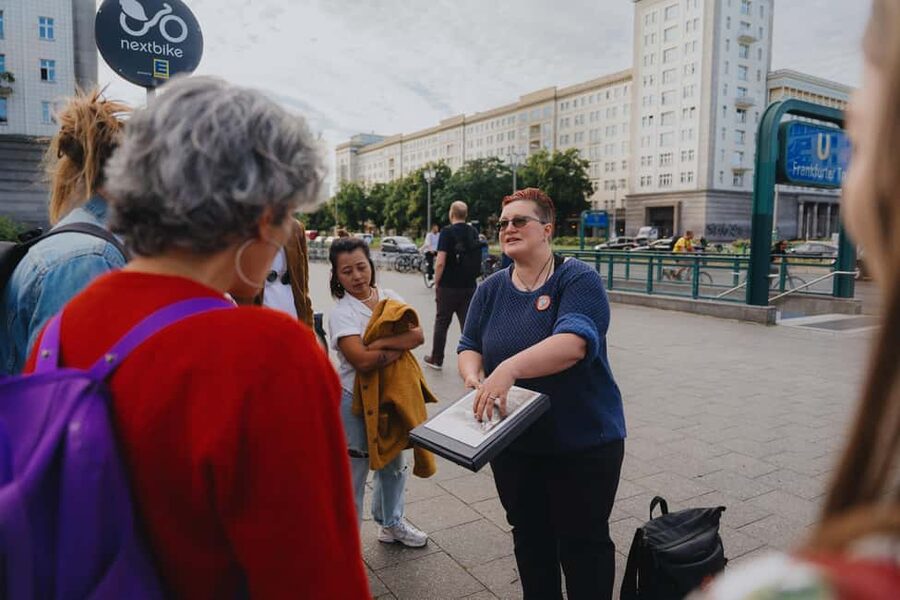
- Start at U Frankfurter Tor: Meet by the southern tower, at the corner of Warschauer Straße and Karl-Marx-Allee, where your guide carries an orange umbrella.
- See socialist classicism up close: The enormous housing blocks were East Germany’s grandest postwar building project.
- Connect buildings to the 1953 uprising: The street’s construction helped trigger a protest that nearly brought down the young government.
- Look beyond the polished facade: Learn how Stasi wiretaps and attic listening stations operated out of sight.
- Trace several architectural periods: The route includes postwar modernism, monumental socialist classicism, and later changes to the street.
- Finish at U Strausberger Platz: The route is simple to follow and ends near public transport.
Why Karl-Marx-Allee tells Berlin’s Cold War story so well
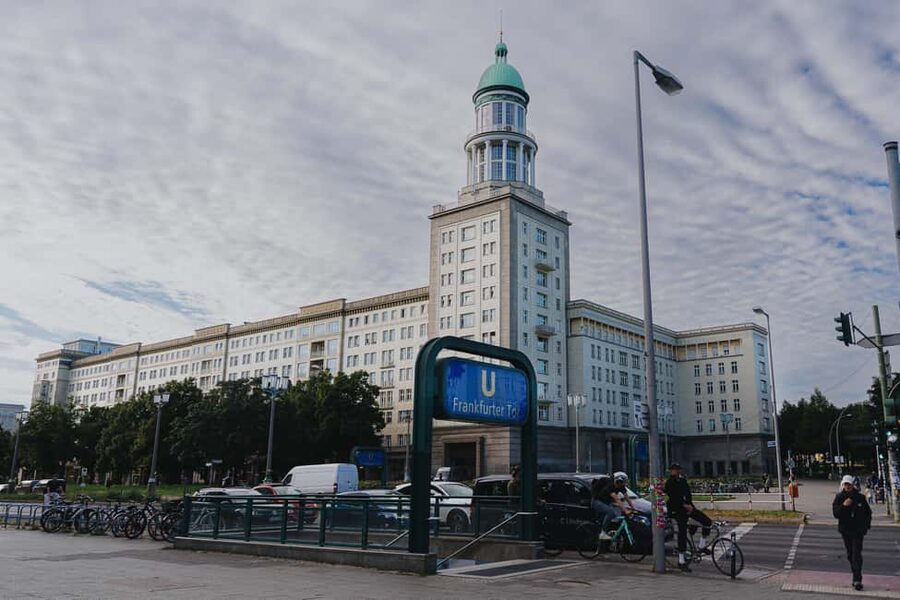
Berlin often teaches its 20th-century history through walls, watchtowers, museums, and memorials. Karl-Marx-Allee offers something different. Here, political history is built into the scale of the street itself.
The avenue was the first socialist street in Germany. After World War II, East Germany treated its reconstruction as a national mission. Thousands of volunteers worked day and night to help rebuild the avenue from the ruins. The result was not modest worker housing. It was a grand statement meant to show that the new socialist state could create order, comfort, and dignity out of destruction.
As you walk, the size of the buildings matters. The housing blocks can make you feel small, and that effect was intentional. The avenue was built for parades and public ceremony as well as ordinary life. Its scale told citizens and foreign observers that the new state had power, resources, and a clear plan.
That is why this walk works best when you pay attention to the relationship between the buildings and the government behind them. You are not simply looking at decorated facades. You are looking at a political message made permanent.
A few more architecture walks in Germany worth a look
- Munich 3-Hour Segway Tour: Nazi Munich & Royal Architecture
★ 4.9 · 194 reviews - Düsseldorf: Guided City Architecture Walking Tour
★ 4.6 · 61 reviews - Hidden Architectural Gems of Munich (Max. 16 guests)
★ 4.9 · 52 reviews
Meeting at Frankfurter Tor and reading the first buildings
The meeting point is outside U Frankfurter Tor, by the southern tower at the corner of Warschauer Straße and Karl-Marx-Allee. Look for the guide with an orange umbrella. This detail matters because the area is large and the meeting point sits at a busy transport junction.
Frankfurter Tor gives you a useful start. The towers and broad avenue immediately show the intended grandeur of the project. From here, your guide introduces the street as a planned showcase of East German socialism, not just another residential road.
The architecture is often called socialist classicism. It uses monumental proportions and decorative details to create a formal, official appearance. The housing was practical, but the design was meant to look far more ceremonial than ordinary apartment construction.
You will also hear about the earlier modernist buildings that came before the grand blocks of the 1950s. Those structures grew from utopian urban ideas formed after Berlin’s wartime destruction. They represent a different hope for the future, one based more on modern planning than on historical-looking grandeur.
That contrast is one of the tour’s best teaching tools. You can see that East German architecture did not develop in one straight line. The regime first accepted modernism, then rejected it in favor of a more imposing style that better suited its political image.
From wartime ruins to a socialist showcase
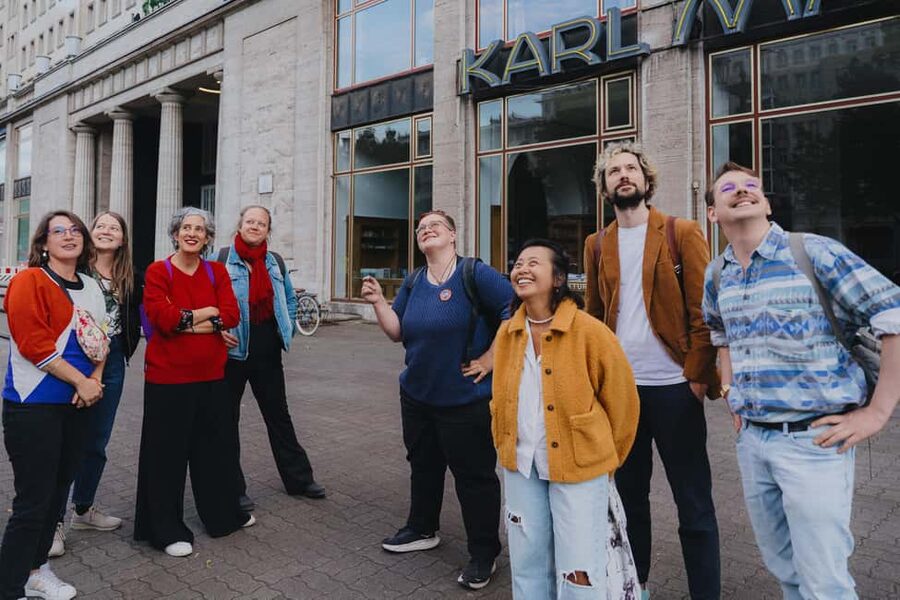
Karl-Marx-Allee was the centerpiece of East Germany’s national reconstruction program. Its construction was meant to solve more than a housing problem. The avenue had to show that socialism could rebuild Berlin and provide a better life for working people.
The street’s apartment blocks were paired with cafes, restaurants, and well-stocked shops. This was important propaganda. The avenue was designed to present an image of comfort and plenty within a socialist system.
Your guide places that promise beside the harder reality of daily life. The attractive facade did not mean that everyone experienced the system as free or prosperous. The avenue projected an ideal version of East German living, while political control remained close at hand.
This is where the walk moves beyond architecture. You start to ask who the street was built for, who was meant to admire it, and what the government wanted people to believe as they passed through it.
The buildings also tell you something about public space. A wide boulevard can support housing and commerce, but it can also host parades and official displays. Karl-Marx-Allee served both purposes. It was a place to live, and it was a stage for the state.
The 1953 uprising and the cost of rebuilding
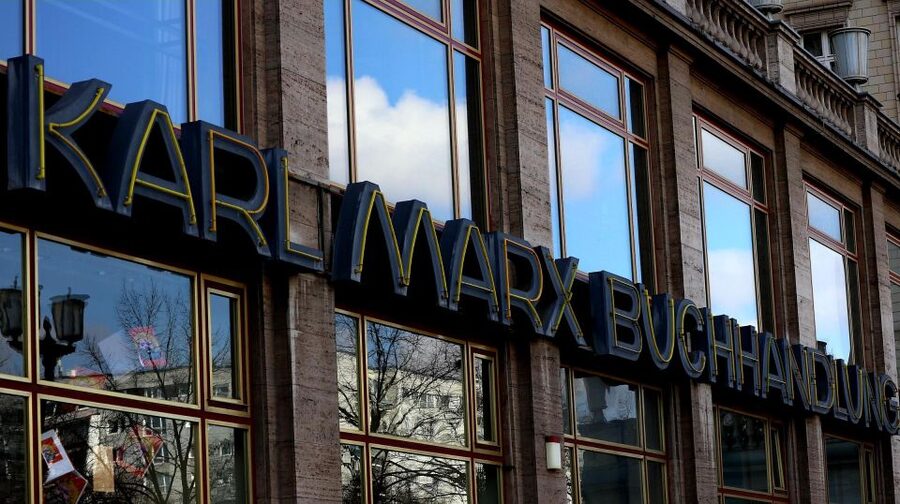
One of the most important parts of the tour is the East German uprising of June 1953. The street’s construction helped create the conditions for the revolt. Disgruntled workers began a mass uprising that came close to toppling the young socialist government.
This is a striking twist in the story. The avenue was supposed to prove that the government represented workers. Instead, the demands of construction and labor helped expose the gap between official promises and working conditions.
As you walk, this episode gives the monumental buildings a human scale. You are no longer looking only at grand facades and state planning. You are thinking about the people who built them, the pressure placed on workers, and the anger that spread through East Germany.
The 1953 uprising also shows why a guided walk is useful here. The avenue itself cannot explain the political crisis. Without context, you might admire the buildings and miss the conflict that surrounded their construction.
I would pay close attention during this section if you have a general interest in Cold War history. It explains why Karl-Marx-Allee was not just a symbol of government confidence. It was also connected to one of the most serious challenges faced by East Germany.
Same city, a different facade:
- Potsdam: Guided Walking Tour of UNESCO Site and Architecture
★ 4.7 · 49 reviews - Private Taxi Tour City East & West History and Architecture 3-4h
★ 5.0 · 42 reviews - Stuttgart city library – an architectural tour
★ 4.4 · 27 reviews - Karl-Marx-Allee Tour: Life and Architecture in East Berlin
★ 5.0 · 19 reviews
The hidden side of the Stasi state
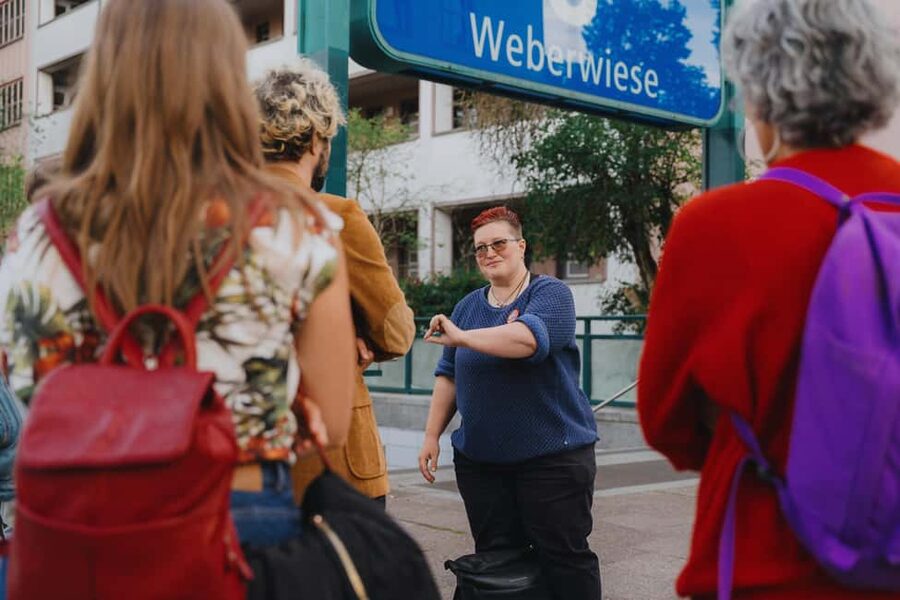
The street’s polished public image had a less visible side. The East German secret police, known as the Stasi, used wiretaps in apartments and listening stations in attics. These surveillance systems were designed to remain out of sight.
That contrast is central to the experience. Down below, the avenue offered cafes, shops, and a carefully planned image of normal life. Above and inside the buildings, the state watched and listened.
The tour does not treat surveillance as an abstract idea. It connects Stasi control to the very buildings you are looking at. That makes the subject more immediate. You begin to imagine how a comfortable-looking apartment could also be part of a system built on suspicion and control.
This part may be unsettling, but it is valuable. The street’s grand appearance can tempt you to romanticize East Germany as a vanished world of handsome buildings and orderly neighborhoods. The story of the listening stations corrects that picture.
You also gain a better sense of how suppression worked. It was not always visible in public squares or official announcements. Sometimes it was hidden in the structure of everyday life, inside walls, above ceilings, and behind an ordinary residential facade.
Poplar trees and the changing face of the avenue

The earlier modernist buildings were later hidden from passersby by fast-growing poplar trees. That detail may seem small, but it reveals how the regime managed the visual story of the street.
Architecture was not only built. It was framed, concealed, and presented. If a style no longer matched the government’s idea of socialist living, it could be pushed out of sight.
This gives the walk another useful layer. You are not only studying what remains visible. You are learning to notice what the city chose to hide.
The route also shows how political taste can change. Modernism was once linked to hopeful urban planning after the war. Later, the government favored monumental socialist classicism. The avenue became a physical record of those changing priorities.
If you enjoy architecture, this may be the most rewarding part of the tour. You do not need specialist knowledge to follow it. The guide explains how styles relate to politics, housing, and public image, making the buildings easier to read.
Film locations on Karl-Marx-Allee

The avenue has also found a second life on screen. The tour points out filming locations connected with The Lives of Others and The Queen’s Gambit.
These references add a practical bit of pop culture to a serious history walk. The locations can help you recognize the street as a cinematic setting, but the films also fit the themes of the route. The Lives of Others deals directly with surveillance and state control, while The Queen’s Gambit uses Berlin locations to evoke a particular period and atmosphere.
If you have seen either production, these stops should make the walk more memorable. If you have not, they do not replace the main historical content. The tour’s focus remains the architecture, the East German state, and the people who lived under it.
I like this addition because it gives you another way to look at the avenue. A place can be a real neighborhood, a political symbol, and a film location at the same time. Karl-Marx-Allee has carried all three roles.
From forgotten boulevard to housing protest
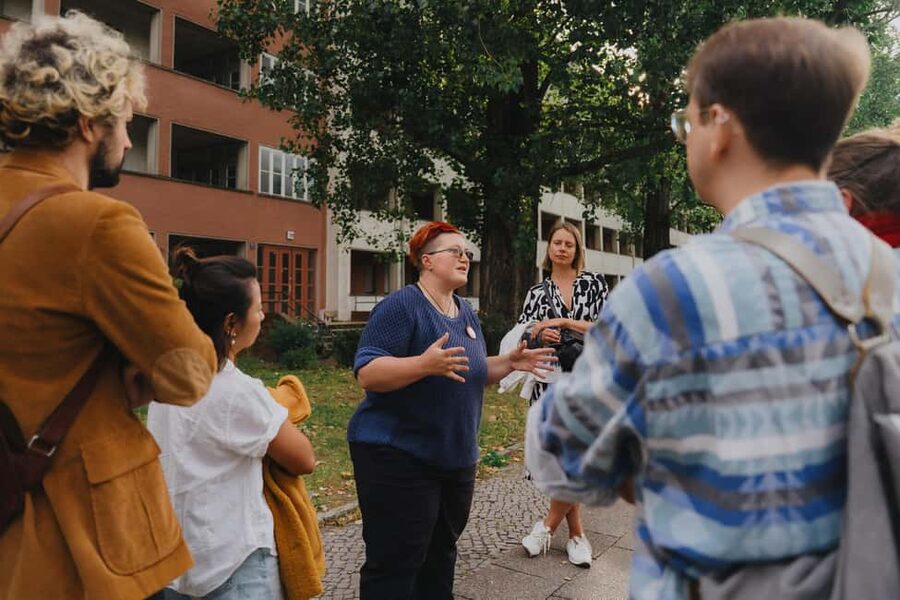
After the Berlin Wall fell, Karl-Marx-Allee was left in poor condition and began to look like an odd relic from another era. It seemed to fade from public attention.
Berlin’s housing shortage changed that. Real estate interest returned, and the avenue became part of current arguments over gentrification and rising living costs. It is no longer mainly a boulevard for socialist parades. It is now also a place where local residents protest changes to their neighborhood.
This final chapter keeps the walk from becoming a sealed-off history lesson. The street still affects people who live nearby. Its buildings are not only reminders of East Germany. They are homes in a city where housing costs have become a major concern.
That connection between past and present is one of the strongest reasons to book the tour. You learn what Karl-Marx-Allee meant under socialism, what happened to it after reunification, and why the avenue still matters now.
You may also leave with a more useful view of Berlin’s redevelopment debates. The issue is not simply old buildings versus new apartments. It is about who gets to remain in a neighborhood, how public spaces are valued, and what happens when politically symbolic housing becomes attractive real estate.
What the $29 price gives you
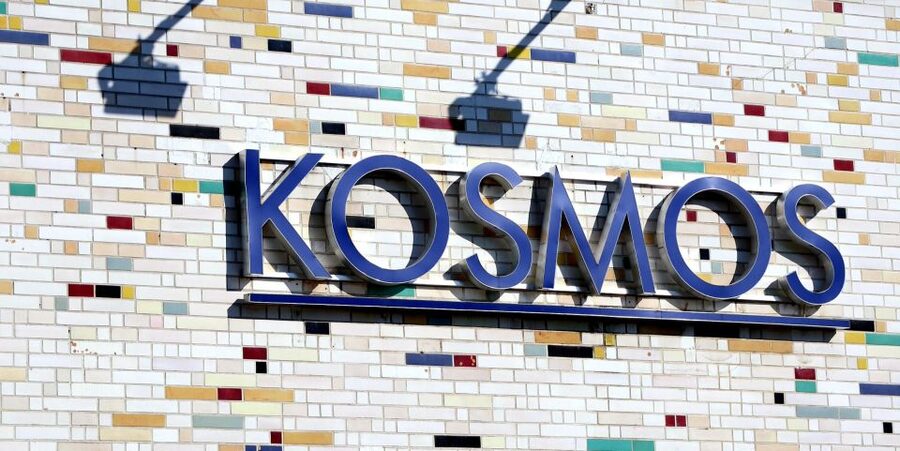
At $29 per person, the tour is reasonably priced for a live, two-hour history walk. You are paying for a guide who can connect architecture, labor unrest, surveillance, cinema, and housing politics instead of giving you a short list of building names.
The value depends on your interests. If you already know Karl-Marx-Allee well and only want to photograph the facades, you may prefer a self-guided walk. If you want to understand why the avenue looks the way it does, the guide adds far more than directions.
The small number of details supplied about the guiding style is encouraging. Martina is specifically praised for responding to curious participants instead of delivering a fixed speech. That matters on a route where questions can take you from architecture to politics very quickly.
The tour is available in English or German. It also offers free cancellation up to 24 hours before the start and a reserve-now, pay-later option, which is useful if you are organizing several Berlin activities around changing weather or schedules.
Who should book this walk?
I would recommend it to adults and older children interested in:
- Cold War Berlin and East German politics
- Architecture and urban planning
- The Stasi and state surveillance
- The Lives of Others or The Queen’s Gambit
- Current debates about housing and gentrification
Children under 10 are not suitable for this activity. The subject matter is serious, and the tour relies on careful explanation rather than visual spectacle.
The walk is wheelchair accessible, and comfortable shoes are still a good idea. You move along a large urban avenue, and the experience works best when you can stop, look up, and listen without worrying about sore feet.
Should you book the Karl-Marx-Allee tour?
Book it if you want Berlin’s Cold War story explained through real streets and buildings. The route gives you a clear sense of how the East German government used architecture to project confidence, how workers challenged that government in 1953, and how surveillance operated behind a carefully managed public image.
Skip it if you want a short photo stop or a tour centered on Berlin’s best-known monuments. Karl-Marx-Allee rewards curiosity more than speed.
For $29, the strongest value is the connection between past and present. You see socialist classicism, hear about the Stasi, identify film locations, and finish with a street still tied to housing protests. That is a lot of Berlin history packed into a straightforward walk from Frankfurter Tor to Strausberger Platz.
FAQ
Where does the Karl-Marx-Allee tour start?
The tour starts outside U Frankfurter Tor, by the southern tower on the corner of Warschauer Straße and Karl-Marx-Allee. Look for the guide holding an orange umbrella.
Where does the tour finish?
The walk finishes at U Strausberger Platz.
How long does the tour last?
The activity lasts two hours. The guided portion of the Karl-Marx-Allee route is listed as 1.5 hours.
Which languages are available?
The tour is offered in English and German.
Is the tour wheelchair accessible?
Yes, the activity is wheelchair accessible.
Can children join the tour?
Children under 10 are not suitable for this activity. Comfortable shoes are recommended for everyone.
Newly added in Germany
- Hidden Architectural Gems of Munich (Max. 16 guests)★ 5.0 · 2 reviews
- Munich Your Way: Private Tour with Architect & Guide★ 5.0 · 2 reviews
- Architectural Frankfurt: Private Tour with a Local Expert★ 5.0 · 2 reviews
- Berlin Architecture/River Spree Full Day Photography Tour★ 5.0 · 2 reviews
- Private Taxi Tour of City East History and Architecture 2-3h★ 5.0 · 2 reviews
- Architectural Berlin: Private Tour with a Local Expert★ 4.0 · 3 reviews
- Lübeck: Architecture and Local Craft Private Guided Tour★ 4.0 · 6 reviews
- Lübeck: Private Historical and Architectural Walking Tour★ 4.5 · 6 reviews
Berlin Architecture Tours, compared.
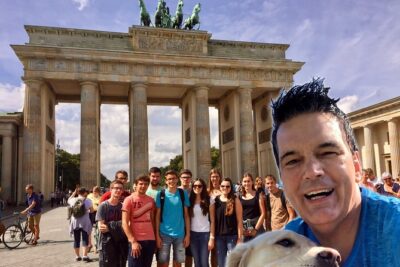
Private Taxi Tour City East & West History and Architecture 3-4h
Read our review →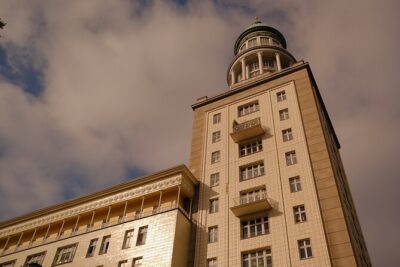
Karl-Marx-Allee Tour: Life and Architecture in East Berlin
Read our review →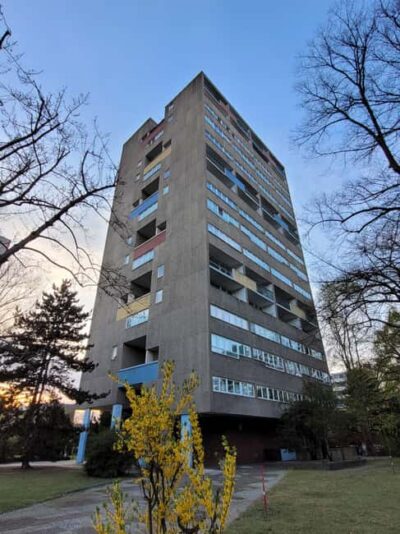
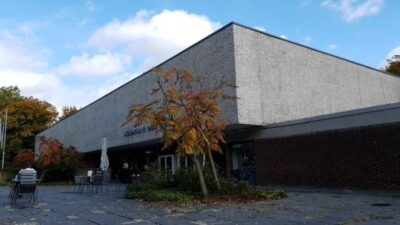
Guided Architectural Walking Tour of Hansaviertel
Read our review →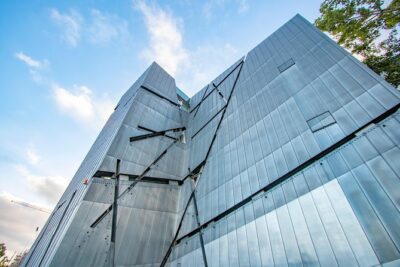
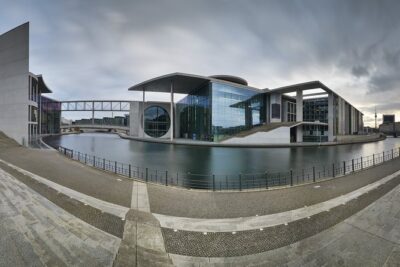
Berlin Architecture/River Spree Full Day Photography Tour
Read our review →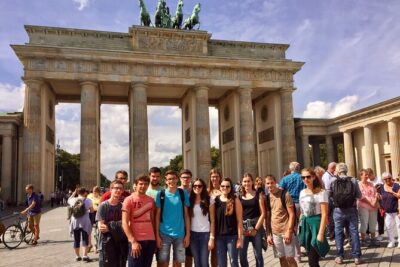
Private Taxi Tour of City East History and Architecture 2-3h
Read our review →Browse the lists this tour appears in