
Review · BAUHAUS AND BRUTALIST ARCHITECTURE TOURS
Brutal Tbilisi — Night Edition: Dark Side of Soviet Architecture
Tbilisi’s Soviet architecture looks most dramatic after sunset. This private night tour links abandoned museums, war-scarred buildings, glowing monuments, and concrete structures that seem to float above the city. It is less about polished sightseeing and more about seeing the Georgian capital’s difficult past in places most visitors miss.
I like the private transport, which saves you from piecing together distant hilltop stops, and the practical photography help, which gives your phone a real job beyond taking quick snapshots. The main consideration is the mood: some sites are bleak, and the route may include uneven ground, long drives, heights, and tight spaces.
Key points to know before booking
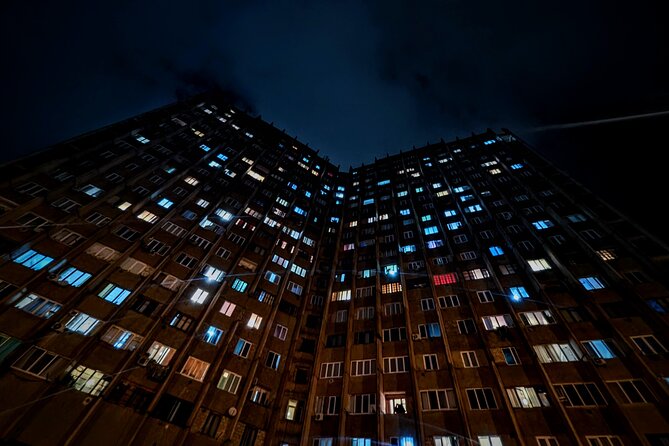
- Arashenda Building: See an unfinished 17-storey hotel project that became shelter for families displaced by war.
- Night photography: Get help with angles, light, and phone-camera settings at some of Tbilisi’s boldest sites.
- Six unusual stops: Visit the Chronicles of Georgia, Digomi’s former Archaeology Museum, the former Ministry of Highways, Nutsubidze Skybridge, and the Wedding Palace.
- Private evening route: Door-to-door pickup is available in central Tbilisi, and only your group takes part.
- Strong atmosphere: Expect abandoned concrete, shadowy stairways, old elevators, and stories shaped by political change.
- Practical limits: The tour operates in rain or snow and is not suited to people uneasy with heights, claustrophobic spaces, or emotionally heavy subjects.
Why Soviet Tbilisi works better at night
Most city tours lead you toward churches, balconies, sulfur baths, and cafe-lined streets. This one points the vehicle toward the outskirts and hills, where Tbilisi’s Soviet-era experiments take on a stranger beauty after dark.
You will see buildings designed to project confidence and progress, many of which were interrupted by political change, war, or the collapse of the Soviet system. Some are still useful. Some were never completed. Others now serve a purpose far removed from their original plans.
That contrast is the heart of the experience. You are not just looking at concrete forms. You are seeing how a city adapts when grand plans fail. A half-built hotel becomes housing. A civic wedding palace takes on an almost sacred air. A former government headquarters becomes a modern bank.
The tour lasts about three to four hours. Each stop is fairly short, usually 20 or 45 minutes, so you get a broad look at Tbilisi rather than a long architectural lecture at one address. I think that format works well at night, when the mood comes from moving between different locations and seeing the city lights from several heights.
More Bauhaus and Brutalist Tours in the world:
- London: Brutalist Architecture & History Walking Tour
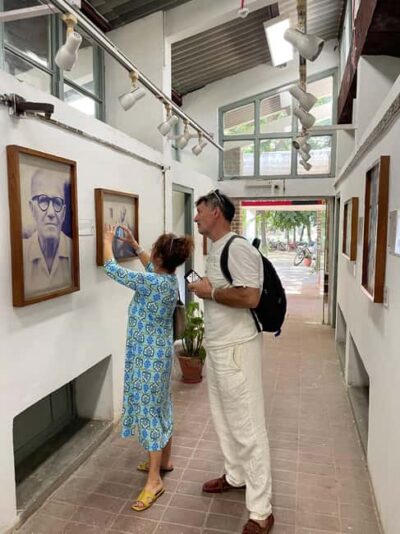
★ 4.8 · 42 reviews - Le Corbusier’s Chandigarh : A Complete Architecture Tour
★ 4.7 · 25 reviews - Architecture of New Belgrade – Brutalism Decoded
★ 4.5 · 24 reviews
Arashenda Building and a hotel that never opened
The first stop introduces the tour’s darker side. The Arashenda Building was begun in the early 1980s as the Hotel Odishi, a major 17-storey project that was never finished.
Political upheaval and civil conflict halted construction. The empty frame later became shelter for families displaced by war, creating an improvised vertical community inside a building never intended to serve that role.
At night, its two folded wings resemble an open book. The comparison is fitting, though the story inside is about survival rather than ceremony. Cracked surfaces, open stairways, and makeshift balconies become visible in fragments as your guide explains what happened here.
The building is also useful for photography. From its open stairways, you can see the nearby Chronicles of Georgia monument. That view places two very different symbols together: one unfinished and scarred, the other monumental and carefully composed.
You should expect a quick 20-minute stop, not a full exploration of every floor. The important point is the story and the exterior atmosphere. Uneven terrain and dim conditions make sturdy shoes a good idea.
Chronicles of Georgia under golden light
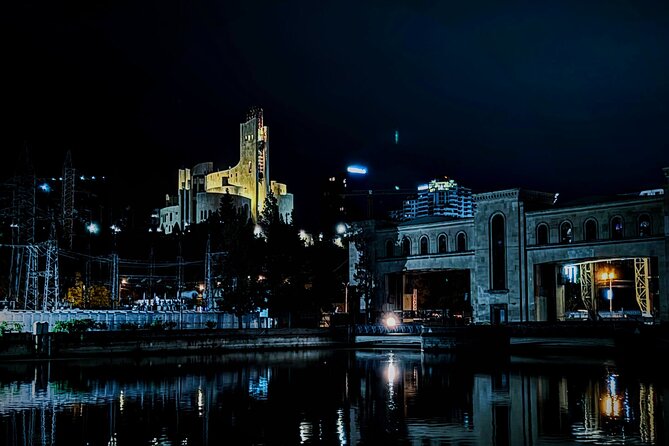
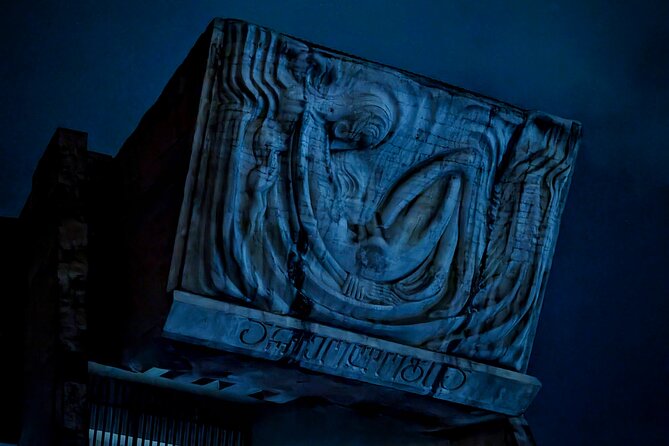
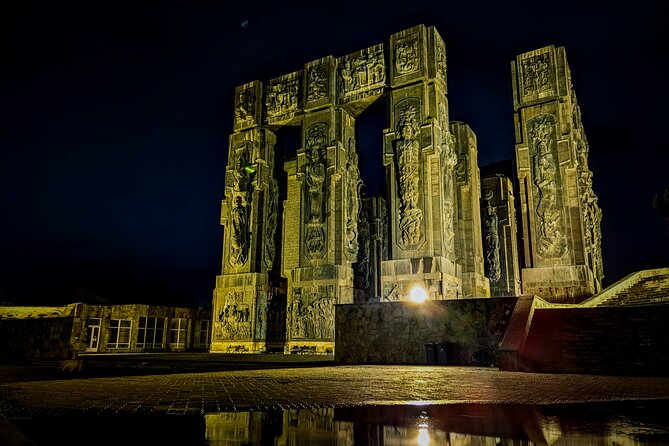
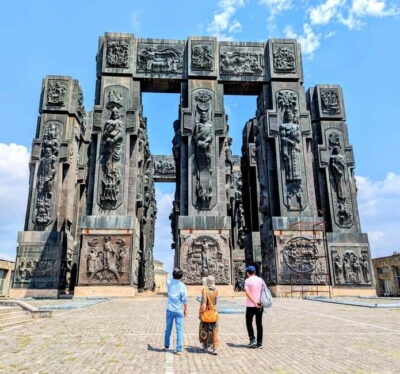
The Chronicles of Georgia is probably the most polished stop on the route. Huge stone columns rise above Tbilisi, with carved scenes connected to Georgia’s kings, saints, and religious traditions.
In daylight, the monument is already imposing. At night, the lighting changes its character. Soft golden illumination picks out sections of the carvings, while large areas fall into shadow. The result is quieter and more theatrical than a daytime visit.
Your guide explains the figures and legends as you move among the columns. That context matters because the monument is not easy to read at a glance. The carvings are large, but the meaning is not always obvious if you do not know the subjects.
The top platform gives you a wide night view toward Tbilisi and the dark waters of the Tbilisi Sea. I would treat this as one of the best places to pause and take in the city rather than rushing straight to photographs.
You get about 45 minutes here. That is enough time for a short explanation, several viewpoints, and phone photos without turning the stop into a long history lesson.
The former Archaeology Museum on Digomi Hill
The former Archaeology Museum in Digomi is another unfinished piece of Georgian ambition. Built in 1988 to house ancient Georgian treasures, it never fully opened.
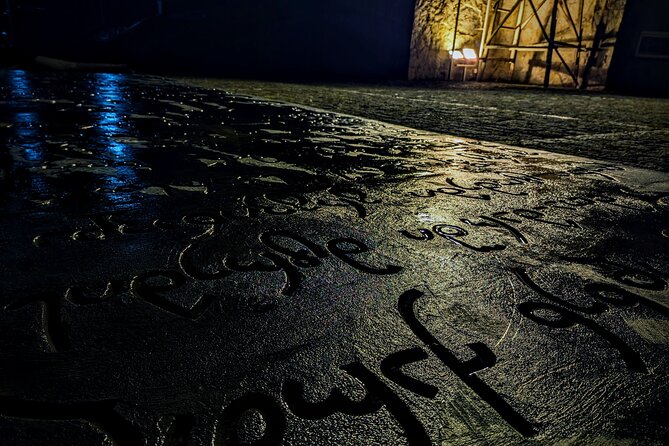
Its location on Digomi Hill gives the building a commanding position above the city. The broad stairway creates the first impression. It looks almost like the entrance to an ancient temple, although the structure itself belongs to the late Soviet period.
Carved bas-reliefs cover parts of the building. At night, the figures appear and disappear as the light shifts across cracked stone. The empty setting adds to the effect. This is not a restored museum with displays and climate control. It is a quiet shell connected to a plan that never reached its intended purpose.
The guide’s explanation is especially useful here. Without context, you may see only an abandoned concrete building. With the story of its intended collection, political changes, and unfinished opening, the place becomes a clear example of how cultural projects can be overtaken by events.
Allow about 20 minutes. The stop is atmospheric, but it is not a conventional museum visit. There are no exhibits described as part of the experience, so do not arrive expecting indoor collections.
More Evening Tours in the world:
- Chicago River: Guided Sunset Cocktail & Architecture Tour
★ 4.6 · 203 reviews - Night Tapas Walking Tour in Barcelona Modernist Area with Small Group and Dinner
★ 4.5 · 56 reviews - Tirana Evening & Night Walking Tour History and Architecture
★ 4.9 · 15 reviews - Barcelona: Evening Walking Tour in the Gaudi Area with Tapas
★ 3.9 · 35 reviews
The former Ministry of Highways and Soviet engineering
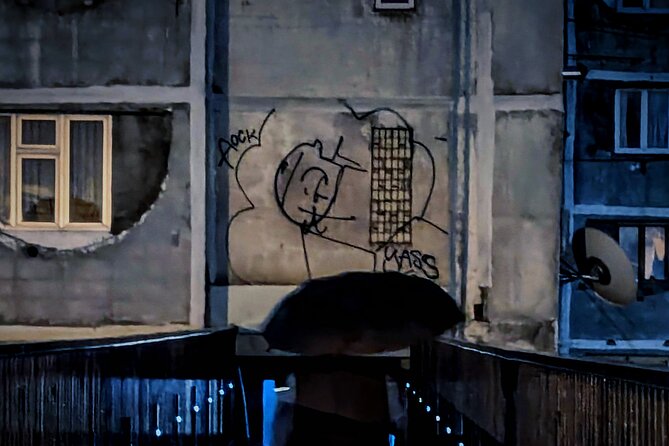
The former Ministry of Highways of the Georgian SSR is one of Tbilisi’s most famous examples of daring Soviet design. Built in the 1970s, it is made from large concrete blocks arranged like bridges suspended above one another.
The design is linked to Georgia’s mountainous roads. The structure suggests movement, connection, and engineering, yet its great masses also feel almost impossible to balance. At night, lighting picks out corridors and openings, making the building appear part futuristic machine and part ancient ruin.
The structure now houses the Bank of Georgia Headquarters. That present use adds a useful layer to the visit. You are not looking at a dead monument. The building has been absorbed into modern Tbilisi while keeping its original visual force.
This is a good place to let your guide handle the best angles. The building’s scale can confuse phone cameras. A wide shot may lose the detail, while a close shot may hide the unusual arrangement of blocks. The photography tips are practical here, especially if you want the building to look as strange in your pictures as it does in person.
The visit lasts about 20 minutes. You will see the exterior and learn the background, but this is not a tour of the bank’s interior.
Nutsubidze Skybridge and the old elevator ride
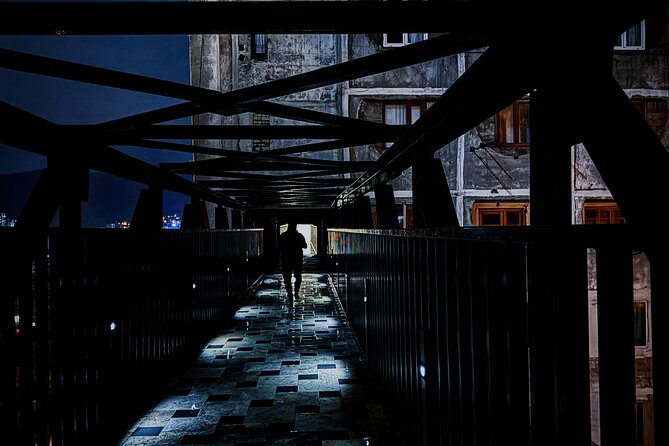
The Nutsubidze Skybridge is the most hands-on stop. Three large residential blocks on the steep Nutsubidze Plateau are linked by suspended bridges high above the city.
At night, the bridges glow faintly. City lights flicker below, while the concrete towers fade into the darkness above. The setting can feel eerie, but it is also unmistakably lived-in. This is not an isolated monument. It is part of a residential area, with people still using its elevators and walkways.
You ride an old elevator operated by a lift lady who has watched generations pass through the building. The elevator ride is a small detail, but it gives the visit a human scale. Instead of treating the architecture as a strange object, you see how residents use it as part of everyday life.
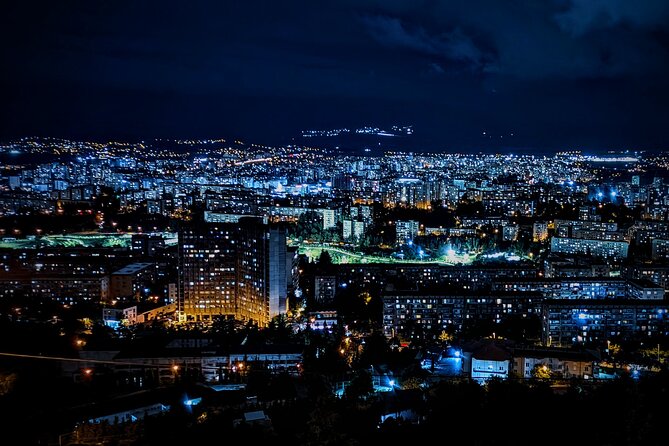
From the bridges, your view reaches across Tbilisi, from newer glass buildings toward the distant hills and older parts of the city. This may be the tour’s most memorable viewpoint, though it is also the stop that requires the most comfort with height and enclosed spaces.
The planned time is about 45 minutes. Wear shoes with a good grip, and keep your phone secure near railings and open viewpoints. If heights or old elevators make you uneasy, this is the stop to think about most carefully before booking.
Arcadia Georgia, the Wedding Palace, and civic ritual
The Wedding Palace, also called the Palace of Rituals, was built in 1984 by architect Victor Jorbenadze. It replaced a church wedding with a state-run civic ceremony, giving marriage a new setting under Soviet rule.
The building’s form is unusual even by Tbilisi standards. It rises in a spiral shape, with arches that recall Georgian churches while using raw concrete and modern structural ideas. The result feels part civic hall, part futuristic temple.
At night, light from the interior passes through curved windows and openings. The building becomes softer and more romantic than its concrete material might suggest. That mood is not accidental. The structure was built around an emotional ritual, and the architecture tried to give that ritual a sense of importance without religious ceremony.
Your guide can help connect the design to its political setting. The story is not simply about an odd building. It is about how governments shape public rituals, and how architects search for beauty inside official systems.
This stop takes about 20 minutes. You will likely spend most of the time outside, looking at the form and photographing its curves and shadows.
Photography help that is useful, not just decorative
The tour includes a professional photographer and phone-camera guidance. That matters because many of the sites are difficult to photograph well.
Night scenes create familiar problems: bright lights, deep shadows, tall buildings, and limited room to step back. Your guide can help you choose angles, frame the concrete forms, and make better use of the phone camera you already carry.
The service is not presented as a studio photo session with a fixed package of edited images. Instead, expect practical help while moving through the route, along with photographs of you at selected viewpoints. The exact number or delivery method for finished images is not specified, so ask before booking if that is important to you.
The earlier city tours connected with the same provider have used guides named Alex, Oksana, Jonah, and Aleski, with Alex and Oksana particularly associated with personal photos and local storytelling. Your booking confirmation should tell you who will lead this night route. The key point is to request a guide who can balance architecture, history, and photography if those are equally important to you.
What the $100 price means
At $100 per person, the tour is not cheap if you are traveling alone. Its value improves for couples, families, or friends who can share the private experience, especially since private transport is included.
You are paying for more than admission. All six sites list free entry, so the price covers the local guide, vehicle, route planning, pickup service, and photography help. The distant and uphill locations would be awkward to connect using public transport in one evening, particularly if you want to visit them in a sensible order.
There are no meals included. Bring water and eat beforehand, since the route is built around moving between sites rather than stopping for a restaurant meal.
Group discounts are offered, but the amount is not specified. Ask for the current rate if you have several people in your party. Free cancellation is available if you cancel at least 24 hours before the start time. Changes or cancellations inside that window are not refunded.
Pickup, weather, and physical comfort
Door-to-door pickup is available within central Tbilisi. After booking, you provide your accommodation address and receive an exact pickup time and location. If you are outside the pickup area, the usual alternatives are Liberty Square or Europe Square near the vintage tram-cafe.
Your guide or driver contacts you through WhatsApp on the day. Keep your phone available and make sure the number attached to the booking can receive messages.
Traffic, weather, and special events may change the order of the stops. The six key sights remain part of the experience, but the route is not locked to a minute-by-minute sequence.
The tour runs in all weather, including rain and snow. Wear warm clothing when needed and choose comfortable shoes. The route may involve uneven ground, long drives, stairs, bridges, old elevators, and exposed viewpoints.
The provider specifically warns against booking if you have a fear of heights or claustrophobia. The stories can also be emotionally heavy, particularly at Arashenda, where the building’s connection to displaced families is central to the visit.
Who should book this night tour
I would choose this experience if you have already seen Tbilisi’s central sights and want a different side of the city. It suits people interested in architecture, photography, Soviet-era planning, urban change, and places that still carry visible signs of unfinished history.
It also works well for couples or small groups who want a private evening with flexible attention from a guide. The photo help gives the route an extra purpose, especially if you want more than ordinary snapshots.
I would not choose it for a relaxed dinner-and-walk evening, a standard Old Town introduction, or a museum-focused outing. You will spend time in vehicles and around unfinished or exposed structures. The mood is often dramatic, sometimes bleak, and not designed to feel easygoing.
The tour has a perfect five-star rating from 10 submitted ratings, with full recommendation from those participants. That is encouraging, though the sample is small. The strongest pattern in the available feedback is the guide’s ability to personalize the route, explain Tbilisi from a local point of view, and take appealing photographs.
Should you book Brutal Tbilisi, Night Edition?
Book it if you want Tbilisi beyond the postcard. The best parts are the unusual route, private transport, night lighting, and the way each building connects architecture with real political and social change.
Before paying, confirm the pickup area, the guide’s name, how photographs are delivered, and the group discount if you are not traveling alone. If you are comfortable with heights, old elevators, rough ground, and emotionally serious stories, this is a strong way to spend an evening.
If those conditions sound unpleasant, stick with Tbilisi’s central streets and viewpoints. This tour asks you to look at the city’s scars as well as its beauty.
FAQ
How long does Brutal Tbilisi, Night Edition last?
The experience lasts approximately three to four hours.
How much does the tour cost?
The listed price is $100 per person. Group discounts are available, but the discount amount is not specified.
Is this a private tour?
Yes. Only your group takes part in the activity.
Is hotel pickup included?
Door-to-door pickup is provided within central Tbilisi. You need to share your accommodation address after booking.
What happens if my accommodation is outside the pickup area?
The provider will suggest a nearby meeting point, usually Liberty Square or Europe Square near the vintage tram-cafe.
What language is the tour offered in?
The tour is offered in English.
Is transportation included?
Yes. Private transportation is included, along with a live local guide and photography tips.
Are entrance tickets included?
All six listed stops have free admission, so there are no entrance fees described for this route.
Does the tour operate in bad weather?
Yes. The tour operates in all weather conditions, including rain and snow. Comfortable shoes and suitable clothing are recommended.
Is the tour suitable for people afraid of heights or enclosed spaces?
No. The provider says the experience is not suitable for people with a fear of heights or claustrophobia. It may also include uneven terrain, long drives, and emotionally charged stories.
Newly added in the world
- Venice Art and Architecture Private Walking Tour★ 4.5 · 11 reviews
- Basilica San Marco and the Pala d’Oro with Architect Guide★ 4.5 · 19 reviews
- Walking tour in Venice with an architect★ 5.0 · 16 reviews
- Paris: Discover the hidden architecture gems of Le Marais★ 3.8 · 4 reviews
- Porto Tour: Street Art & Architecture Experience 3h★ 5.0 · 4 reviews
- Faro Private Walking Tour: Uncovering its Architectural Legacy★ 5.0 · 8 reviews
- Private Walking Tour of Old Gdańsk with an architect-guide★ 5.0 · 7 reviews
- Sopot Private City Walking or Bike Tour with a local architect★ 5.0 · 19 reviews
Bauhaus and Brutalist Architecture Tours, compared.
Brutalist Tbilisi: Urban exploration and untold stories
Read our review →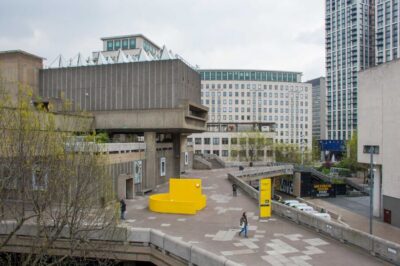
Le Corbusier’s Chandigarh : A Complete Architecture Tour
Read our review →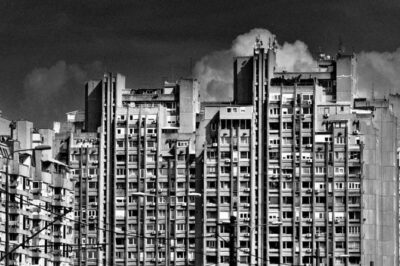
Architecture of New Belgrade – Brutalism Decoded
Read our review →
USSR History, Soviet Architects ,Statues & Mosaics
Read our review →USSR History , Soviet Architects , Statues & Mosaics
Read our review →
Browse the lists this tour appears in