
Review · WALKING TOURS
Walking Tour about Golden Age Architecture, private local guide
Amsterdam’s Golden Age is written into the city’s brick façades, canal warehouses, carved stones, and slightly crooked houses. This private walk with local guide Anna connects those details to the merchants, craftsmen, engineers, and city builders who shaped Amsterdam in the 17th century. You see a lot in 90 minutes, moving from the Royal Palace area toward Westerkerk.
I like the focus on design and engineering, especially the explanation of how Amsterdam built grand structures on soft, marshy ground. I also like the private format. You can stop for photos, ask about a house that catches your eye, and steer the conversation toward architecture, social history, or local life. The main drawback is the pace: standing and walking for an hour and a half may be tiring, and the tour is not recommended for people using walkers or those with trouble walking.
Key points to know before booking
- Private time with Anna: You have a guide focused only on your group, with room for questions and photo stops.
- Golden Age details, not just famous sights: Look closely at gables, hoisting beams, façade stones, domes, and crooked buildings.
- A useful route through central Amsterdam: The walk links Dam Square, the canal belt, Jordaan, and Westerkerk.
- No entrance fees during the walk: The experience is built around exterior architecture and street-level storytelling.
- A short but active outing: Plan on about 1 hour and 30 minutes of walking and standing.
- Strong value for architecture fans: At $73.59 per person, the price makes the most sense for visitors who want interpretation rather than a simple orientation stroll.
Why this walk is different from a standard city introduction
Many Amsterdam walks point out canals, bridges, and famous houses, then move on. This one asks you to look harder. Why are the houses so narrow? Why do many have lifting beams near the roof? What do those small carved plaques mean? How did builders put a huge stone town hall on wet ground?
That focus gives the tour a clear purpose. You are not simply collecting landmarks. You are learning how Amsterdam worked as a trading city and how its buildings reflected money, status, religion, work, and practical needs.
Anna’s role matters here. The supplied information identifies her as a local guide who lives on the canals, and her approach is described as friendly, clear, and open to questions. You can expect an English-language tour with a personal feel rather than a large group moving from one fixed speech to the next.
The private format also changes the pace. If you want to stop for a photograph, ask about a doorway, or spend more time on a building style, you have a better chance of doing so. A small group of three was described as a comfortable size, and that gives you a useful idea of the experience: personal, conversational, and easier to adapt than a standard group walk.
More Walking Tours in the world:
- Lecce: Baroque Architecture and Underground Walking Tour
★ 4.6 · 1,248 reviews - Chicago in a Day: Food, History & Architecture Walking Tour
★ 5.0 · 1,153 reviews - Ramblas, Old Town, Gothic and Gaudi Architecture Walking Tour
★ 5.0 · 723 reviews
Starting near Dam Square and the Royal Palace
The meeting point is listed at the Royal Palace Amsterdam, at Nieuwezijds Voorburgwal 147. The route begins with Dam Square, where you get the basic story of Amsterdam’s rise during the 17th century.
Dam Square is a sensible place to begin because it helps explain the city’s power. Amsterdam grew into a major trade center during the Dutch Golden Age, and that prosperity paid for ambitious civic buildings, merchant homes, churches, warehouses, and canal works.
The opening section is short, about five minutes, so do not expect a long lecture in the square. Instead, it sets the period and gives you a framework for the buildings ahead. If you arrive early, use the time to orient yourself. The exact meeting point is the Royal Palace, while Dam Square is the first listed stop, so checking the guide’s precise meeting instructions after booking is a practical move.
The palace itself was first built as Amsterdam’s town hall, not as a royal residence. That distinction is important. It was a public symbol of a wealthy, self-governing trading city before it became the royal building you see today.
You will hear about its Dutch Neoclassical style, large-scale materials, and construction methods. The most useful part is the engineering story. Amsterdam’s ground is soft and marshy, so constructing a massive stone building required careful planning and substantial support beneath it. The palace becomes more interesting when you see it not only as a grand façade, but also as a technical answer to difficult ground conditions.
The palace stop lasts about ten minutes. Admission is not included because the walk treats it as an exterior sight, and no entrance ticket is required for the tour.
House Bartolotti and the meaning of a merchant façade
House Bartolotti gives you a closer look at the private side of Golden Age wealth. Its red-brick façade, broad windows, and sandstone decoration show how an Amsterdam merchant could turn a city house into a public statement of status.
The building is linked to an owner with strong trading ties to Italy, which helps explain the Italian influence in its decorative design. Here, architecture is not just about shelter. It communicates money, connections, taste, and ambition.
This is a brief five-minute stop, so you will need to pay attention to details quickly. Look at the contrast between brick and sandstone, the arrangement of the windows, and the amount of decoration compared with more modest canal houses. Anna’s explanation is particularly useful because the street can look like a continuous row of attractive buildings until someone points out why one façade carries more weight than another.
Torensluis and Amsterdam’s crooked houses
Torensluis is one of the stronger viewing points on the route. From this broad bridge, you can compare several façade designs associated with Amsterdam’s mercantile class.
The bridge gives you space to look across the canal and study how Baroque ideas were adapted to Dutch conditions. The effect is not the same as grand European palace architecture. Amsterdam’s version appears on narrow urban houses, commercial buildings, and façades squeezed into a working city.
This is also where the famous crooked houses become part of the story. Some buildings lean because of shifts in the soft ground, changes in foundations, age, or the way structures were built. Their odd angles are charming, but they also point to the practical problems of constructing and maintaining a city on marshy land.
The stop takes about ten minutes. It is a good place for photographs, and Anna’s willingness to pause for pictures is useful here. Still, remember that this is an exterior viewing stop. You are learning to read the street rather than entering a museum or private interior.
More Private Tours in the world:
- Best of Chicago: Architecture & Highlights City Private Tour
★ 5.0 · 94 reviews - Private Harajuku Omotesando Architecture Walking Tour
★ 5.0 · 67 reviews - Private Santa Barbara History and Architecture Walking Tour
★ 5.0 · 56 reviews - Private Barcelona Modernism and Gaudí Walking Tour
★ 4.7 · 54 reviews
De Dolphijn and a link to Rembrandt
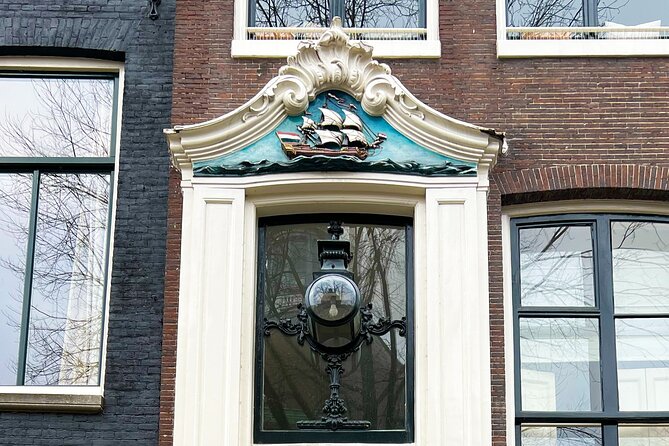
De Dolphijn adds a personal name to the architectural story. The dolphin symbol refers to wealth and Amsterdam’s maritime trade, while the house was originally owned by Frans Banning Cocq, the captain associated with Rembrandt’s The Night Watch.
That connection gives the building extra appeal, but the architectural point is just as important. Merchant houses were tied to the city’s trade networks, and their symbols could advertise prosperity without the need for a long written explanation.
The stop is only about five minutes, so expect a concise explanation rather than a full art-history lesson on Rembrandt. It works best as one piece of a larger pattern: Amsterdam’s buildings preserve traces of the people who paid for them, lived in them, and used the city’s commercial network.
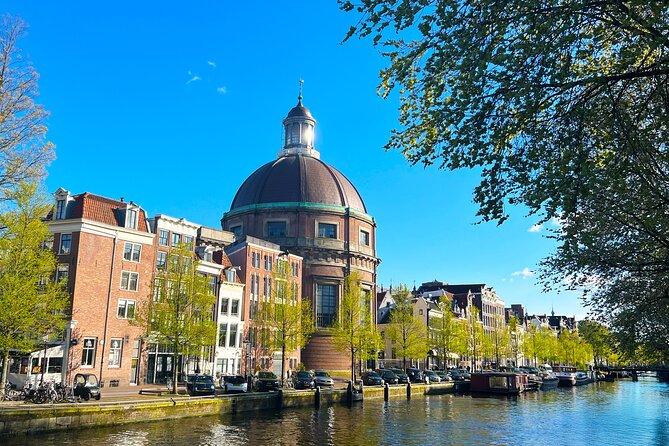
The Ronde Lutherse Kerk and the power of a dome
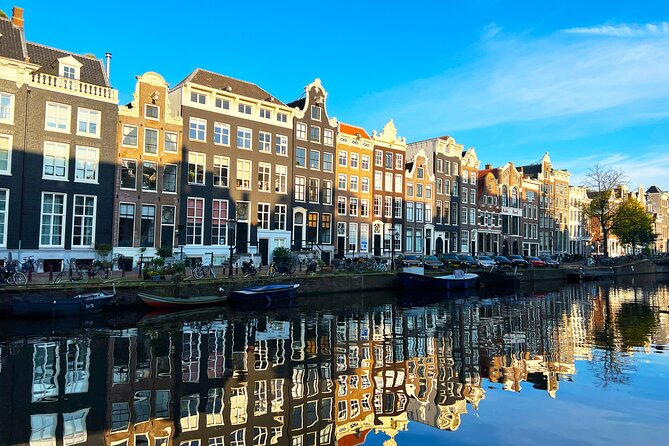
The Ronde Lutherse Kerk introduces a different kind of architectural ambition. Its dome reflects the importance of large-scale forms during the Renaissance period and offers a contrast to the tall, narrow canal houses.
This stop is also brief. The value comes from seeing how a religious building changes the visual rhythm of the city. Instead of repeating rows of merchant façades, the church draws attention upward and outward.
The tour does not include entry, so your appreciation will come from the exterior discussion and the building’s place in the surrounding streets. If you are especially interested in interiors, art, or church architecture, you may want to return separately, but the walk gives you a useful reason to notice it.
Prinsengracht warehouses and the practical side of trade
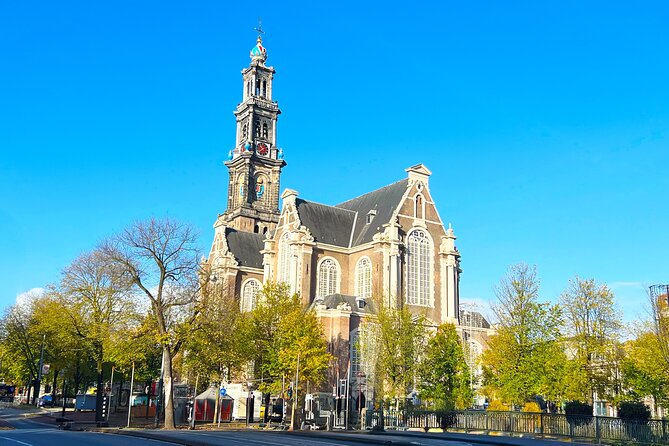
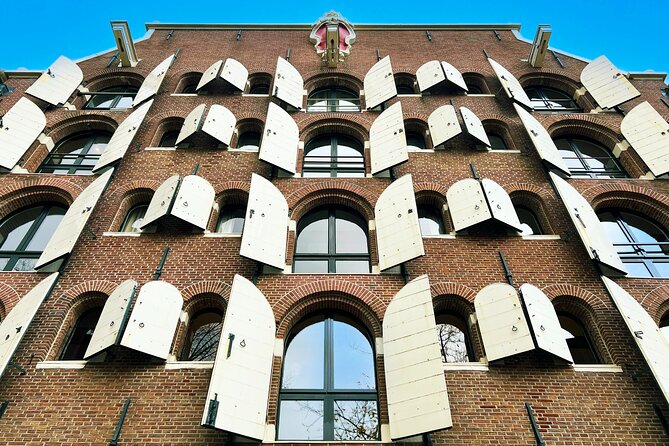
Along Prinsengracht, the architecture becomes more openly functional. Warehouses and canal buildings were designed to support commerce, with tall gables, large windows, and wooden hoisting beams near the roof.
Those beams are easy to miss if you are simply walking beside the canal. They were used to lift cargo from boats and move heavy goods into upper floors. Suddenly, the height of the building and the placement of its windows make practical sense.
The exteriors are often simpler than the grander merchant houses. That simplicity was not a lack of ambition. It reflected the building’s job. The scale still signals wealth, but the design is organized around storage, access, and trade.
This is a short five-minute stop, yet it may be one of the most useful for understanding Amsterdam as a working city. You learn to spot the clues that reveal how buildings operated, not just how they looked.
Jordaan and the stories hidden in gevelstenen
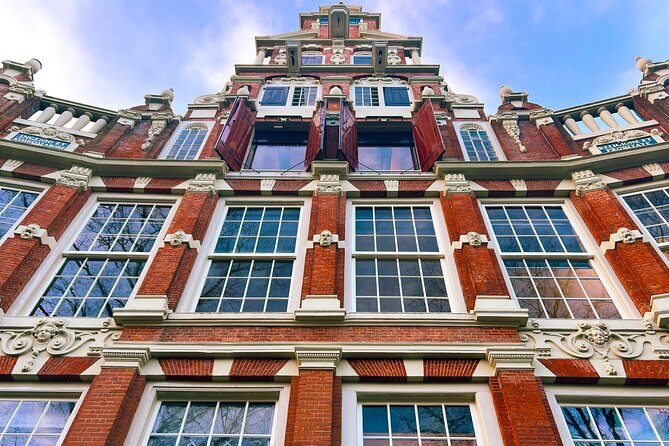
The Jordaan section lasts about 20 minutes, making it the longest part of the walk. That extra time is well used because the neighborhood offers a closer look at everyday urban life during the Golden Age.
The Jordaan developed as a district for craftsmen and laborers, with homes, workshops, and small shops packed along narrow canals and streets. Its buildings tell a different story from the grand civic architecture around Dam Square. Here, the city feels more domestic and practical, even though the same period of economic growth shaped it.
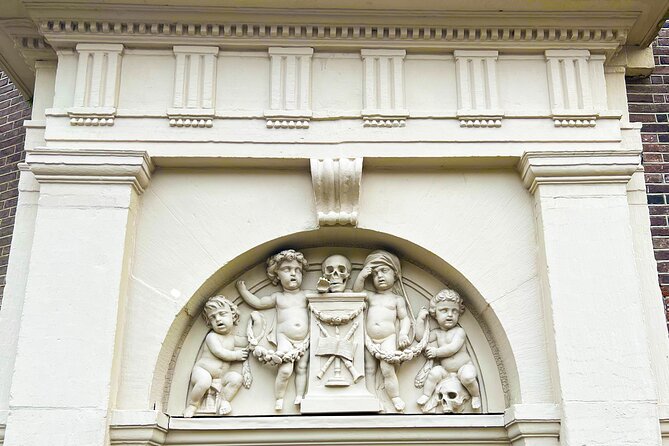
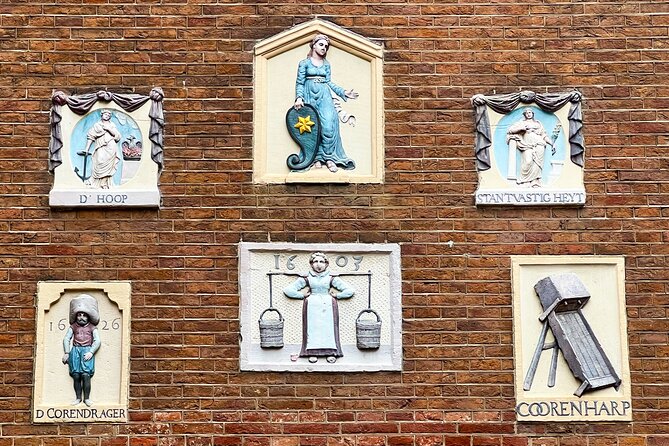
The main focus is on gevelstenen, or façade stones. These small carved plaques were placed into building fronts and could show the profession of the owner, the purpose of the building, or an important fact about the people who lived and worked there.
I like this part because it gives you a way to keep exploring after the tour ends. Once you know to look for façade stones, you begin to see Amsterdam’s streets as a collection of visual clues. A carving may identify a trade, recall a former occupant, or explain a building’s original use.
The stones also make the city’s history feel less abstract. Instead of hearing only about merchants and economic growth, you get signs connected to real work and neighborhood life. Anna’s local knowledge is especially useful here because these details are easy to walk past without explanation.
Westerkerk and the finish near Anne Frank House
The walk ends at Westerkerk on Prinsengracht, near the Anne Frank House. This is a practical ending point if you are continuing with central Amsterdam sightseeing, although the church itself is not entered as part of the tour.
Westerkerk was built as a Calvinist church for Amsterdam’s growing population. Its design is large and airy, but relatively restrained, reflecting the simpler style associated with Calvinist worship spaces.
The 85-meter tower is one of the most recognizable features in the Jordaan. Its imperial crown reflects Amsterdam’s civic status, and the clock’s chimes have marked the hours for centuries. The connection to Anne Frank’s diary gives the sound and location an additional modern historical meaning.
The church is also associated with Rembrandt, who was buried there. That link neatly brings together several threads from the walk: art, religion, civic pride, architecture, and the people who shaped Amsterdam’s public memory.
Because the tour finishes here, you can continue sightseeing on foot afterward. Keep in mind that the Anne Frank House requires its own admission arrangements, and this walking tour does not include entry to it or to the church.
Is $73.59 per person good value?
At $73.59 per person, this is not the cheapest way to see Amsterdam’s center. It is also not trying to be a cheap way to see Amsterdam’s center. The value depends on how much you want interpretation and personal attention.
For a group that cares about architecture, the price can make sense. You cover nine locations or architectural subjects in about 90 minutes, with a private guide explaining construction, symbolism, trade, religion, and social class. A private tour also means you are not paying for a large group experience with limited time for questions.
The value is weaker if you mainly want a broad introduction to Amsterdam or a quick list of famous sights. You will spend much of the walk looking at exteriors, and several stops last only five minutes. You should book this for the stories behind the buildings, not for lengthy visits inside them.
There are no bottled-water supplies included, so bring your own if you want one. The tour is offered in English, includes a mobile ticket, and group discounts may be available.
Who should book this walk?
I would choose this tour if you enjoy architecture, historic city planning, or the small signs that explain how old buildings were used. It is also a good choice if you have already seen the headline sights and want more meaning from the streets around them.
It suits couples, families with older children, and small groups who prefer conversation to a fixed script. The private format is useful if your group has many questions or wants to pause for photographs.
I would be more cautious if you have limited stamina. The tour involves walking and standing for 1 hour and 30 minutes, and it is not recommended for people who use a walker or have difficulty walking and standing. Mobility aids are not available.
You can cancel for a full refund up to 24 hours before the start time. Changes or cancellations made less than 24 hours ahead are not accepted for a refund.
Should you book it?
Book it if you want to understand why Amsterdam’s Golden Age buildings look the way they do. The strongest parts are the engineering behind the Royal Palace, the merchant façades, the practical canal warehouses, and the Jordaan’s carved gevelstenen.
Skip it if you want interior visits, a long stop at every landmark, or a low-cost general orientation. For the right audience, Anna’s local perspective and the private question-and-answer format make this a focused way to see central Amsterdam with sharper eyes.
FAQ
How long is the Golden Age architecture walking tour?
The tour lasts approximately 1 hour and 30 minutes.
Where does the tour start?
The meeting point is the Royal Palace Amsterdam at Nieuwezijds Voorburgwal 147, 1012 RJ Amsterdam.
Where does the tour end?
The tour ends at Westerkerk, Prinsengracht 279, near the Anne Frank House.
Is this a private tour?
Yes. Only your group participates in the activity.
What language is the tour offered in?
The tour is offered in English.
Is admission to the buildings included?
No admission tickets are included. The experience focuses on exterior architecture and street-level explanations, and the listed stops have no admission charge for this tour.
Is the tour suitable for people with limited mobility?
It is not recommended for participants who use a walker or have trouble walking and standing for 1.5 hours. Mobility aids are not available.
Is bottled water included?
No. Bottled water is not included.
Can I cancel for a full refund?
Yes. You can cancel at least 24 hours before the experience start time for a full refund. Cancellations or changes made less than 24 hours before the start time are not accepted for a refund.
Newly added in the world
- Venice Art and Architecture Private Walking Tour★ 4.5 · 11 reviews
- Basilica San Marco and the Pala d’Oro with Architect Guide★ 4.5 · 19 reviews
- Walking tour in Venice with an architect★ 5.0 · 16 reviews
- Porto Tour: Street Art & Architecture Experience 3h★ 5.0 · 4 reviews
- Faro Private Walking Tour: Uncovering its Architectural Legacy★ 5.0 · 8 reviews
- Private Walking Tour of Old Gdańsk with an architect-guide★ 5.0 · 7 reviews
- Sopot Private City Walking or Bike Tour with a local architect★ 5.0 · 19 reviews
- Lesser Poland Wooden Architecture Trail UNESCO Private Tour from Krakow★ 5.0 · 15 reviews
Walking Tours, compared.
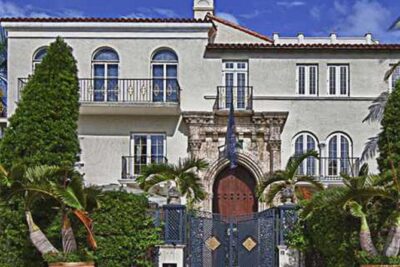
The Official Art Deco Walking Tour by The Miami Design Preservation League
Read our review →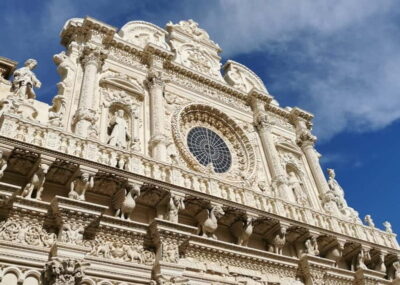
Baroque Architecture and Underground Walking Tour
Read our review →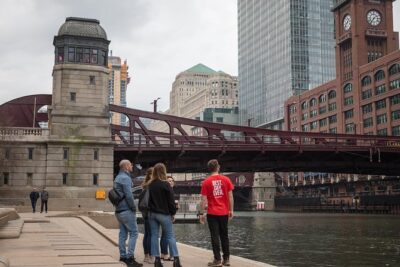
Chicago in a Day: Food, History & Architecture Walking Tour
Read our review →

Ramblas, Old Town, Gothic and Gaudi Architecture Walking Tour
Read our review →
Chicago’s Secret Interiors Architectural Walking Tour
Read our review →
Browse the lists this tour appears in