
Review · HISTORICAL TOURS
Rotterdam Must Do Tour: Highlights, History, WW2 and Architecture
Rotterdam’s story is written in concrete, steel, wood, and bright murals. Much of the old city was destroyed during the Second World War, and this two-hour walk shows how Rotterdam rebuilt itself with daring architecture instead of copying the past. You’ll move from Rotterdam Centraal to the Markthal and Old Harbour, with the Cube Houses as a memorable finish.
I like the small maximum group of 15, which gives a guide room to answer questions and adjust the pace. I also like the mix of major sights and lesser-known projects, especially the 390-meter Luchtsingel bridge and the rebuilt Delft Gate. The main drawback is time: two hours is brisk, and one past guest had to shorten the walk because of a late ship arrival.
Key points about this Rotterdam walk
- Postwar Rotterdam in plain view: Learn how the 1940 bombing shaped the city’s streets, shops, and modern skyline.
- A strong architecture route: See the Groot Handelsgebouw, Lijnbaan, Luchtsingel, Markthal, and Cube Houses.
- A local guide makes the difference: Guides named Michel, Susan, Edwin, John, Ed, and Stephan have led this experience.
- Small-group format: The group is capped at 15 people, making conversation easier than on a large coach tour.
- Easy central meeting point: The walk begins at Rotterdam Centraal, close to public transportation.
- Good value for a short orientation: At $29.41, it gives you two hours of context before you explore on your own.
Why Rotterdam’s rebuilding makes this walk worthwhile
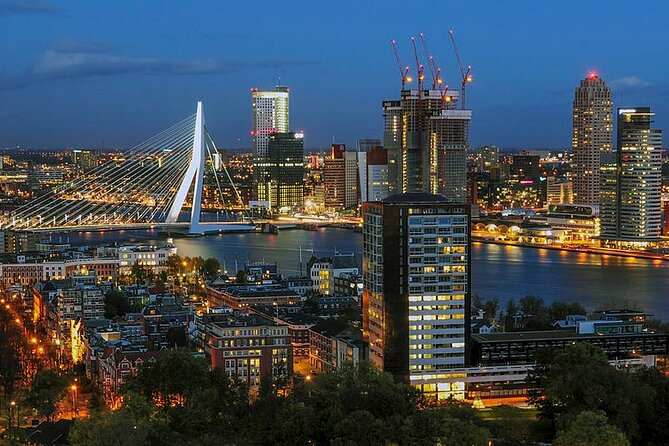
Rotterdam can feel unlike other Dutch cities. Instead of a nearly intact medieval center, you find broad streets, sharp angles, towers, elevated roads, and buildings that seem to test what a city can be. That difference is not accidental. It comes from wartime destruction and the decisions made during reconstruction.
This tour gives you a useful frame for reading the city. The guide explains the harbor, the bombing during the Second World War, and the rebuilding that followed. You are not simply ticking off unusual buildings. You are seeing how Rotterdam turned a painful break with the past into a new architectural identity.
I find that context especially helpful at the Lijnbaan. Today it is Rotterdam’s main pedestrian shopping street, but it was created in 1953 after the former shopping district had been destroyed. The street makes more sense when you understand that it was part of a planned new center, not an old lane that slowly became popular.
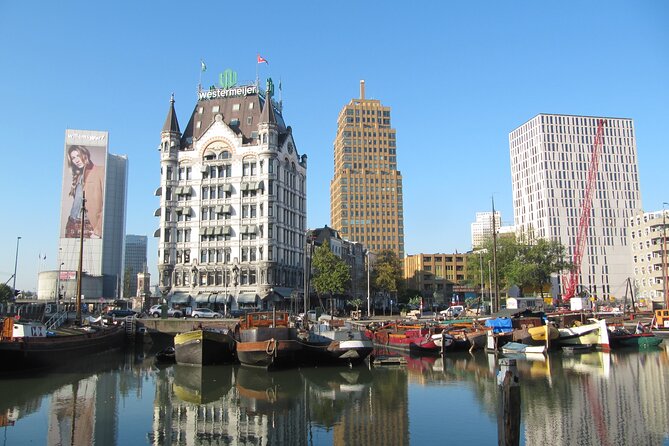
The same idea comes through at the Groot Handelsgebouw. Completed in 1953, it was one of the first major buildings put up after the bombing. Its importance is less about a single grand detail and more about what it represents: Rotterdam getting back to work.
More History Walks in Netherlands:
- Rotterdam: Highlights, Gems, Architecture & History Walk
★ 5.0 · 191 reviews - The rise of Haarlem: Culture, History, Art and Architecture Walking Tour
★ 5.0 · 59 reviews - Gouda Private Walking Tour: History, Architecture & Cheese
★ 4.5 · 8 reviews
Starting at Rotterdam Centraal
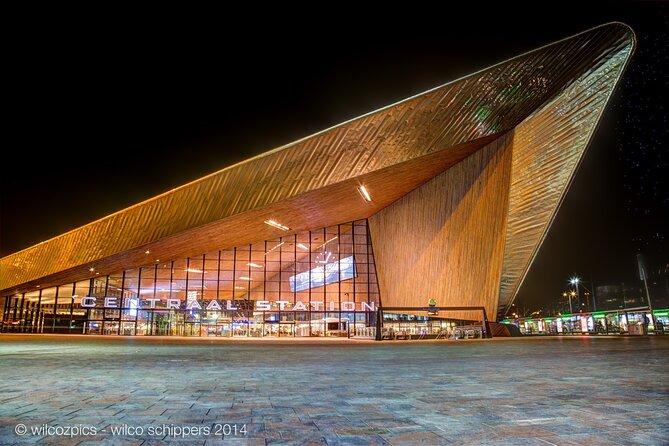
Meet your guide at Stationsplein 10, outside Rotterdam Centraal. This is a practical starting point if you arrive by train or use local transportation, and it gives the walk a clear visual introduction. The station itself is one of the city’s modern architectural landmarks.
The guide begins by explaining Rotterdam’s architecture and setting the route in context. Guides have included Michel, Susan, Edwin, John, Ed, and Stephan, so the exact tone will depend on who leads your group. The strongest feedback focuses on guides who combine facts with stories and make the city feel personal rather than lecturing from a script.
Allow a few minutes to find the meeting point and identify your guide. The supplied meeting information gives the station address, but it does not describe a special booth or indoor meeting area. Since the tour is on foot, comfortable shoes are sensible.
Groot Handelsgebouw and the first postwar clues
The Groot Handelsgebouw gives the tour an early anchor. Built in 1953, it belongs to the first wave of major postwar construction. Your guide uses it to explain how Rotterdam recovered after the bombing and why business and trade were central to the city’s return.
This stop is valuable because it keeps the history tied to a real building. You are not hearing a general account of wartime damage and then moving on. You are looking at one of the structures that helped mark Rotterdam’s return to normal life.
The visit is brief, listed at about ten minutes. I would treat it as a close look and a short explanation, not an architectural tour of the interior. If you want to study the building in detail, you will need extra time after the walk.
West-Kruiskade and Lijnbaan
The route continues through the Kruiskade and West-Kruiskade shopping streets. These streets help show the everyday side of central Rotterdam, with shops and city life replacing the formal language of monuments.
Then comes the Lijnbaan, one of the route’s most useful history stops. Opened in 1953, it was designed as the main pedestrian shopping street in the new center. Its creation followed the destruction of the old shopping district, so its broad, planned character reflects a fresh start.
I like this part of the route because it connects architecture with daily use. Rotterdam’s rebuilding was not only about striking towers. It also involved designing places where people could shop, walk, and meet in a city center that had been badly damaged.
The shopping streets can make the walk feel less scenic than the Markthal or Old Harbour. That is part of the point, though. You are seeing how the rebuilt city works, not just visiting its most photogenic corners.
A few more architecture walks in Netherlands worth a look
- Rotterdam: Architectural Highlights Guided Walking Tour
★ 4.8 · 215 reviews - Rotterdam Walk: Hilights, Gems, Architecture & WWII | 2 or 3hrs
★ 5.0 · 149 reviews - Rotterdam Architecture Highlights Walking Tour
★ 5.0 · 66 reviews - Rotterdam: Architecture Highlights Tour including the Depot
★ 4.6 · 17 reviews
Luchtsingel: a bridge with a second life
The Luchtsingel is a 390-meter wooden pedestrian bridge linking Rotterdam North with the city center. It crosses an area that had suffered from vacancy and neglect, bringing movement and a new purpose to a part of town that had been overlooked.
This is one of the tour’s more distinctive stops. The bridge is not an old monument, and it does not tell a story about Rotterdam’s medieval past. Instead, it shows a newer approach to city improvement: reconnecting separated areas with a simple public walkway.
You will likely hear how the bridge helped give an abandoned area a new role. That makes it a useful counterpoint to the postwar buildings. Rotterdam’s rebuilding did not end in the 1950s. The city continues to reshape unused spaces.
The stop is listed at roughly ten minutes, so expect an explanation and a walk across part of the bridge rather than a long pause. If you enjoy urban design and public projects, this may be one of your favorite sections.
The Nieuwe Delftse Poort and a lost city gate
The Delftse Poort was once a city gate. The last version was built in 1764, and a later steel reconstruction by artist Cor Kraat was erected near the original site at Pompenburg.
This stop shows how Rotterdam handles the remains of its older identity. The original gate is gone, but its place in the city has not been forgotten. The reconstructed steel version is not a conventional restoration. It is an artistic reminder of what once marked the edge of Rotterdam.
That distinction matters. You are not seeing a perfectly preserved medieval entrance. You are seeing a modern interpretation of a lost landmark. Your guide can help explain why the city chose a contemporary form rather than trying to recreate the past in stone.
Because the stop is short, the value comes from the explanation. Without context, the structure may be easy to pass. With context, it becomes part of the larger story of a city balancing memory and reinvention.
Laurenskerk, Rotterdam’s medieval survivor
The Grote of Sint-Laurenskerk is the only surviving remnant of medieval Rotterdam. It is now a Protestant church, and you can enter for free.
After the modern buildings and postwar planning, the church offers a sharp change in mood. It reminds you that Rotterdam once had a more traditional historic center, much of which disappeared in the bombing. The church is therefore not just a religious building. It is a physical link to the city that existed before the war.
The itinerary allows about ten minutes here. That is enough for an exterior explanation and, if open, a short look inside. I would not expect a full church tour or extended interior visit within this compact walk.
If you care about historic buildings, pay close attention at this stop. It may be the moment when the scale of the wartime loss becomes clearest. The modern center is impressive, but this one surviving church helps you picture what came before it.
Markthal and the city’s bold new center
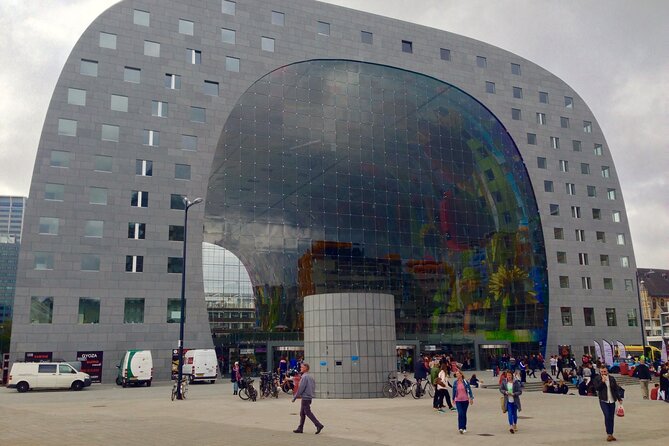
The Markthal is one of Rotterdam’s most recognizable buildings. Designed by MVRDV, it has a large horseshoe-shaped structure faced with gray natural stone. Inside, the ceiling carries an enormous artwork of enlarged fruits, vegetables, seeds, fish, flowers, and insects.
The Markthal is both a market building and a piece of public art. It is also one of the few stops where you can pause for food after the guided portion, though food and drinks are not included in the tour price.
The listed visit is about 30 minutes, making it one of the longer stops. That gives your guide time to explain the design and the surrounding area, while you can look up at the interior artwork and see how the building functions as a public space.
I would save your appetite for after the guide’s explanation if you want to browse the food stalls. The tour does not include meals, and the price covers the guide rather than purchases inside the hall.
One possible weakness is that the experience of the Markthal depends heavily on the guide. A past guest felt the artistic qualities of the building were not explained fully, while other accounts praise guides for bringing Rotterdam’s buildings to life. If Markthal is your main reason for booking, listen closely and ask questions.
Oude Haven and the Cube Houses
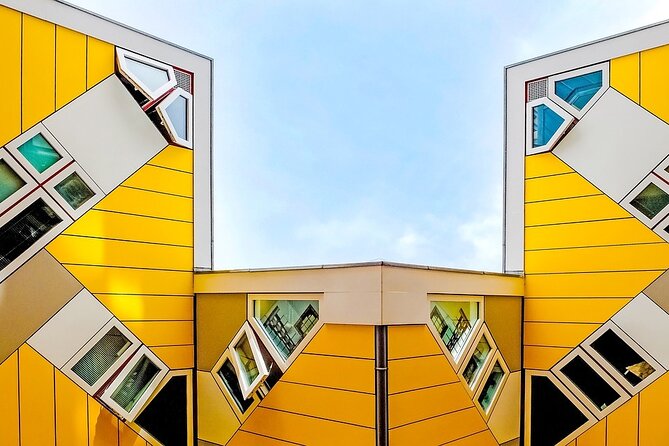
The walk ends around the Oude Haven, or Old Harbour, a historic port area in the city center on the north side of the Maas. It is now a lively city district and home to the famous Cube Houses.
This is a satisfying final section because it pulls together several themes from the tour. You see Rotterdam’s relationship with water, its older harbor identity, and its modern taste for unusual architecture in one place.
The Cube Houses are hard to miss. Their tilted forms turn ordinary ideas about homes and streets upside down. The tour focuses on seeing the area and understanding its place in Rotterdam’s architecture. It does not state that entry into a Cube House is included, so do not assume an interior visit.
The Oude Haven stop is listed at about 20 minutes. That is enough to see the buildings, hear the story, and take photographs, but you may want to return later if you want a slow meal or a longer look.
Because the official end point is back at the meeting point, check the guide’s instructions on the day. The route description places the main sights through the center and Old Harbour, but the stated end information says the activity finishes at the meeting point. If you have a train, ship, or timed reservation, leave a cushion.
What two hours really gives you
This is a compact introduction, not a full-day study of Rotterdam. The route covers many stops, and several are assigned only about ten minutes. You will see a lot, but you will not have time to linger at every building.
That pace works well if you have a short stay or want a city orientation before exploring alone. It also suits cruise passengers and first-time visitors who need the main story quickly. One guest with a delayed ship arrival managed a shortened version by working with the local contact and guide, but the walk became fast. I would not plan on that kind of flexibility if your schedule is extremely tight.
The group limit of 15 is a real advantage. It should be easier to hear the guide, ask about buildings, and keep the group together than on a large city tour. The experience is offered in English, and mobile tickets are accepted.
Most people can take part, and service animals are allowed. The route is in a central urban area and uses public streets and pedestrian paths, but the provided information does not give detailed accessibility notes for every section.
Is $29.41 a fair price?
At $29.41 per person, I consider this a reasonable price for a two-hour guided introduction, especially if you value explanations more than admission tickets. The church entry is free, and the listed stops do not require paid admission. Your money mainly buys the guide’s time, route planning, and historical context.
The value is strongest when the guide is active and specific. Susan is described as helpful with both buildings and shopping suggestions. Edwin is associated with clear explanations of Rotterdam’s reconstruction and architecture. Michel is praised for covering the key parts of the city, while Ed, John, and Stephan are also described as engaging guides.
The price is less attractive if you want long visits, museum interiors, or food included. You will need to pay for anything you eat at the Markthal, and the tour does not include drinks. Still, for a first look at a city whose meaning is tied so closely to its rebuilding, the cost is modest.
Group discounts may be available, which could improve the value for families or parties. The supplied details do not specify the discount amount, so check the price shown for your group before booking.
Who should book this walking tour?
I would choose this tour if you want Rotterdam explained rather than simply photographed. It fits first-time visitors, architecture fans, history-minded visitors, and anyone with only a few hours in the city.
It is also a good choice if you prefer a small group and a local guide. The strongest guide accounts describe friendly conversation, clear history, and pride in Rotterdam. That personal connection can turn a collection of odd-looking buildings into a city with a clear story.
I would hesitate if you want a slow photographic walk or a deep look inside each landmark. The route covers a lot of ground, and the short stops require attention. You should also leave room in your schedule if you need to catch a ship or train afterward.
Free cancellation is available up to 24 hours before the start time. Changes or cancellations inside that 24-hour window are not accepted for a refund, and the tour requires a minimum number of participants. If that minimum is not met, you are offered another date or experience, or a full refund.
My verdict on Rotterdam’s two-hour introduction
I recommend this walk for a fast, useful first look at Rotterdam. Its best quality is the way it links the Second World War, reconstruction, shopping streets, public projects, and bold architecture in one route.
Book it when you want a guide to help you read the city, especially if Michel, Susan, Edwin, John, Ed, or Stephan is leading. Skip it if you already know Rotterdam well or want a slower tour with long interior visits. For most first-time visitors, $29.41 is a fair trade for two hours of orientation and a clearer understanding of why Rotterdam looks the way it does.
FAQ
How long does the Rotterdam walking tour last?
The experience lasts approximately two hours. The route includes several short stops, so the pace is compact and designed to cover many central sights.
Where does the tour begin?
The meeting point is Stationsplein 10, 3013 AJ Rotterdam, at Rotterdam Centraal Station.
Where does the tour end?
The activity information states that it ends back at the meeting point.
What sights are included?
The route includes Rotterdam Centraal, Groot Handelsgebouw, West-Kruiskade, Lijnbaan, Luchtsingel, Nieuwe Delftse Poort, Grote of Sint-Laurenskerk, Markthal, Oude Haven, and the Cube Houses.
Is the tour offered in English?
Yes. The experience is offered in English.
How large is the group?
The tour has a maximum of 15 participants.
Is food included?
No. Food and drinks are not included, although the Markthal has restaurants and food sellers where you can make your own purchases.
Newly added in Netherlands
- Private Rotterdam Walking Tour – guided by Architects★ 5.0 · 2 reviews
- Rotterdam Architecture and Highlights Walking Tour (TOP RATED)★ 4.5 · 14 reviews
- Maastricht Highlights, Architecture & Heritage Tour★ 5.0 · 7 reviews
- Gouda Private Walking Tour: History, Architecture & Cheese★ 4.5 · 8 reviews
- Rotterdam: Art and Architecture Highlights Walking Tour★ 4.9 · 10 reviews
- Rotterdam: Architecture Highlights Tour including the Depot★ 4.6 · 17 reviews
- Rotterdam Architecture: Centre and South Bank with watertaxi★ 5.0 · 4 reviews
- Rotterdam: Wilhelminapier, High-rise & floating architecture★ 4.0 · 3 reviews
Historical Tours, compared.
Chicago in a Day: Food, History & Architecture Walking Tour
Read our review →
Charleston’s Best Highlights: History, Culture & Architecture
Read our review →
Palm Springs Modernism Architecture & History Bike Tour
Read our review →
Historic Georgetown: History, Gossip, & Architecture Walking Tour
Read our review →
Charleston History, Homes, and Architecture Guided Walking Tour
Read our review →
Historical and Architectural Chicago Fireboat River & Lake Cruise
Read our review →Browse the lists this tour appears in