
Review · WALKING TOURS
Rotterdam: Architectural Highlights Guided Walking Tour
Rotterdam makes more sense when someone explains why its buildings look so different. This 2-hour architect-led walk links the rebuilt city center with the Maas waterfront, showing how wartime destruction, postwar planning, modern design, and future development shaped what you see.
I like the clear route from Rotterdam Centraal to the river, and I like that guides such as Tania, Silvia, and Tanya put buildings into social and historical context rather than simply naming them. The main drawback is the pace: you cover 3 to 4 km in two hours, so there is limited time for long stops or side trips.
- Starts under the clock at Rotterdam Centraal, an easy meeting point for visitors arriving by train.
- Explains Rotterdam’s rebuilding after the 1940 bombing, not just the appearance of its buildings.
- Covers several design eras, from City Hall and Lijnbaan to Timmerhuis, Markthal, and the Cube Houses.
- Ends by the Maas, with views toward the Erasmus Bridge and new South Bank development.
- Uses working architects as guides, including Tania, Silvia, Tanya, Tina, and others who explain design choices in plain English.
- Works well as a first Rotterdam activity, but comfortable shoes are essential and the tour runs in rain or shine.
Why Rotterdam Needs an Architecture Walk
Rotterdam is not a city you understand by ticking off old monuments. Its character comes from the collision of eras: prewar buildings, wartime loss, postwar modernism, experimental housing, giant public buildings, and new towers along the water.
That is why I see this tour as more than a sightseeing stroll. You are not simply shown a striking building and told its name. You are given a way to read the city. A guide explains how Rotterdam’s industrial past, changing population, transport needs, and planning choices affected its streets.
The bombing of 1940 is central to that story. Much of the historic center was destroyed, leaving city planners with an unusual amount of room to rethink the heart of Rotterdam. The result is a city that can feel deliberately modern, sometimes practical, sometimes playful, and occasionally puzzling.
An architect guide is useful here because design details can be easy to miss. A building’s shape, height, materials, open space, or position may relate to traffic, housing, commerce, sunlight, or the larger plan for the city. Without that context, you may see a collection of odd-looking structures. With it, the city becomes a long-running argument about how urban life should work.
Starting Beneath the Clock at Rotterdam Centraal
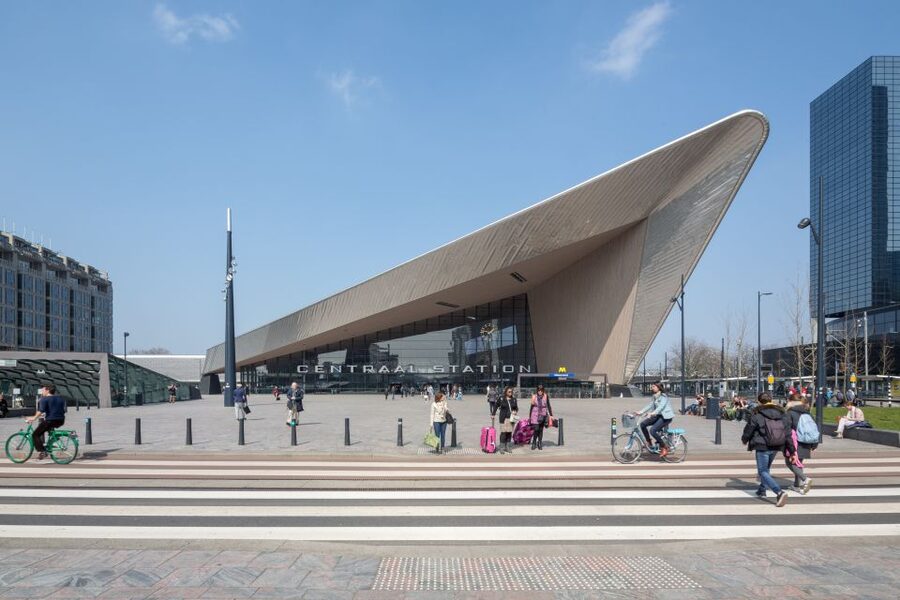
The meeting point is under the clock at Rotterdam Centraal Station. This is a sensible place to begin, especially if Rotterdam is part of a rail trip through the Netherlands. You can arrive by train, find the large station hall, and meet the guide without making your way across the city first.
The station itself provides the opening lesson. Its recently built design presents Rotterdam as a forward-looking city, while the station’s role as a transport hub shows how architecture and daily life overlap. Your guide uses the area to introduce Rotterdam’s scale, movement, and modern identity.
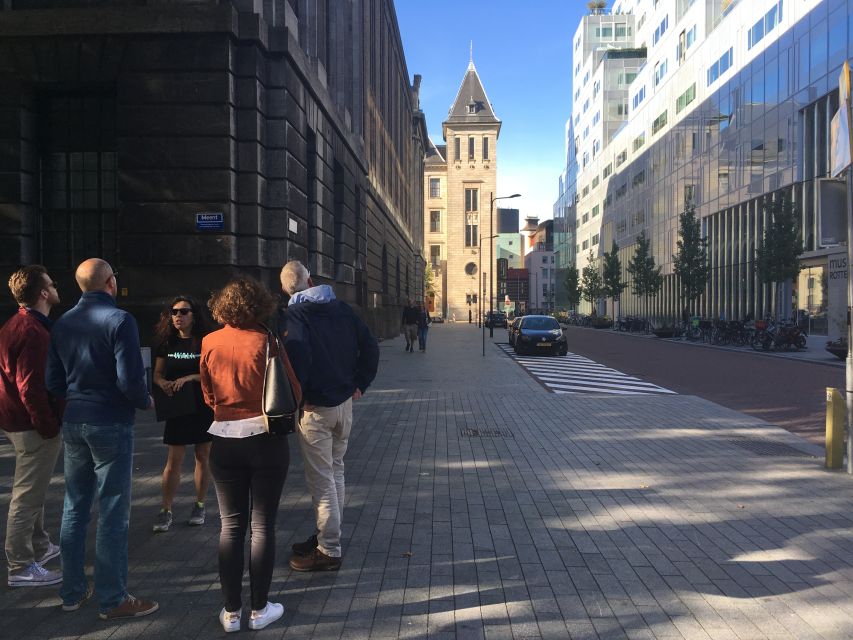
From here, you walk toward the center. The route is not a museum tour with long indoor stops. It is a moving conversation, so expect to listen outdoors, cross streets, and keep up with the group. The walk covers about 3 to 4 km, which is manageable for most people who are comfortable walking, but it is not a slow, one-block-at-a-time outing.
This is also where you should judge the guide’s style. The best guides on this route, including Silvia, Tania, Tanya, Tina, and others named by participants, have been praised for being friendly, prepared, and willing to answer questions. Some have brought historical photographs to show how the city changed. That sort of visual aid can make the rebuilding story far easier to grasp.
More Walking Tours in the world:
- Lecce: Baroque Architecture and Underground Walking Tour
★ 4.6 · 1,248 reviews - Chicago in a Day: Food, History & Architecture Walking Tour
★ 5.0 · 1,153 reviews - Ramblas, Old Town, Gothic and Gaudi Architecture Walking Tour
★ 5.0 · 723 reviews
Lijnbaan and the Shape of the Postwar City
The Lijnbaan area gives you an early look at postwar planning. It is not included simply as a shopping street. It helps explain how Rotterdam tried to create a new kind of city center after wartime destruction.
Here, the guide can connect pedestrian movement, retail, public space, and the changing idea of what a central street should be. You begin to see that Rotterdam’s architecture is not only about individual buildings. It is also about how people move between them.
I find this part especially useful for first-time visitors because it creates a reference point for the rest of the walk. Later buildings may look more dramatic, but Lijnbaan helps you understand the planning decisions behind the modern center. The tradeoff is that the tour cannot pause at every detail. If you want a close study of one district, a private version may give you more room for questions.
City Hall, Timmerhuis, and Layers of Design
The route continues through several major civic and commercial buildings, including City Hall and the Timmerhuis. These stops show how Rotterdam moved through different design periods rather than following one tidy architectural style.
City Hall gives the group a chance to consider public architecture and the image a city wants to present. Timmerhuis offers a more recent contrast, with a form that reflects Rotterdam’s interest in new construction and flexible city-center development.
Your guide’s role matters here. A basic city walk might point out the buildings, but an architect can discuss why a structure was shaped or placed as it was. The explanations also connect architecture with urban development, a subject that several participants found particularly helpful.
Do not expect a technical lecture aimed at architecture students. The tour is designed for ordinary visitors, including people with little background in design. The strongest guides adjust their explanations to the group and make the subject approachable. That makes this a good choice if you are curious about buildings but do not want a specialized course.
One small caution: English delivery can vary by guide. Most comments describe clear, friendly communication, but one participant found a strong Spanish accent occasionally hard to follow. If you have difficulty hearing outdoors, stay close to the guide and ask questions when needed.
Sint Laurens Church and the Memory of Old Rotterdam

The Sint Laurens church adds an important change of mood. After the modern station, retail planning, and newer office buildings, this historic church reminds you that Rotterdam did have an older center before the war.
Its presence makes the city’s break with the past more visible. You are not moving through a place that simply grew in a steady line from medieval streets to modern towers. You are seeing remnants, reconstruction, and fresh planning placed beside one another.
The church also helps prevent the tour from becoming a parade of contemporary design. Rotterdam’s story includes older civic and religious structures, industrial growth, wartime loss, and the choices made afterward. A good explanation here gives you a stronger sense of what was lost and what the city chose to build in its place.
Because the whole tour lasts only two hours, the stop is mainly about setting context from the outside. If your main goal is to visit interiors, this is not the right format. The value comes from seeing the church in relation to the surrounding city.
More Guided Tours in the world:
- Chicago River: 1.5-Hour Guided Architecture Cruise
★ 4.8 · 8,046 reviews - Charleston: History and Architecture Guided Walking Tour
★ 4.8 · 349 reviews - Vienna: Spanish Riding School Guided Architectural Tour
★ 4.8 · 333 reviews - Charleston History, Homes, and Architecture Guided Walking Tour
★ 5.0 · 267 reviews
Inside the Markthal
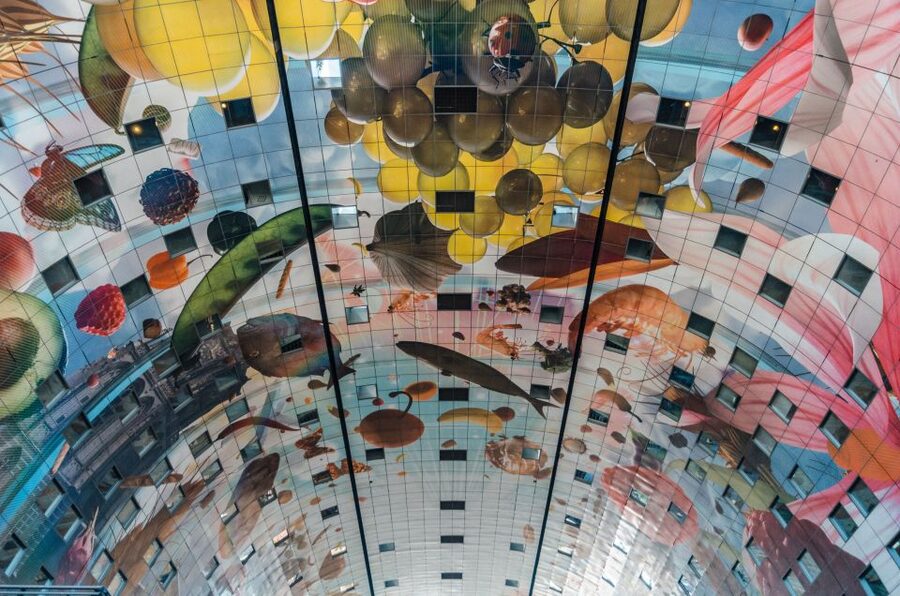
The Markthal is one of the walk’s most memorable stops because you go inside rather than viewing it only from the street. The building combines a market, food businesses, housing, and a huge interior artwork, giving the guide plenty to discuss about mixed-use city design.
This is a useful moment to consider how Rotterdam puts public activity inside large modern structures. The Markthal is not just a place to admire. It is also part of the city’s everyday life, and that practical side matters when you are comparing it with more purely visual landmarks.
You may have time to look around as the guide explains the building, but do not expect a full food tour. Food and drinks are not included, and the activity is built around architecture rather than tasting. If you want to browse market stalls or stop for lunch, plan to return later or allow extra time after the walk.
The Markthal also provides a welcome indoor pause if the weather is poor. Still, the tour operates rain or shine, and much of the route is outdoors, so bring suitable clothing rather than counting on this one interior stop.
The Cube Houses: Admire Them, Question Them
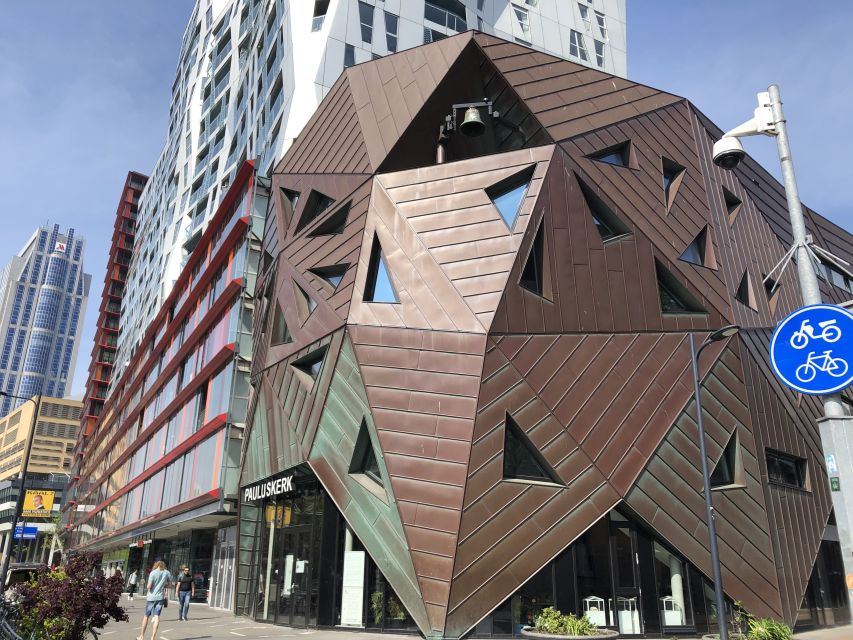
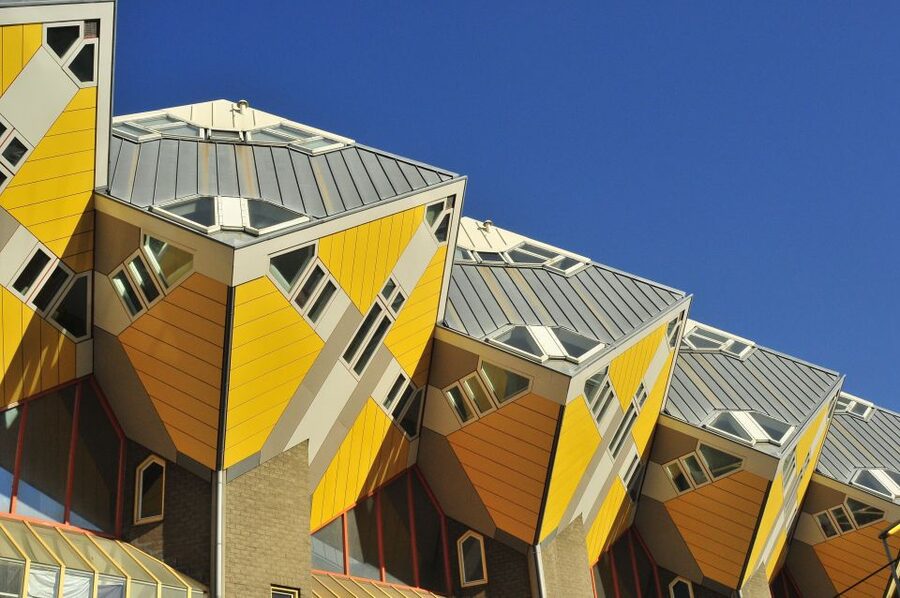
The row of Cube Houses comes next, and this is one of the places where the tour benefits from an honest guide. Their tilted yellow forms are among Rotterdam’s best-known images, but the design is not beyond criticism.
You will hear why the houses look the way they do and how their unusual geometry relates to the idea of creating a village above the city. You also have the chance to look past the postcard image and consider practical questions about windows, space, furniture, and daily life.
One participant specifically felt it was time to stop treating the Cube Houses as an unquestioned success. That is a fair reminder that unusual architecture is not automatically good architecture. The tour is strongest when it gives you room to form your own opinion instead of insisting that every famous building must be admired.
The houses are viewed as part of the walking route, not presented as a long private visit. If you want an interior look, check what is open separately, since that is not included in the tour details.
Reaching the Maas and the Erasmus Bridge
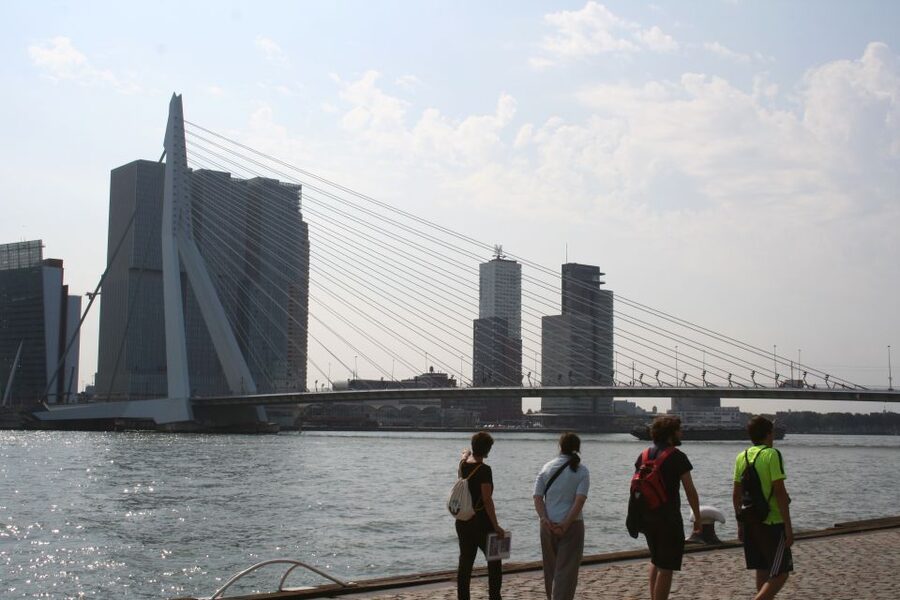
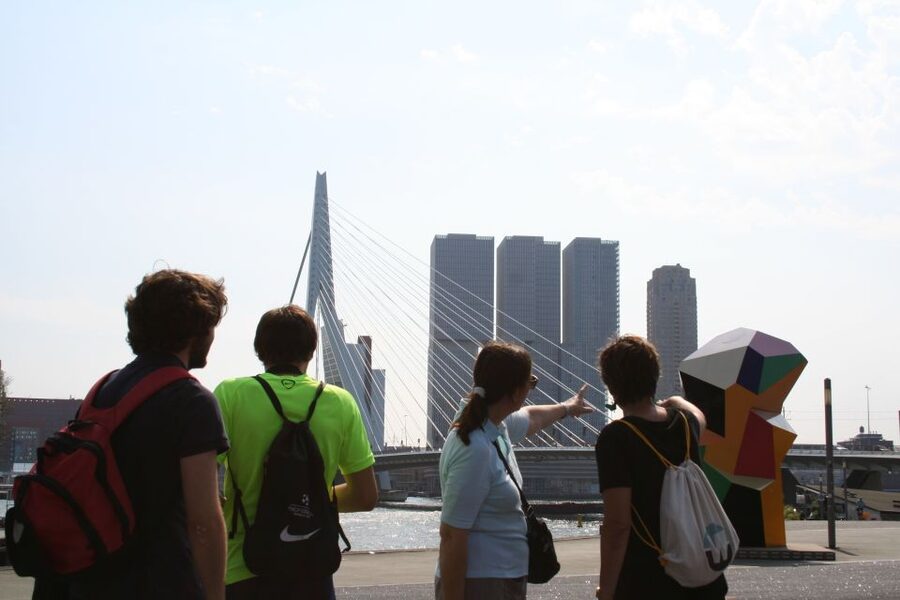
The walk finishes by the riverside, where the city opens toward the Maas and the newer development on the South Bank. The change in scale is striking. You move from streets and individual buildings to a broad view of towers, water, bridges, and ongoing urban growth.
The Erasmus Bridge is the natural closing image. Its shape has become one of Rotterdam’s defining symbols, but the guide adds value by placing it within the city’s wider development. You learn how the waterfront is changing and how the South Bank fits into Rotterdam’s plans for the future.
This ending works well because it connects the tour’s two main themes: Rotterdam’s past damage and its willingness to build ahead. The city is not presented as finished. It continues to test new ways of using its riverfront and central districts.
The waterfront is also where the tour can feel a little rushed. You have covered several kilometers and reached the final major view near the end of the two-hour limit. Some participants wished for four hours instead. If you want time for photographs, questions, or a closer look at harbor-area buildings, treat this walk as an introduction and explore further afterward.
What the $53 Price Buys You
At $53 per person, this is not the cheapest way to walk around Rotterdam. You can see the exteriors of many buildings on your own for free. The question is whether the guide’s explanations are worth paying for.
For me, the price makes sense if you want the city’s buildings explained in context. You are paying for a planned route, an English-speaking architect, and a clear account of how Rotterdam developed over roughly the last 80 years. The tour also saves you from spending your first day trying to work out which buildings matter and why.
The value improves for architecture fans, urban-planning enthusiasts, and visitors who enjoy learning how cities function. It is also a strong first activity because the route introduces the center, Markthal, Cube Houses, and waterfront in one morning or afternoon.
The value is less convincing if you prefer slow photography, shopping, food stops, or free time at each sight. The set route moves at a steady pace, and transportation, food, and drinks are not included. You should also compare the cost against the group arrangement available for your booking, since a private group may make sense for families or a small party that wants more flexibility.
Who Will Enjoy This Walk Most?
I would choose this tour for you if you like cities more once you understand the decisions behind them. It suits first-time visitors, architecture fans, design students, urban planners, and anyone curious about Rotterdam’s postwar identity.
It also works for people who normally find architecture tours too technical. The route is designed for a general audience, and the best guides explain form and function in everyday language. The repeated praise for friendly pacing and thoughtful answers suggests that the human side of the tour is a major part of its appeal.
Families can bring children aged 0 to 12 free of charge. Parents should think carefully about the 3 to 4 km distance, the two-hour duration, and the amount of spoken information. Younger children may enjoy the Cube Houses and Markthal more than the longer discussions about planning.
You should think twice if you dislike walking in bad weather, need frequent breaks, or want a flexible route. The tour operates in rain or shine, and one participant suggested adding more pauses for slower walkers. Comfortable shoes and weather-appropriate clothing are not optional extras here.
Practical Details Before You Book
The tour is in English and includes a walking tour with an architect guide. Meet under the clock at Rotterdam Centraal Station, not at the Markthal or the waterfront.
Plan on two hours and 3 to 4 km of walking. There are no transportation costs included, but the route itself is designed as a walk from the station toward the river.
The experience is wheelchair accessible, though you may still want to confirm the route details for your particular needs when booking. A private group is available, which may be useful if you want to ask many questions or keep the pace tailored to your party.
You can cancel up to 24 hours in advance for a full refund, and the reserve-now, pay-later option keeps your plans flexible. Check the available starting times before you book, since the tour schedule can vary.
Should You Book the Rotterdam Architecture Tour?
Book it if you want Rotterdam to become more than a collection of photogenic buildings. The architect guides, especially the repeatedly praised Tania, Silvia, Tanya, and Tina, bring the city’s rebuilding, planning, and design choices together in a way that is hard to reproduce with a guidebook.
Skip it if your priority is shopping, food, long visits inside buildings, or a slow photography walk. The route is fixed, the pace is steady, and two hours is barely enough for a city with this much architectural material.
For most first-time visitors, I would take the tour early in your stay. It gives you a useful framework for the Lijnbaan, Timmerhuis, Markthal, Cube Houses, and Erasmus Bridge, then leaves you better prepared to return to the places that deserve more time.
FAQ
Where does the Rotterdam architecture tour meet?
Meet the guide at Rotterdam Centraal Station, underneath the clock.
How long does the walking tour last?
The tour lasts 2 hours.
How far do you walk?
The route covers approximately 3 to 4 km.
What language is the tour in?
The live tour is conducted in English.
Which buildings and areas are included?
The walk includes Rotterdam Centraal, the Lijnbaan area, City Hall, Timmerhuis, Sint Laurens church, the Markthal, the Cube Houses, and the riverside area near the Erasmus Bridge.
Is an architect included as the guide?
Yes. The tour is led by a local architect guide.
Is the tour wheelchair accessible?
Yes, the activity is listed as wheelchair accessible.
Can children join the tour?
Children aged 0 to 12 can join for free. Parents should consider the walking distance, the content, and the two-hour duration.
What should I bring?
Bring comfortable shoes and clothing suitable for the weather. The tour operates rain or shine.
Newly added in the world
- Venice Art and Architecture Private Walking Tour★ 4.5 · 11 reviews
- Basilica San Marco and the Pala d’Oro with Architect Guide★ 4.5 · 19 reviews
- Walking tour in Venice with an architect★ 5.0 · 16 reviews
- Private Munich Tour for History Buffs with Architectural Gems and WWII sites★ 5.0 · 3 reviews
- Neoclassical Paris Architecture 2-Hour Private Walking Tour★ 5.0 · 7 reviews
- Street Art and Architecture:Porto Speaks Through Its Streets★ 3.0 · 2 reviews
- Wrocław Architecture Cruise by Catamaran★ 4.7 · 25 reviews
- Paris: Discover the hidden architecture gems of Le Marais★ 3.8 · 4 reviews
Walking Tours, compared.
The Official Art Deco Walking Tour by The Miami Design Preservation League
Read our review →
Baroque Architecture and Underground Walking Tour
Read our review →
Chicago in a Day: Food, History & Architecture Walking Tour
Read our review →

Ramblas, Old Town, Gothic and Gaudi Architecture Walking Tour
Read our review →
Chicago’s Secret Interiors Architectural Walking Tour
Read our review →
Browse the lists this tour appears in