
Review · NETHERLANDS ARCHITECTURE TOURS
Amsterdam, Eastern Docklands Architecture: Private Tour
Amsterdam’s Eastern Docklands is where old harbor infrastructure meets bold housing design. On this private walk, you move through Java, KNSM, Borneo, Sporenburg, and Riet Landen, seeing how a working port became a desirable residential district without losing its industrial character.
I like the close comparison between Java and KNSM, two islands shaped by a shared idea but given very different architectural answers. I also like the guide-led focus: guides have academic backgrounds in architecture, sociology, or art history, and the walk can be adjusted to your group. The main drawback is its narrow subject. If modern architecture and urban planning do not interest you, two hours of buildings, density, and development theory may feel like hard work.
Key points at a glance
- Five distinct districts: Visit Java, KNSM, Borneo, Sporenburg, and Riet Landen in one focused walk.
- A useful island comparison: Java and KNSM follow a related concept, yet their final designs look strikingly different.
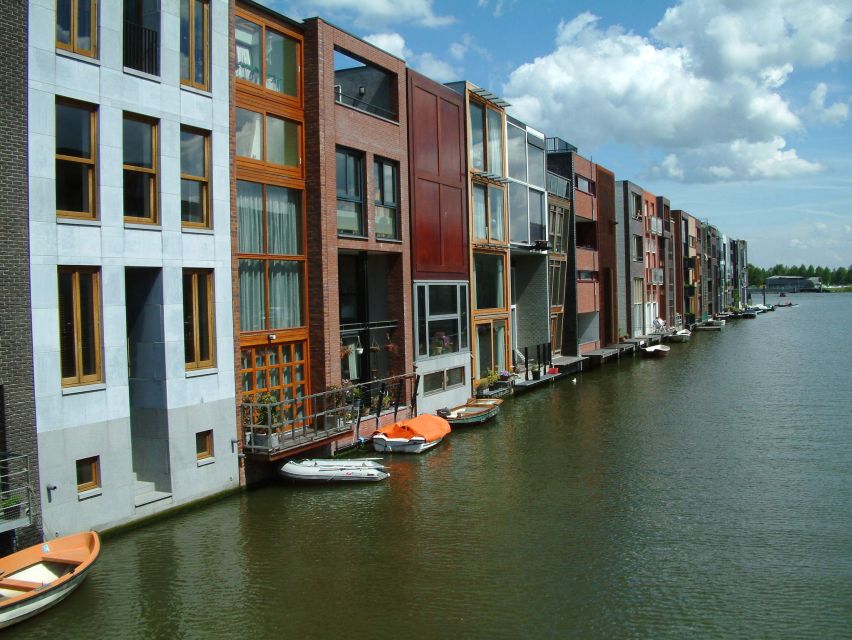
- Low-rise housing at high density: Borneo and Sporenburg show how single-family homes can fit into a setting often given to tall apartment blocks.
- A clever traffic solution: Riet Landen brings together a major junction, a park, and housing in one carefully planned area.
- Academic guidance: Guides have studied fields such as architecture, sociology, and art history, with some also working as architecture and heritage journalists.
- Private and flexible: The walk costs $235 for a group of up to 10, with a two or three-hour format adapted to your needs.
Why Amsterdam’s Eastern Docklands deserves your time
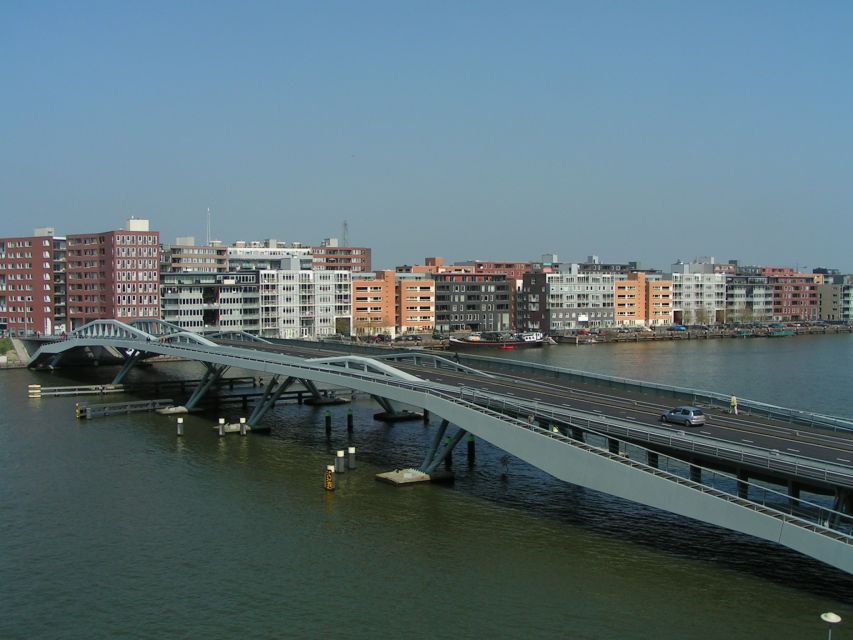
Amsterdam is often pictured through canals, narrow houses, and old bridges. The Eastern Docklands gives you a different city: broad water, former warehouses, new housing, and urban experiments from the late 20th century.
Since the 1970s, this former harbor has changed from a modest working port into a sought-after residential district. Much of the key development took place during the 1980s and 1990s, with further work continuing into the new millennium.
That timing matters. The area was not simply cleared and replaced with anonymous apartment blocks. Instead, planners and architects had to work with docks, islands, industrial traces, and the demands of modern city life.
I find that this makes the walk more useful than a simple architecture photo stop. You are not only looking at façades. You are asking practical city questions: How much housing can fit near water? Can a neighborhood feel private without becoming isolated? Can family homes work in a dense urban district? What happens when cars, parks, homes, and old port routes all meet?
The answers change from one district to the next. That variety gives the walk its shape.
More Private Tours in the world:
- Best of Chicago: Architecture & Highlights City Private Tour
★ 5.0 · 94 reviews - Private Harajuku Omotesando Architecture Walking Tour
★ 5.0 · 67 reviews - Private Santa Barbara History and Architecture Walking Tour
★ 5.0 · 56 reviews
Meeting at Pakhuis De Zwijger
The walk begins in front of Pakhuis De Zwijger, next to Jan Schaeferbrug. This is a sensible meeting point for a tour about the Eastern Docklands because it places you beside the former harbor area rather than in central Amsterdam’s older core.
You should arrive ready to walk outdoors for two or three hours. Food and drinks are not included, and no transfer is provided, so plan to reach the meeting point independently and bring what you need for the duration.
Large bags and luggage are not allowed. That is worth taking seriously if you are heading directly from a train station, airport, or hotel checkout. A small day bag is the safer choice, but the stated restriction specifically rules out large luggage.
The tour is wheelchair accessible. Because the walk is private, you can also discuss the pace and interests that matter most to your group. The included walk can last two or three hours, so confirm the exact format and starting time when you book.
Java and KNSM, one idea with two results
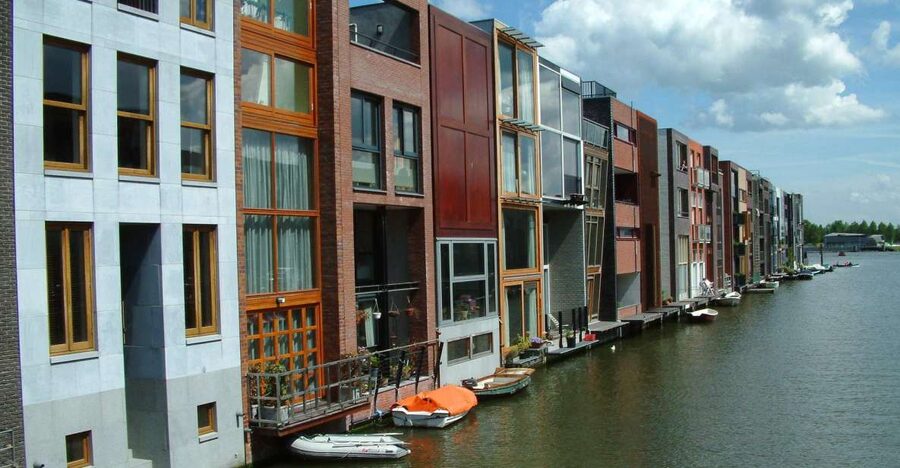
Java and KNSM are presented as twin islands, and the comparison is one of the strongest parts of the experience. Both were shaped by a shared concept inspired by Amsterdam’s past, but they developed into notably different places.
This is the kind of comparison that makes architecture easier to understand. Looking at one district in isolation, you may simply decide that you like or dislike its buildings. Seeing Java and KNSM together gives you a better question: what changes when the same broad idea is interpreted through different building forms, public spaces, and housing arrangements?
Your guide can explain how each island responds to its setting and to the memory of Amsterdam’s historic urban pattern. The point is not that one is correct and the other is wrong. Their contrast shows how planning choices affect the way a district feels and functions.
Java is paired with KNSM for a reason. They let you see how an old city reference can be used in a new waterfront district without producing a simple copy of the past. The result is a conversation between Amsterdam’s older identity and the experimental spirit of late 20th-century development.
I would pay close attention here if you are interested in urban design. The value is not just in seeing unusual buildings. It is in learning to notice the relationship between individual structures, the waterfront, routes through the district, and the wider plan.
Borneo and Sporenburg, family homes in a dense setting
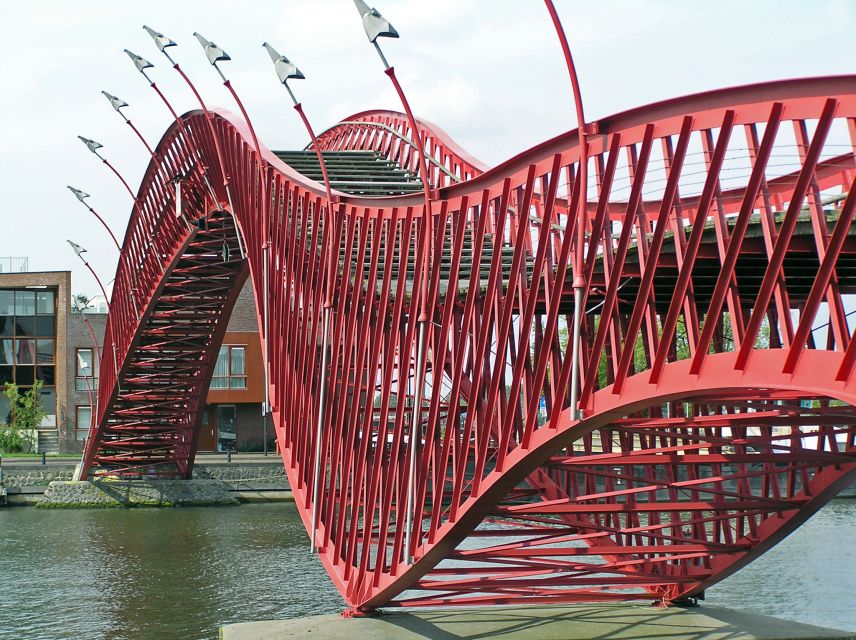
Borneo and Sporenburg address one of the tour’s most interesting planning problems: how do you create low-rise, single-family housing while keeping the same density usually associated with multi-storey apartment buildings?
The stated figure is about 100 apartments per acre. That makes the achievement easier to grasp. Low-rise housing often spreads outward and uses more land. Here, the goal was to provide houses while retaining a compact urban pattern.
This part of the walk is especially useful for anyone who assumes that high density must mean towers. Borneo and Sporenburg offer another answer. You can study how homes are arranged tightly enough to support a dense district while still offering the scale and form of individual houses.
Your guide will help you read the area as a planned whole rather than a collection of isolated façades. Look at how the homes relate to one another, how streets and public areas are organized, and how the low-rise plan fits the former dockland setting.
There is a practical lesson here for city visitors. Architecture is not only about appearance. It affects privacy, movement, daylight, neighborhood character, and the amount of land used for housing. Borneo and Sporenburg make those issues visible.
This may also be the section that appeals most to people who usually prefer traditional residential streets. The homes are not presented as old Amsterdam, but the lower scale can make the district easier to read at walking pace than a cluster of very tall buildings.
A few more architecture walks in the world worth a look
- Chicago Architecture River Cruise
★ 5.0 · 15,756 reviews - Chicago River 90-Minute Architecture Tour
★ 4.5 · 9,629 reviews - Chicago River: 1.5-Hour Guided Architecture Cruise
★ 4.8 · 8,046 reviews - Chicago Architecture Center River Cruise aboard First Lady
★ 5.0 · 5,536 reviews
Riet Landen, where traffic and parkland meet
Riet Landen provides the tour’s clearest example of infrastructure being treated as part of the plan rather than an unwanted obstacle. The area joins a traffic junction, a residential district, and a notable park.
That combination sounds awkward on paper. Roads bring noise and movement, while parks and homes usually aim for calm. Riet Landen shows how those competing needs can be brought together through design.
The guide will explain how the traffic junction sits at the heart of the area and how the park wraps around it. This is a chance to think about urban planning at a larger scale. Instead of hiding infrastructure or pushing it to the edge, the plan works with it and makes it part of the district’s identity.
I like this stop because it broadens the tour beyond building design. You are looking at public space, movement, housing, and greenery as one problem. It also gives the walk a useful ending: after studying islands and residential blocks, you see how a whole neighborhood manages the pressure of traffic.
Riet Landen may be less immediately photogenic than a striking building, but it could be more valuable if you want to understand how cities work. The important achievement is the way several conflicting uses are arranged in close proximity.
What the guide adds to the buildings
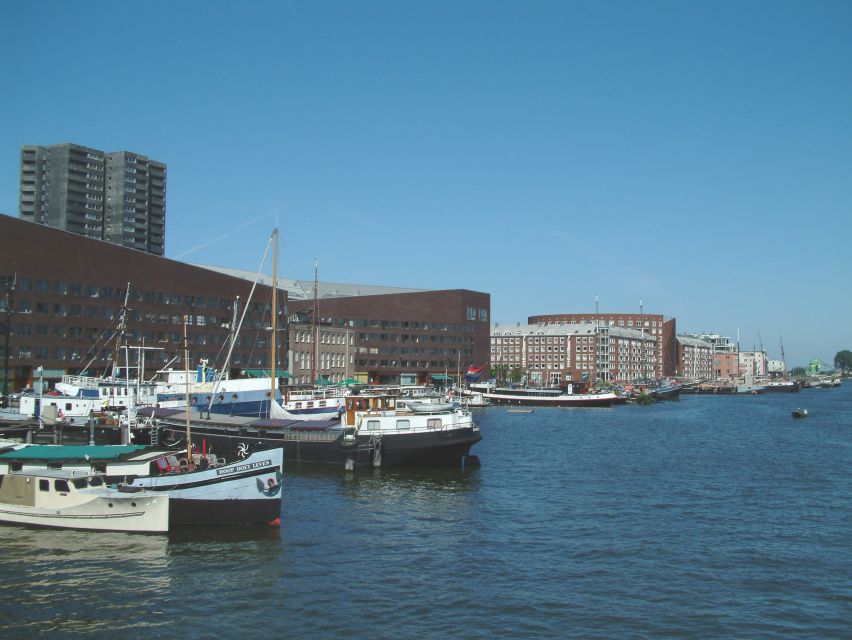
The guides are not simply escorts who point out unusual structures. Each has an academic background, including architecture, sociology, or art history. Some also work as architecture and heritage journalists, and two have recently published a book about Amsterdam’s Eastern Docklands that is being translated into English.
That background matters because the subject can become technical. Terms such as density, urban renewal, housing types, and waterfront planning mean more when they are tied to places you can see in front of you.
A strong guide should also help you connect the districts. Java and KNSM are not just two stops. Borneo and Sporenburg are not just a collection of houses. Riet Landen is not merely a park beside a road. The wider story is how Amsterdam tested different ways to rebuild and populate an old harbor area.
The one available verified comment, written in German, praised the explanations as detailed and competent, and noted that the guide responded to questions and requests. It also described the walk as varied and lively in pace. That fits the design of a private tour, where you can ask for more detail on housing, social planning, architecture, or the port’s transformation instead of following a fixed script.
No guide names are provided, so you cannot request a particular person by name from the available information. You can choose English, Dutch, or German.
Is $235 good value for a private group?
The price is $235 for a group of up to 10. That works out to $23.50 per person if you fill all 10 places, which is a reasonable rate for a private, specialist-led walk. For two people, the per-person cost is much higher, but you are paying for privacy and a guide focused only on your group.
The value is strongest for visitors who want more than a general city walk. This is a specialist experience about architecture, housing, and urban development. A general sightseeing tour may cover more famous landmarks, but it will not give the same attention to the Eastern Docklands or explain why these districts were planned as they were.
The flexible format also helps. The walk lasts two or three hours and can be adapted to your needs. A group of architecture students may want technical detail. A family may prefer a shorter explanation at each district. A visitor with a particular interest in public housing or waterfront renewal can ask the guide to spend more time on that theme.
Remember that the price does not include food, drinks, or transfers. You are buying the guide and the walk, not a full-day package. That is fine for most people, since the experience is focused and the meeting point is clear, but it is worth budgeting separately for anything else you need.
Who will get the most from this walk?
I would recommend this tour first to people who enjoy understanding why a city looks the way it does. Architecture students, urban planners, design fans, photographers, and visitors who have already seen Amsterdam’s central sights should find plenty to think about.
It also suits a private group with mixed interests, provided everyone is willing to look closely and listen. The variety between islands, housing forms, parks, and traffic planning keeps the walk from being only a parade of buildings.
You may want to skip it if your ideal Amsterdam outing centers on paintings, canal houses, markets, or food. The Eastern Docklands is a different side of the city, and the guide’s focus is serious even when the pace is described as varied and engaging.
The tour is also a good choice for repeat visitors. You get away from the standard center and see how Amsterdam continued to change after its most familiar historic streets were established.
Practical advice for a better walk
Wear comfortable shoes and dress for an outdoor walk. The exact start time depends on availability, and the experience takes place across several dockland districts, so you should plan around a steady period outside.
Keep your bag small. Large luggage is not allowed, and there is no transfer included. If you are leaving Amsterdam that day, store your main bags before arriving.
Think about your questions before the guide arrives. Ask about housing density, the difference between Java and KNSM, the decision to use low-rise homes in Borneo and Sporenburg, or the planning of Riet Landen. Since the group is private, your questions can shape the discussion.
If accessibility matters, the tour is wheelchair accessible. Still, tell the provider about your needs when arranging the walk so the guide can adapt the pace and emphasis.
You can cancel up to 24 hours in advance for a full refund, and you can reserve now and pay later. Those terms are useful if your Amsterdam schedule is still moving around.
Should you book the Eastern Docklands tour?
Book it if you want to understand Amsterdam as a living city, not only as a historic postcard. The strongest reasons are the expert academic guides, the useful Java and KNSM comparison, the high-density low-rise housing of Borneo and Sporenburg, and the clever mix of traffic, park, and homes at Riet Landen.
I would especially choose it for a private group of several people, since the $235 price becomes much better value when shared. I would pass if you want famous landmarks, food stops, or a broad first introduction to Amsterdam.
For the right audience, this is a focused and thoughtful walk through one of the city’s best examples of modern urban planning. It shows you how a former harbor became a neighborhood, and it gives you practical ways to read the city long after the walk ends.
FAQ
Where does the Eastern Docklands architecture tour begin?
It begins in front of Pakhuis De Zwijger, next to Jan Schaeferbrug.
How long does the tour last?
The tour is offered as a two or three-hour walk adapted to your needs. The stated duration is two hours, so check the available format when booking.
How much does the private tour cost?
The price is $235 for a private group of up to 10 people.
Which areas does the walk visit?
The route examines five districts: Java, KNSM, Borneo, Sporenburg, and Riet Landen.
Which languages are available?
The live guide is available in English, Dutch, and German.
Is the tour wheelchair accessible?
Yes, the activity is wheelchair accessible.
Are food, drinks, or transfers included?
No. Food, drinks, and transfers are not included in the tour price.
Can I bring luggage?
Large bags and luggage are not allowed. A small bag is the more practical choice.
Can I cancel the booking?
Yes. You can cancel up to 24 hours in advance for a full refund. You can also reserve now and pay later.
Newly added in the world
- Barcelona: Guided tour e-bike Barcelona historical and modernist Barcelona★ 4.5 · 5 reviews
- Barcelona Architecture Walking Tour With Casa Batlló Upgrade★ 4.8 · 11 reviews
- Astana: Old City Tour, Imperialistic and Soviet Architecture★ 5.0 · 4 reviews
- Barcelona Beyond Gaudí: Modernism, Rooftops, and Hidden Gems★ 5.0 · 2 reviews
- An Architect’s Tour of Downtown Santiago★ 5.0 · 7 reviews
- Architecture Tour: Old Historic Madrid with an architect★ 4.3 · 3 reviews
- London: Architecture Tour of Benjamin Franklin House★ 5.0 · 5 reviews
- Architectural Wonders of KAFD, An Iconic Destination★ 5.0 · 3 reviews
Netherlands Architecture Tours, compared.
Rotterdam Walk: Hilights, Gems, Architecture & WWII | 2 or 3hrs
Read our review →
The rise of Haarlem: Culture, History, Art and Architecture Walking Tour
Read our review →
Walking Tour about Golden Age Architecture, private local guide
Read our review →
Architecture Museum Het Schip Entry Ticket & Tour
Read our review →
Browse the lists this tour appears in