
Review · BAUHAUS AND BRUTALIST ARCHITECTURE TOURS
Architecture of New Belgrade – Brutalism Decoded
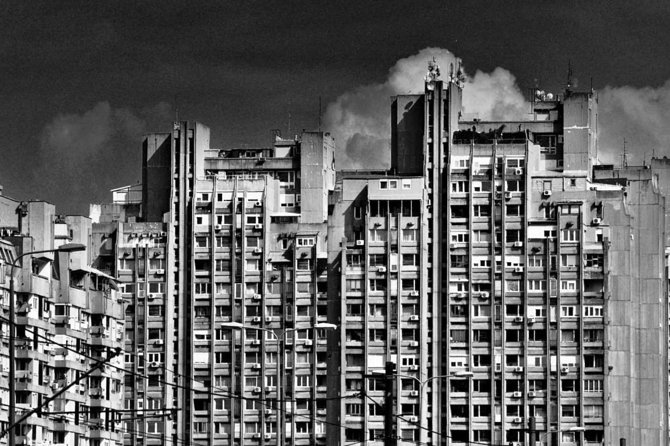
New Belgrade makes more sense when you see it as a political project in concrete, glass, marble, and open space. This private tour connects the city’s grand public buildings with the everyday apartment blocks built for a new socialist society. Genex Tower and the Museum of Contemporary Art provide the visual drama, while Block 23 explains how ordinary life was meant to work.
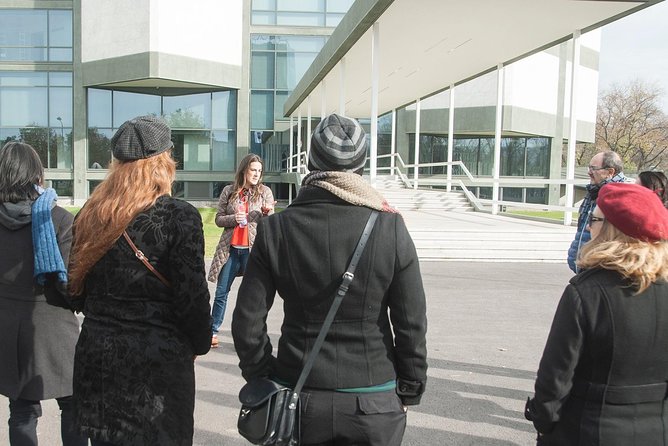
I like the personal scale of the tour. You travel with only your own group, meet easily at the Museum of Contemporary Art, and can ask questions without competing with a large crowd. I also like the mix of architecture and daily life, especially the guide’s stories about the blocks during their prosperous decades in the 1960s, 1970s, and 1980s.
The main thing to consider is pace. The tour is advertised at about two and a half hours, but the route includes several short stops and a drive past one major building. One account found the experience lasted less than two hours, so ask your guide at the start how much time you will spend at each location.
Key points at a glance
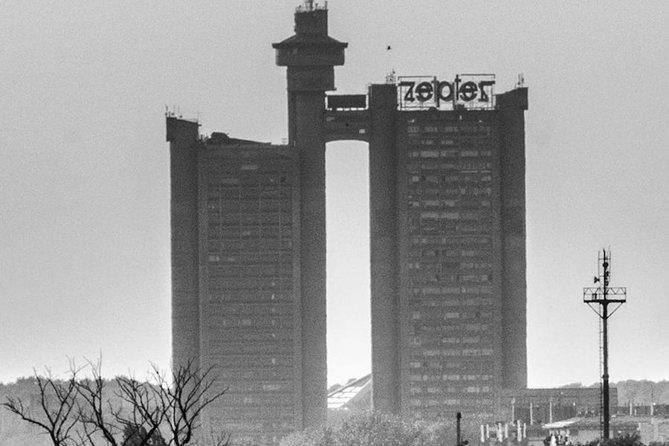
- Genex Tower gives you New Belgrade’s signature view: See the 30-floor Western City Gate, an early Balkan smart building and a major work of brutalist design.
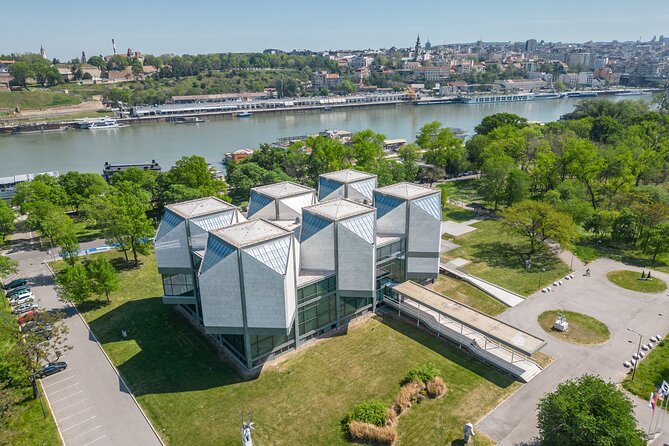
- The Museum of Contemporary Art challenges socialist stereotypes: Its 1960s volumes and costly marble facades show a more polished side of Yugoslav modernism.
- Block 23 explains planned urban life: Apartments, a school, kindergarten, sports courts, and a small shopping center were designed as one complete neighborhood.
- The Park of Friendship links architecture with diplomacy: Learn how leaders from the Non-Aligned Movement planted trees here as symbols of peace.
- Private guiding changes the experience: You can focus on design, politics, or daily life, depending on your interests and questions.
- The route ends at Sava Center: This huge congress complex still functions and offers some of the tour’s most interesting interior details.
Why New Belgrade is the right place to study brutalism
Belgrade’s old center is where most first-time visitors begin, but New Belgrade tells a different story. Built largely after the Second World War, it expresses the ambitions of socialist Yugoslavia through broad avenues, large apartment blocks, public institutions, and monumental concrete forms.
The tour is not simply a parade of unusual buildings. It helps you read the choices behind them. Why use marble on a public museum? Why build a tower with a rotating restaurant and a separate residential section? Why group schools, shops, sports courts, and housing in one block?
Those questions make the area more interesting than a quick drive past concrete towers. You begin to see New Belgrade as a planned experiment in how a modern city should function.
The word brutalism can also mislead. Some buildings on this route use exposed concrete and heavy geometric shapes, but others rely on glass, marble, steel, or carefully finished interiors. The experience is best for anyone who wants to understand the wider modernist movement in Yugoslavia, not just photograph raw concrete.
More Bauhaus and Brutalist Tours in the world:
- London: Brutalist Architecture & History Walking Tour
★ 4.8 · 42 reviews - Le Corbusier’s Chandigarh : A Complete Architecture Tour
★ 4.7 · 25 reviews - Bishkek : USSR History, Soviet Architects ,Statues & Mosaics
★ 4.9 · 14 reviews
Starting at the Museum of Contemporary Art
The meeting point is in front of the Museum of Contemporary Art at Ušće. This is a practical starting place because the building itself is the first lesson.
You spend about 20 minutes looking at its 1960s design. The museum is made from interlocking modernist volumes, with a strong sculptural quality even before you know anything about the collections inside. Its marble facades are especially useful for breaking the usual image of socialist architecture as plain, cheap, or purely utilitarian.
The marble was valuable, and the finish gives the building a formal, almost ceremonial character. Your guide explains why that material choice mattered and how it fits into Yugoslavia’s effort to present itself as modern, independent, and culturally confident.
The museum admission fee is not included. The tour focuses on the exterior, so you should not book this expecting a gallery visit. If you want to see the art collections as well, treat that as a separate plan.
This first stop is also where the private format has real value. A good guide can point out shapes and surfaces that are easy to miss when you walk past alone. Xenia, one of the guides associated with the experience, has been praised for explaining both the architecture and the human side of the city.
Park of Friendship and the Non-Aligned Movement
The next stop is Park of Friendship, or Park Prijateljstva. You spend about 15 minutes here, learning about the Non-Aligned Movement and its connection to Belgrade.
In 1961, the movement was founded in Belgrade by countries that wanted to avoid being tied to either of the main Cold War power blocs. Leaders planted trees in the park as symbols of peace. The park therefore adds political context to the buildings you see later.
This is a short stop, but it helps explain why Yugoslav architecture often feels more international than you might expect. Yugoslavia was socialist, yet it followed its own political path after breaking with Stalin. It also built strong ties with countries across Asia, Africa, and Latin America.
The park itself is not a major architectural spectacle. Its value lies in the story and in the open space around it. You get a pause from the heavy buildings and a clearer sense of the political world that shaped New Belgrade.
The Government Building and Yugoslavia’s political shift
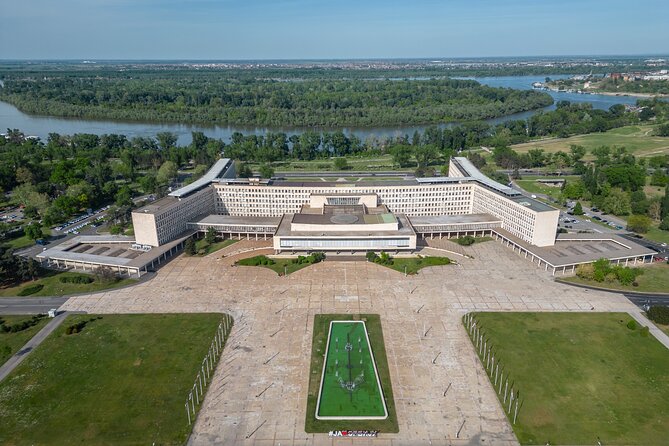
Between the park and Genex Tower, you drive by the large Government Building. You do not make a full stop here, so the view is brief, but the building gives the guide a chance to explain an important change in Yugoslav politics.
Construction began during an earlier phase of the country’s relationship with Stalin and the Soviet Union. While the building was still going up, Yugoslavia moved away from Stalin’s model. That political break affected the country’s architecture, planning, and public image.
This is a useful reminder that buildings do not exist outside history. A government complex can record a change in foreign policy just as clearly as a speech or treaty. Still, because you see it while driving by, this part is more of a visual introduction than a detailed visit.
If political history is your main interest, ask your guide for extra context here. If architecture is your priority, the following stop offers more time and a stronger visual payoff.
A few more architecture walks in the world worth a look
- Chicago Architecture River Cruise
★ 5.0 · 15,756 reviews - Chicago River 90-Minute Architecture Tour
★ 4.5 · 9,629 reviews - Chicago River: 1.5-Hour Guided Architecture Cruise
★ 4.8 · 8,046 reviews - Chicago Architecture Center River Cruise aboard First Lady
★ 5.0 · 5,536 reviews
Genex Tower at Narodnih heroja 45
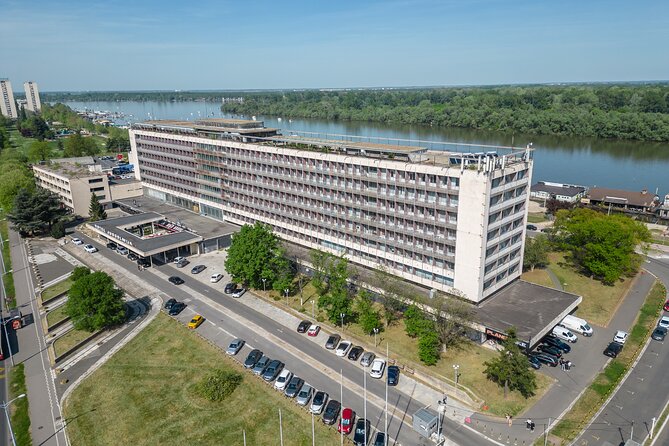
Genex Tower is the route’s big visual moment. You stop near Narodnih heroja 45 for a close look at the Western City Gate of Belgrade, a 30-floor structure completed about 40 years ago.
The tower is made from two tall sections joined by a bridge near the top. Its shape gives New Belgrade a powerful vertical marker among the broad roads and lower blocks. Even from a distance, it looks more like a piece of futuristic infrastructure than a conventional office or apartment building.
The guide explains that Genex was the first smart building in the Balkans. That detail gives the tower a second layer of interest. It was not only designed to look advanced. It also represented a belief that technology, communications, and modern planning could improve urban life.
Genex Tower has received attention in international architecture circles as an important example of brutalism. You do not need to be an architecture specialist to appreciate it. The building is photogenic, but the explanation of its original purpose makes the stop more than a photo opportunity.
The tower is also a good place to ask about the difference between a building’s original ambitions and its later life. The tour information does not promise access inside, so plan on an exterior visit. You will spend around 20 minutes here, enough to study its structure and hear the main story without turning the stop into a long technical lecture.
Sava Center and the late 1970s rush to build
The tour ends at Sava Center on Milentija Popovića 9. This enormous congress complex was built in the late 1970s in record time and was the first building of its type in this part of Europe.
Its size is hard to grasp from a single photograph. Sava Center was built for large meetings, conferences, and public events, and it remains in use. That continuing function matters. You are not looking at an abandoned monument frozen in the past, but at a building that still has a role in the city.
The visit lasts about 15 minutes. The most interesting details are inside, where the design includes solutions that still feel fresh after four decades. The tour can show you how the architects handled circulation, public space, and the needs of a huge congress venue.
Do not expect a long guided visit through every part of the complex. The stop is short and the exact interior access may depend on what is open. Still, ending here gives the route a clear sense of progression, from the museum’s sculptural modernism to a massive public building designed for international events.
Sava Center is also convenient as an endpoint. If you want to continue exploring New Belgrade, you finish near public transportation rather than returning to the starting point.
Block 23 and the practical side of socialist planning
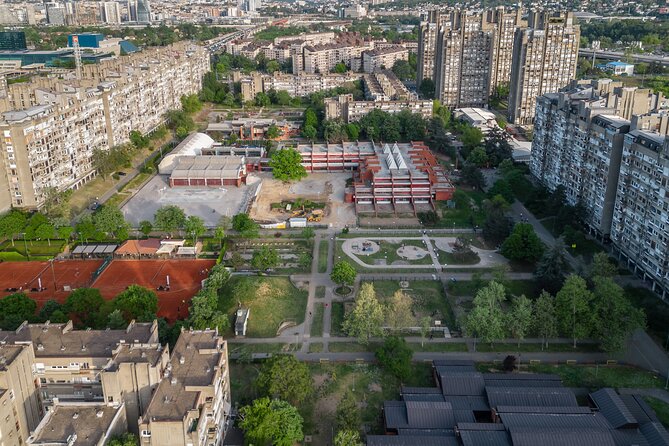
The final major area is Block 23, where you visit the Primary School Laza Kostić and examine one of New Belgrade’s most representative public housing projects.
This is where the tour moves from monuments to ordinary routines. The block was designed to provide much of what residents needed close to home: apartment buildings, a school, a kindergarten, sports courts, and a small shopping center. The idea was not just to house people, but to create a complete neighborhood.
The architecture is often described as concrete expressionism. That label fits the bold forms and heavy materials, but the more important point is how the buildings were arranged. The design tried to balance density with shared facilities and open areas.
You hear personal stories about life in the blocks during the 1960s, 1970s, and 1980s, when these neighborhoods were in their golden decades. You also hear about the harder conditions of the 1990s. That contrast keeps the tour from becoming a simple celebration of socialist planning.
A building can be admired for its design while still having flaws as a place to live. Your guide’s stories help you think about noise, maintenance, community, convenience, and the gap between an architect’s plan and a resident’s daily experience.
This stop may be the most rewarding part of the experience if you are interested in people rather than only facades. The architecture becomes easier to understand when you imagine children walking to school, families using the sports courts, and residents shopping within the block.
What the private format is worth
The price is $86.42 per person. That is not a low-cost walk, especially since the route lasts about two and a half hours and the Museum of Contemporary Art admission is not included.
The value improves if you are traveling with several people who want a focused experience. This is a private activity, so only your group participates. You are paying for a dedicated guide, a carefully connected route, and the chance to ask questions suited to your own interests.
It also saves you from trying to connect scattered New Belgrade sites on your own. The locations are not all right beside one another, and the tour includes a drive between some stops. If you have limited time in Belgrade, that transport and structure can justify part of the cost.
The price is harder to defend if you want only quick photo stops or a long interior visit at each building. Several stops last only 15 or 20 minutes, and the Government Building is viewed while passing by. Ask yourself if you want interpretation and context, or simply a self-guided look at the main facades.
The English-language guiding is an important part of the value. The strongest version of this tour is not a list of dates. It is a conversation about why buildings look the way they do and what life inside them was like.
Timing, meeting point, and practical advice
The meeting point is the Museum of Contemporary Art at Ušće 10. It is easy to identify, and the tour ends at Sava Center, at Milentija Popovića 9.
Plan on approximately two hours and 30 minutes, but allow flexibility. The published stop times add up to a brisk route, and one account found the total experience closer to two hours. The actual length may depend on traffic, questions, and how much time your guide spends at each building.
The tour is offered in English and uses a mobile ticket. Confirmation arrives when you book. The route is near public transportation, and most people can take part.
Wear comfortable shoes, even though this is not a long walking tour. You will move between several outdoor stops and may spend time standing while looking up at large buildings. Bring questions if you have a particular interest in Cold War politics, urban planning, photography, or apartment life.
Free cancellation is available if you cancel at least 24 hours before the start time. Changes or cancellations made later are not accepted for a refund.
Who should book Architecture of New Belgrade
I would choose this tour if you have already seen Belgrade’s central sights and want a different side of the city. It suits architecture fans, students of modern European history, photographers, and anyone curious about how a planned neighborhood works.
It is also a good choice if you prefer a private guide to a large group. The guide can explain the difference between brutalism, modernism, and concrete expressionism without forcing you through a fixed lecture.
I would hesitate if you want extensive museum access, long walks, or detailed interior tours. The Museum of Contemporary Art is viewed from outside, Genex Tower is an exterior stop, and several parts of the route move quickly.
Overall, this is a strong way to understand New Belgrade in a short period. The best moments are not just the famous tower or the giant congress center. They are the connections between politics, design, technology, and daily life. If that mix appeals to you, the private format and English-language guide make the $86.42 price easier to justify.
FAQ
Where does the tour begin?
The tour begins in front of the Museum of Contemporary Art at Ušće 10 in Belgrade, Serbia.
Where does the tour end?
The tour ends at Sava Center, located at Milentija Popovića 9, Belgrade 11000.
How long does the experience last?
The stated duration is approximately two hours and 30 minutes. The pace can vary, and some accounts describe a shorter experience of less than two hours.
Is the tour private?
Yes. Only your group participates in the activity.
Is the tour offered in English?
Yes. English-language guiding is available.
Is admission to the Museum of Contemporary Art included?
No. Admission to the Museum of Contemporary Art is not included. The tour focuses on the building and its exterior architecture.
Can I cancel for a full refund?
Yes, if you cancel at least 24 hours before the experience start time. Cancellations or changes made less than 24 hours in advance are not accepted for a refund.
Newly added in the world
- Barcelona: Guided tour e-bike Barcelona historical and modernist Barcelona★ 4.5 · 5 reviews
- Barcelona Architecture Walking Tour With Casa Batlló Upgrade★ 4.8 · 11 reviews
- Astana: Old City Tour, Imperialistic and Soviet Architecture★ 5.0 · 4 reviews
- Barcelona Beyond Gaudí: Modernism, Rooftops, and Hidden Gems★ 5.0 · 2 reviews
- An Architect’s Tour of Downtown Santiago★ 5.0 · 7 reviews
- Architecture Tour: Old Historic Madrid with an architect★ 4.3 · 3 reviews
- London: Architecture Tour of Benjamin Franklin House★ 5.0 · 5 reviews
- Architectural Wonders of KAFD, An Iconic Destination★ 5.0 · 3 reviews
Bauhaus and Brutalist Architecture Tours, compared.
Brutalist Tbilisi: Urban exploration and untold stories
Read our review →
Le Corbusier’s Chandigarh : A Complete Architecture Tour
Read our review →
USSR History, Soviet Architects ,Statues & Mosaics
Read our review →
Brutal Tbilisi — Night Edition: Dark Side of Soviet Architecture
Read our review →USSR History , Soviet Architects , Statues & Mosaics
Read our review →
Astana: Old City Tour, Imperialistic and Soviet Architecture
Read our review →Browse the lists this tour appears in