
Review · GERMANY ARCHITECTURE TOURS
Karl-Marx-Allee Tour: Life and Architecture in East Berlin
Karl-Marx-Allee is not just a broad avenue lined with imposing buildings. It is a story in stone about East Germany’s hopes, political control, architectural experiments, and the daily lives of people who lived under socialism. This walking tour follows that story from Frankfurter Tor to Strausberger Platz, using the buildings as clues.
I like two things here. First, the route connects grand architecture with ordinary life, so you learn why the buildings look the way they do and what they meant to residents. Second, the small group limit of 15 makes it easier to hear a guide such as Martina, whose talks are praised for their humor, personal touch, and strong historical detail.
The main drawback is that this is an outdoor walking tour, and the schedule depends on good weather. You also need to be comfortable covering several stops on foot in about two hours, with little time for long pauses or indoor visits.
Key things to know before walking Karl-Marx-Allee
- The route covers seven important stops, beginning at Frankfurter Tor and ending at Strausberger Platz.
- Architecture carries the story, from Hans Scharoun’s postwar modernism to Hermann Henselmann’s grand socialist design.
- The 1953 workers’ uprising is a major theme, not a quick footnote.
- Café Sibylle and the Karl Marx monument add daily-life detail to the political story.
- The group can include no more than 15 people, which suits visitors who want room for questions.
- The tour costs $30.01 per person and includes an expert local guide, with free cancellation up to 24 hours before the start time.
Why Karl-Marx-Allee tells East Germany’s story so well
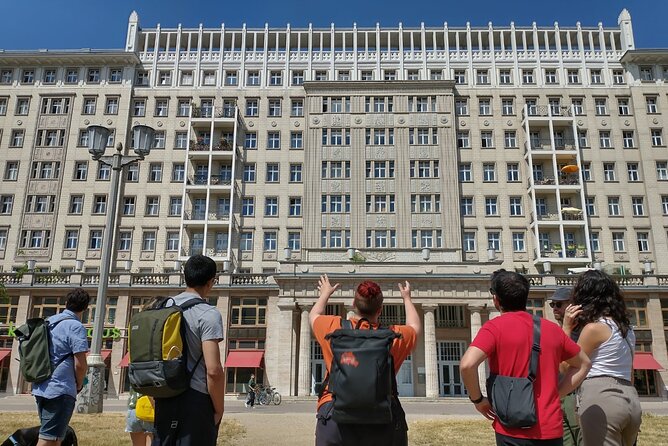
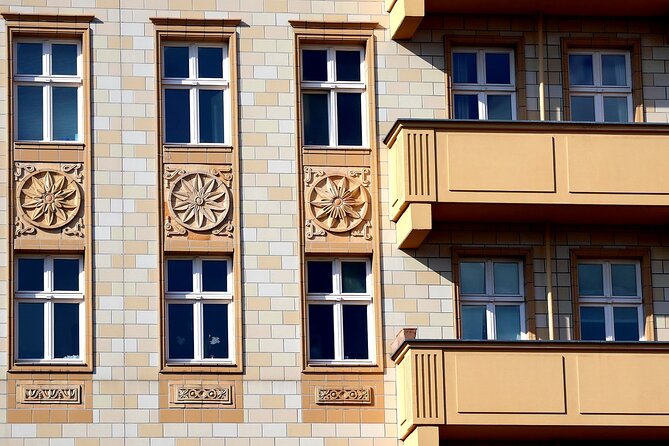
I find Karl-Marx-Allee useful for understanding Berlin because the avenue makes political ideas visible. The scale is deliberate. The towers, broad road, repeated forms, and monumental buildings were meant to express order and confidence in the new socialist state.
But the avenue also reveals uncertainty. Its architecture changed over time. Its political meaning shifted. Buildings that once symbolized a promising future later became reminders of state control, and after German reunification they entered yet another phase as homes, cafés, and protected historic structures.
That tension gives the walk its purpose. You are not simply looking at attractive façades. You are asking who designed them, who paid for them, who lived there, and what the government hoped people would believe.
The route also helps if you have limited time in Berlin. In two hours, you get a focused look at one stretch of the former East Berlin rather than a rushed tour of the whole city. If you already know Berlin’s main Cold War sights, this walk adds a more specific architectural and social angle.
A few more architecture walks in the world worth a look
- Chicago Architecture River Cruise
★ 5.0 · 15,756 reviews - Chicago River 90-Minute Architecture Tour
★ 4.5 · 9,629 reviews - Chicago River: 1.5-Hour Guided Architecture Cruise
★ 4.8 · 8,046 reviews
Frankfurter Tor and the making of a socialist boulevard
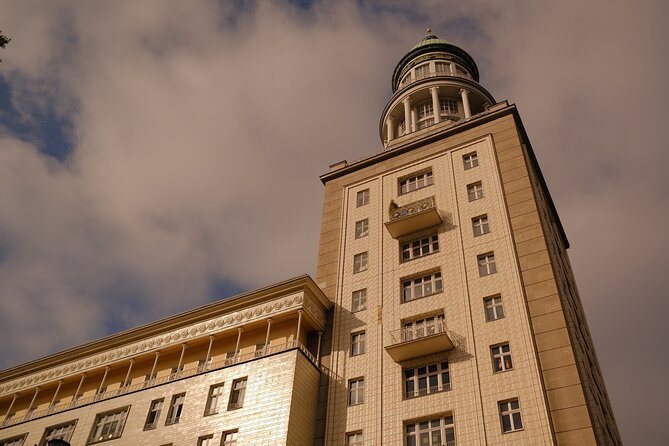
The tour begins at Frankfurter Tor, where the twin towers create one of Karl-Marx-Allee’s most recognizable views. Hermann Henselmann designed the structures with strong symmetry, giving the entrance to the avenue a ceremonial feel.
Your guide explains how plans for Germany’s first socialist street took shape in the early 1950s. The project was part of a national rebuilding effort that brought thousands of volunteers into the work. That detail matters because the avenue was not only a construction project. It was also a public demonstration that the new East German state could rebuild after wartime destruction.
Allow about 20 minutes here. That is enough time to study the towers, understand the plan for the avenue, and hear how architecture became part of political messaging.
I would arrive a few minutes early. The meeting point is at U Frankfurter Tor, at 10243 Berlin, and the station makes the start easy to reach by public transport. The broad setting can feel confusing if you are rushing, so give yourself time to find the right side of the station.
Laubenganghäuser and a rejected modernist future
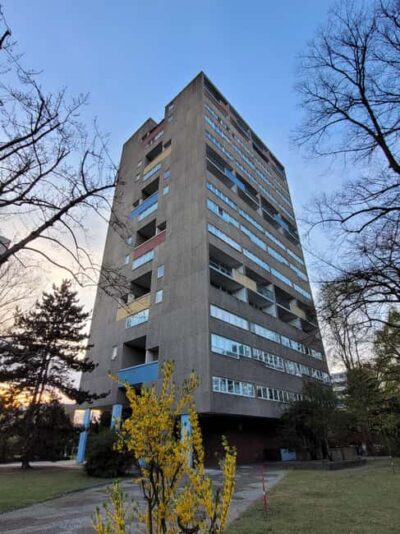
The next stop changes the mood. At the Laubenganghäuser, you see modernist housing from the years immediately after World War II. These buildings connect to Hans Scharoun, an architect whose urban ideas grew from the ruins of Berlin.
Scharoun imagined a more open and humane city. His ideas were utopian in the best sense, shaped by the need to create something better after destruction. The new East German leadership soon rejected this direction, choosing a more monumental socialist style instead.
This short stop, about 15 minutes, gives the tour an important contrast. East Berlin’s architecture was not created according to one fixed plan from the beginning. Different visions competed. Some favored open modernism and new forms of communal living. Others wanted buildings that echoed classical monumentality and projected state power.
I like this part because it prevents the walk from becoming a simple story of government architecture. You see that architects had their own ideas, and those ideas did not always fit the political climate.
Hochhaus an der Weberwiese and the promise of luxury
At the Hochhaus an der Weberwiese, you see a building that served as a prototype for the later Karl-Marx-Allee. Its first residents received a level of comfort that was unusual for the time.
That detail is easy to miss if you explore alone. The building was not only a place to live. It was proof of what the socialist state claimed it could provide: modern housing, improved living conditions, and a better future for working people.
The project soon became a propaganda tool. It also drew the attention of architects from West Germany and beyond, making the building part of a larger argument about how cities should be rebuilt after the war.
The stop lasts about 20 minutes. Listen closely for the link between design and social status. The building’s importance came not just from its appearance but from who got to live there and what those apartments represented.
This is one of the strongest parts of the route for visitors interested in housing. Karl-Marx-Allee was designed to shape public life, but it also promised private comfort. That combination helps explain why the avenue could inspire genuine pride while also serving the interests of the state.
Same city, a different facade:
- Chicago Architecture Center River Cruise aboard First Lady
★ 5.0 · 5,536 reviews - Chicago: Architecture River Cruise Skip-the-Ticket Line
★ 4.8 · 4,325 reviews - Chicago River 45-Minute Architecture Tour from Magnificent Mile
★ 4.5 · 2,924 reviews - Barcelona: Sant Pau Recinte Modernista Entry Ticket
★ 4.6 · 2,567 reviews
The June 17, 1953 uprising at its starting point
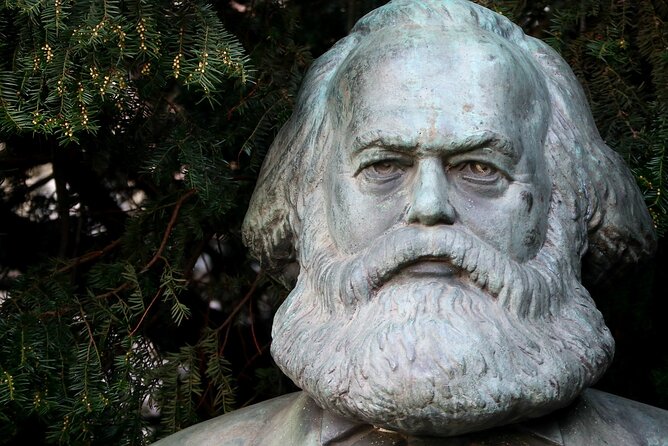
At the Memorial to the Workers’ Uprising of June 17, 1953, the tour shifts from architecture to protest. Workers who were unhappy with the East German government began a mass uprising here. The movement spread and came close to bringing down the socialist government.
The monument itself is controversial, and the guide explains why. A memorial is never just an object. It reflects decisions about which parts of the past should be honored, how political suffering should be shown, and who gets to define the official story.
Allow around 20 minutes. This is a key stop, so you will want to give the explanation your full attention rather than treat it as a quick photo break.
I appreciate the way this moment ties the buildings to the people who built and inhabited them. The avenue was presented as a workers’ achievement, yet workers also challenged the government that claimed to represent them. That contradiction is central to understanding East Germany.
If your main interest is the Cold War, this stop may be the most important one on the walk. If you mainly want architecture, it still gives the buildings a human and political context.
Café Sibylle and the everyday side of East Berlin
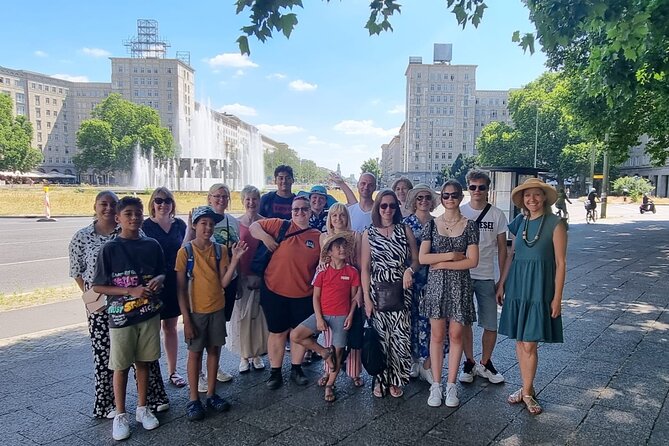
At Café Sibylle, you get a more intimate view of life on Karl-Marx-Allee. In East Berlin’s earlier years, it was one of the avenue’s more exclusive cafés.
The café also connects to the statue of Joseph Stalin that once stood nearby. The statue remained until 1961, and its removal marked a shift in how East Germany handled its relationship with Stalin and the Soviet model.
This stop lasts about 15 minutes. The subject may sound smaller than a workers’ uprising or a government building, but it is valuable because cafés reveal how grand political systems reached into ordinary routines. Where people met, what places felt special, and which figures appeared in public spaces all formed part of daily life.
The café also helps break up the walk. After several large buildings and political events, you get a closer look at social habits and public culture. I would pay attention to how the guide connects a place like this with the wider story rather than treating it as a standalone café stop.
The Karl Marx bust and ideology in daily life
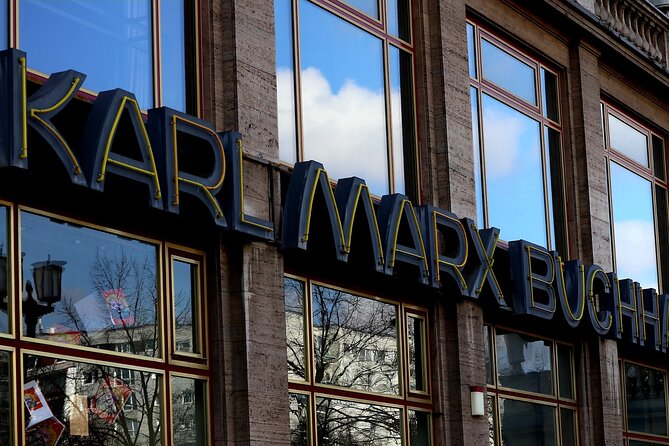
The Karl Marx bust brings the tour back to the ideas behind the avenue’s name. Marx was the author of The Communist Manifesto, and his image became part of the visual language of East Germany.
The stop is not simply about identifying a famous face. It asks how socialist ideology shaped daily life in East Berlin. The guide may connect public monuments, housing, work, education, and official language to the wider political system.
This portion lasts about 15 minutes. It works best if you are willing to consider both the theory and the practice. Political ideas could promise equality and dignity, while daily life often involved limits, shortages, and state control. The tour’s value comes from keeping those two sides together.
I would not expect a long academic lecture. The format is a walking tour, so the discussion remains tied to what you can see around you. That makes abstract ideas easier to follow.
Strausberger Platz and the avenue after reunification
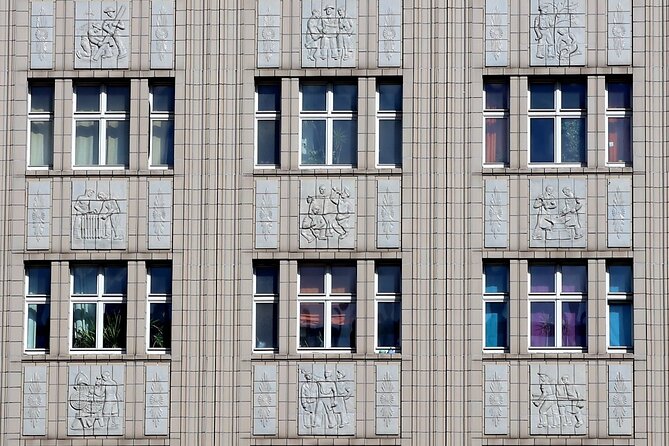
The final stop is Strausberger Platz, another strong example of Henselmann’s style. The roundabout gives you a clear sense of the avenue’s scale and formal design.
Here, the story moves beyond the East German period. You hear about life on Karl-Marx-Allee after the fall of the Berlin Wall and about the area today. That final chapter matters because the avenue did not freeze in 1989. Its buildings continued to be used, debated, renovated, and interpreted.
The tour ends on the eastern side of the Strausberger Platz roundabout, about a 10-minute walk from Alexanderplatz. That location is practical. You can continue sightseeing from there without having to return to the starting point.
The ending also gives you a chance to look back along the avenue. After hearing how the street was planned, built, used, and politically repurposed, the architecture should read differently than it did at the start.
How the guides shape the experience
The guide is the main reason to choose a focused walk instead of exploring the avenue alone. The route is easy to follow, but the meaning behind it is not always obvious.
Martina is repeatedly praised for clear storytelling, humor, strong preparation, and a personal connection to parts of East Germany’s communist period. Marina is also named in the tour feedback, so the guide may vary by date. The important point is to expect a guide-led interpretation rather than a simple walk between buildings.
One particularly useful feature is the use of visual and historical material to support the explanations. The guide has been described as bringing prepared demonstration material and even original items found through online collecting. That kind of material can make an otherwise abstract political story easier to picture.
The best guides on this subject do not reduce East Germany to either a villain story or a nostalgic one. They explain how the buildings could represent hope, control, pride, and disappointment at the same time. This tour appears strongest when it does exactly that.
Price, pace, and group size
At $30.01 per person, the tour offers fair value if you care about Berlin’s history, architecture, or the Cold War. You are paying for about two hours with an expert local guide, not for admission to a museum or a private vehicle.
All seven stops are free to enter, so the price mainly covers the interpretation. That is worthwhile here because the avenue’s scale can make self-guided sightseeing feel thin. Without context, you may notice towers and broad streets but miss the disputes, propaganda, and social meaning behind them.
The maximum group size is 15. That is small enough for a more personal walk and questions, but it is not a private tour. The two-hour schedule also means the pace should be steady. You will have time to listen and look, but not unlimited time for photographs or long architectural study at every stop.
The tour is offered in English and uses a mobile ticket. Most people can participate, and service animals are allowed. Since it takes place outdoors, wear sensible shoes and check the forecast. If poor weather cancels the walk, you are offered another date or a full refund.
You can cancel for a full refund up to 24 hours before the start time. Changes or cancellations inside that window are not accepted, so keep the local cut-off time in mind.
Who should book this East Berlin walking tour?
I would choose this tour if you want more than the standard Berlin Wall story. It suits you especially well if you enjoy architecture, political history, urban planning, or the way public buildings reflect government ideas.
It also works for visitors with only a weekend in Berlin. The route is compact, lasts about two hours, and finishes near Alexanderplatz. You get a focused introduction without giving up a full day.
Families with older teenagers may find it a good fit, especially if they enjoy stories about how people lived under different political systems. One guide’s storytelling has held the attention of a 17-year-old, which suggests the walk can work beyond a specialist audience.
I would hesitate only if you dislike outdoor walking, need a very slow pace, or want to spend most of your time inside buildings. The tour centers on exterior architecture and explanation. It is also less useful for someone who wants a broad overview of every Berlin sight.
Should you book Karl-Marx-Allee Tour?
Book it if you want a clear, human explanation of East Berlin’s architecture and political life. The route is well focused, the group stays small, and the stops build a coherent story from postwar rebuilding to the 1953 uprising and life after reunification.
The strongest reason to go is the connection between design and daily life. You will see how towers, cafés, monuments, and housing projects carried political meaning. Guides such as Martina bring humor and personal perspective to a difficult subject, while the two-hour format keeps the walk manageable.
Skip it if your Berlin plans already contain several long history lectures or if bad weather would spoil your day. For everyone else, this is a useful, fairly priced way to understand a part of Berlin that can look imposing but says little until someone explains what you are seeing.
FAQ
How long does the Karl-Marx-Allee tour last?
The walking tour lasts approximately two hours.
Where does the tour begin?
It begins at U Frankfurter Tor, 10243 Berlin, Germany.
Where does the tour end?
The tour ends at Strausberger Platz, on the eastern side of the roundabout. The area is about a 10-minute walk from Alexanderplatz.
What language is the tour offered in?
The tour is offered in English.
How many people can join the tour?
The group has a maximum of 15 participants.
What is included in the price?
The price includes an expert local guide. Admission to each listed stop is free.
Can I cancel the booking?
You can cancel up to 24 hours before the experience start time for a full refund. If poor weather causes the tour to be canceled, you are offered a different date or a full refund.
Newly added in the world
- Barcelona: Guided tour e-bike Barcelona historical and modernist Barcelona★ 4.5 · 5 reviews
- Barcelona Architecture Walking Tour With Casa Batlló Upgrade★ 4.8 · 11 reviews
- Astana: Old City Tour, Imperialistic and Soviet Architecture★ 5.0 · 4 reviews
- Barcelona Beyond Gaudí: Modernism, Rooftops, and Hidden Gems★ 5.0 · 2 reviews
- An Architect’s Tour of Downtown Santiago★ 5.0 · 7 reviews
- Architecture Tour: Old Historic Madrid with an architect★ 4.3 · 3 reviews
- London: Architecture Tour of Benjamin Franklin House★ 5.0 · 5 reviews
- Architectural Wonders of KAFD, An Iconic Destination★ 5.0 · 3 reviews
Germany Architecture Tours, compared.
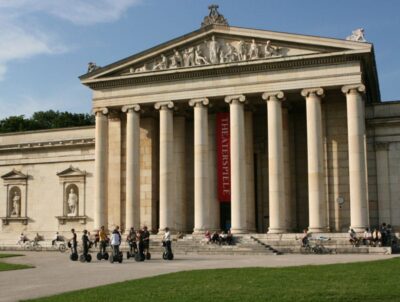
Munich 3-Hour Segway Tour: Nazi Munich & Royal Architecture
Read our review →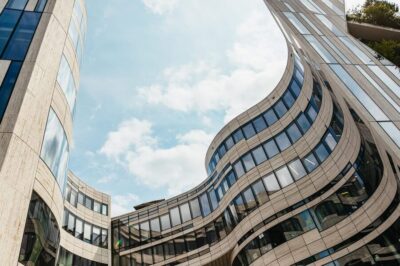
Düsseldorf: Guided City Architecture Walking Tour
Read our review →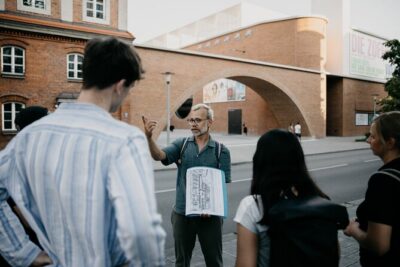
Hidden Architectural Gems of Munich (Max. 16 guests)
Read our review →
Guided Walking Tour of UNESCO Site and Architecture
Read our review →
Private Taxi Tour City East & West History and Architecture 3-4h
Read our review →
500 Years of Munich Architecture (Max. 16 Guests)
Read our review →Browse the lists this tour appears in