
Review · BAUHAUS AND BRUTALIST ARCHITECTURE TOURS
Bishkek : USSR History , Soviet Architects , Statues & Mosaics
Bishkek’s Soviet past is not locked away in a museum. It sits in the middle of the city, in mosaic-covered walls, grand theaters, statues, parks, and broad public squares. This tour gives you a useful way to read those sights, while also explaining the Kyrgyz symbols and traditions that came before and after Soviet rule.
I like two things here: the route covers much more than Lenin and Communist-era buildings, and the guides, including Anna and Alex, explain the meaning behind what you see. You’ll also get practical suggestions for local food and other places in Kyrgyzstan.
The main drawback is the brisk pace. With about 14 stops in 3 to 4 hours, most locations receive only 5 to 10 minutes, and several buildings are viewed from outside. This is a city walk and history lesson, not a series of long museum visits.
Key points to know before booking
- Soviet design is the main attraction: See Socialist Modernism, Stalin-era architecture, statues, public art, and large-scale mosaics across central Bishkek.
- The route also explains Kyrgyz identity: The flag, Manas statue, nomadic traditions, and national institutions balance the Soviet material.
- It is a walking-focused city tour: The route passes through squares, parks, and central streets, with no air-conditioned vehicle included.
- You get many short stops: Expect about 5 to 10 minutes at most locations, with the remaining time used for walking and sightseeing.
- Guide quality matters: Anna and Alex are named guides associated with the experience, but a particular guide is not guaranteed.
- The price is reasonable for a private-feeling history lesson: At $49 per person, the value depends on your interest in architecture, politics, and public art.
Reading Bishkek through its Soviet streets
Bishkek changed sharply during the Russian Imperial and Soviet periods, from 1867 until the Soviet Union ended in 1991. The city was known as Frunze for more than sixty years, named after Bolshevik leader Mikhail Frunze, before returning to the name Bishkek.
That change of name is only one part of the story. Soviet planners reshaped the city with wide public spaces, formal parks, civic buildings, apartment blocks, theaters, libraries, monuments, and large wall mosaics. The result is a city where political history is easy to see if you know what to look for.
I find this kind of tour useful because the buildings are not treated as isolated photo stops. You learn how architecture served government, culture, education, and public memory. At the same time, the Kyrgyz elements of the route keep the experience from becoming a simple celebration of Soviet design.
The tour is listed at $49 per person and lasts roughly 3 to 4 hours. That is a fair price if you want context rather than just a map and a list of addresses. The guide can also suggest food spots and other places in Kyrgyzstan, which adds value at the start of a visit.
More Bauhaus and Brutalist Tours in the world:
- London: Brutalist Architecture & History Walking Tour
★ 4.8 · 42 reviews - Le Corbusier’s Chandigarh : A Complete Architecture Tour
★ 4.7 · 25 reviews - Architecture of New Belgrade – Brutalism Decoded
★ 4.5 · 24 reviews
Ala-Too Square and the changing center of power
Ala-Too Square is the natural opening point. It is the center of Bishkek and a good place to see how public space can carry several layers of political meaning.
Here you’ll look at Soviet-era buildings and learn about statues that were removed after 1991. The square helps explain the transition from Soviet rule to independent Kyrgyzstan, though the short stop means you should expect an overview rather than a long political lecture.
The nearby flagstaff introduces a different subject: the Kyrgyz national flag. Its colors and symbols are tied to Kyrgyz identity, and the guide explains the meaning of the flag and its connection to the country’s nomadic traditions.
That shift is one of the route’s strengths. You move from Soviet civic design to the symbols of an independent nation within a few minutes. It gives the tour a wider frame than a standard Communist monument walk.
The museum stop and the story before Soviet rule
A museum stop follows the flag area. The museum holds thousands of objects connected with Kyrgyz cultural heritage, including sculptures and other pieces dating from antiquity through the end of the twentieth century.
The available schedule gives this stop no clear admission time or detailed visit length, so you should confirm on the day whether the tour includes an interior visit or mainly uses the museum as a point of explanation. That matters if you are hoping to see a full collection rather than simply hear about Kyrgyz culture.
Still, its place in the route is important. You are not looking only at the years when Bishkek was part of the Soviet Union. The museum provides a reminder that Kyrgyz history reaches much further back, with its own artistic and cultural traditions.
Manas and the return of Kyrgyz national identity
The Manas statue is one of the clearest breaks from the Soviet theme. Manas is a famous Kyrgyz hero, and the stop explains his life and his importance to the Kyrgyz nation.
The statue also gives you a chance to think about the way nations choose public figures for their squares. Lenin, Marx, Engels, and Soviet military heroes reflect one political system. Manas reflects Kyrgyz cultural identity and national memory.
The stop is scheduled for only five minutes, so you’ll need to listen closely. If Manas is unfamiliar to you, this short explanation may leave you wanting more, but it gives you the basic context needed to understand why the monument matters.
More History Walks in the world:
- Chicago in a Day: Food, History & Architecture Walking Tour
★ 5.0 · 1,153 reviews - Charleston’s Best Highlights: History, Culture & Architecture
★ 5.0 · 422 reviews - Palm Springs Modernism Architecture & History Bike Tour
★ 5.0 · 359 reviews - Charleston: History and Architecture Guided Walking Tour
★ 4.8 · 349 reviews
Ala-Too Cinema and Bishkek’s public mosaics
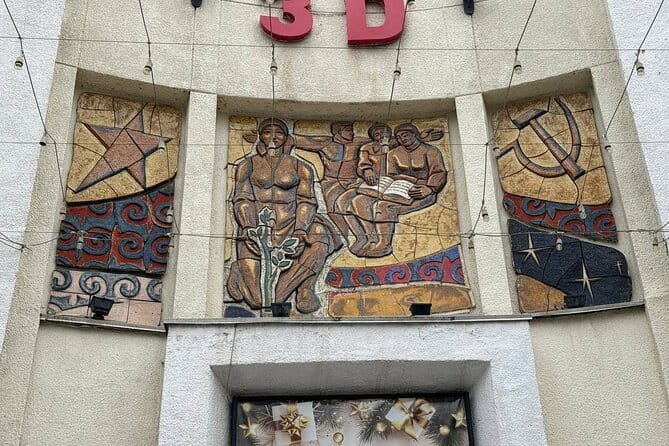
Ala-Too Cinema dates from the early 1960s and is described as the oldest movie theater in Kyrgyzstan. The building’s main appeal on this route is its mosaic work.
This is the sort of stop that rewards a careful look. Soviet public art often used strong figures, work scenes, industry, education, and national imagery to communicate official values. A cinema was not just a place to watch films. Its exterior could also present a public message.
You’ll have about ten minutes here, enough time to inspect the mosaic and hear the building’s background. If you enjoy Soviet visual art, bring a camera and look closely at the details rather than taking only a quick wide shot.
Fine arts, opera, and the culture of the Soviet city
The Gapar Aitiev National Museum of Fine Arts is another distinctive building on the route. It is named for Gapar Aitiev and is noted for its architecture as well as its art collection.
The tour connects the museum with works brought by famous Russian artists. The schedule allows only five minutes, so this is primarily an exterior and historical stop unless the guide adjusts the timing.
The Maldybaev Opera and Ballet Theater offers a different view of Soviet cultural policy. It opened in Bishkek in 1937 as a Musical Drama Theater and later hosted a long run of performances. The building shows how music and theater were given an official place in the capital.
These stops are useful because they keep the tour from focusing only on politics and military memory. Soviet power was expressed through culture, too. Museums, theaters, cinemas, libraries, and concert halls helped shape the public life of the city.
Victory Square and the memory of the Second World War
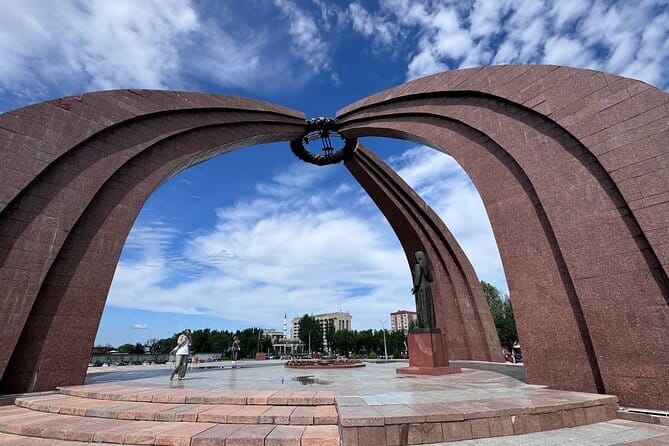
Victory Square was created in 1985 to mark the fortieth anniversary of the end of the war against Nazi Germany. It is dedicated to the Soviet victory and serves as a public memorial in Bishkek.
Expect about ten minutes here. The guide can place the square within the wider Soviet tradition of war remembrance, where memorials were designed not only to honor the dead but also to strengthen a shared political identity.
This is a more serious part of the walk. It also shows how Soviet memory remains part of the city even after independence. The square is not simply an old monument from a discarded era. It continues to be part of Bishkek’s public spaces and ceremonies.
The National Library and Soviet civic confidence
The National Library of the Kyrgyz Republic was founded in 1934 and serves as the country’s legal deposit and copyright agency. Its collection contains six million documents in 89 languages.
The stop lasts about five minutes, so you will not be exploring the collection in depth. Instead, you’ll see the library as a civic institution and as part of the city’s Soviet-era public architecture.
Libraries were important symbols in Soviet cities. They suggested education, access to knowledge, and the reach of the state. The large collection also points to Bishkek’s role as a place where Kyrgyz, Russian, and international material meet.
Marx, Engels, and the surviving Lenin statue
The monument to Karl Marx and Friedrich Engels brings the Communist Manifesto into the discussion. Written jointly between December 1847 and January 1848, it became one of the central texts of communist political thought.
The stop is short, but it helps explain the intellectual basis behind the political system that shaped Bishkek for decades. The tour then turns to the Lenin statue, erected in 1984 for the sixtieth anniversary of the Kyrgyz Soviet Socialist Republic.
After communism fell in 1991, Lenin statues were removed in many places. Bishkek’s remaining Lenin monument therefore offers a useful example of how cities handle political symbols after a major change in government.
I like this part of the route because it avoids treating Soviet statues as mere curiosities. You are encouraged to ask why some were removed, why some survived, and how public memory changes with political power.
Panfilov Park and public space
Panfilov Park sits near Old Square and Manas Square. It is named for Ivan Panfilov, a Hero of the Soviet Union and chairman of the Military Committee of the Kirghiz Soviet Socialist Republic.
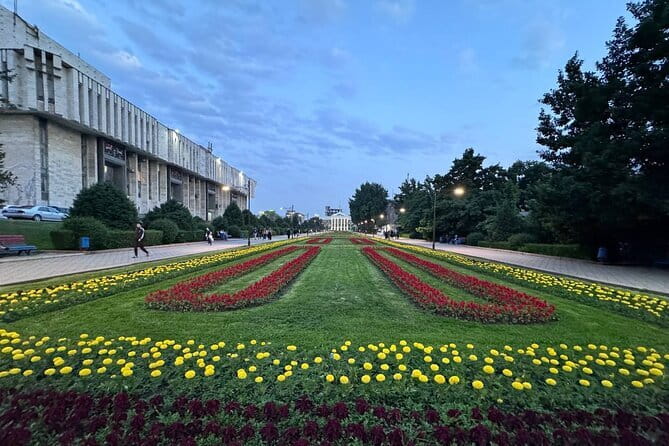
The park adds trees and open space to a route otherwise filled with buildings and monuments. It also shows how Soviet city planning used parks as places for leisure, commemoration, and public gatherings.
The stop is listed at five minutes, so don’t expect a long walk through every corner. You will get the name, the memorial connection, and the park’s place within central Bishkek.
The textile factory mosaic and working women
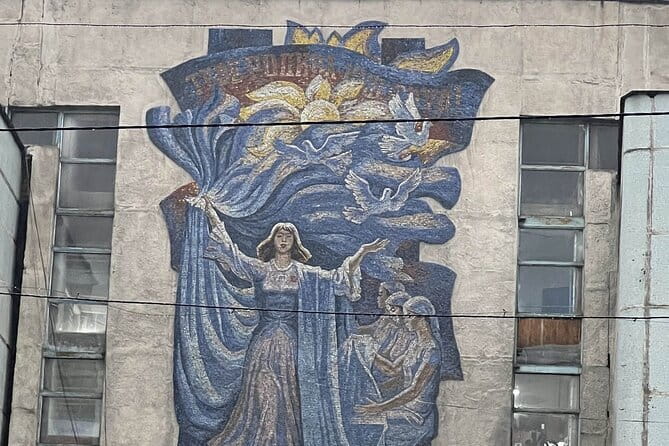
One of the most distinctive stops is the large mosaic titled Our Work to You, Motherland, placed on a textile factory. It presents the power of working women and the contribution of labor to the Soviet nation.
This is exactly the kind of public art that can be easy to miss if you walk around Bishkek without a guide. The mosaic is not simply decoration. It shows how Soviet imagery praised work, industry, women’s participation, and loyalty to the state.
You’ll have about five minutes here. That is enough for an explanation and photographs, though anyone especially interested in mosaics may wish the schedule allowed more time.
Philharmonic Hall and Stalin-era City Hall
The Toktogul Satylganov Philharmonic Hall grew from a Philharmonic Society founded on October 7, 1936. For years, concerts were held in other venues because the society had no dedicated hall. The building represents the effort to create formal institutions for Kyrgyz and Soviet musical life.
The final major architectural stop is Bishkek City Hall. It is the mayor’s office and is described as an example of Stalin-era architecture.
This is a fitting end to the route. You have seen public buildings for cinema, fine art, opera, music, books, government, and memorials. Together, they show how the Soviet capital was designed to organize civic life around state institutions.
The schedule gives ten minutes at City Hall, with the remaining time used for walking, sightseeing, and exploration. Since the tour ends back at the starting point, you can make your next plan from the same central area.
Pace, group size, and practical value
The advertised duration is 3 to 4 hours, and one detailed experience lasted about 3.5 hours. With a maximum of 25 people, the group may be small enough for questions, but it is not a private tour.
The number of stops makes the pace fairly full. Several locations receive five minutes, while only a few receive ten. You should wear comfortable shoes and expect to spend much of the time moving between squares, parks, monuments, and buildings.
No air-conditioned vehicle is included. Food, drinks, and insurance are also not included. All stated fees and taxes, guide services in the mentioned language, and recommendations for local food and other Kyrgyzstan sights are included.
The tour is available with group discounts, and mobile tickets are accepted. Confirmation is received when you book. Most people can participate, though the supplied details do not provide a more specific accessibility assessment.
Free cancellation is available if you cancel at least 24 hours before the local start time. Changes or cancellations made later are not accepted for a refund.
Who will get the most from this Bishkek tour?
I would choose this experience if you enjoy architecture, twentieth-century politics, public art, or cities shaped by changing governments. It is also a good first-day activity because it helps you understand Bishkek’s center and gives you suggestions for food and other places to visit.
It suits you especially well if you prefer a guide to explain why a building matters. The route includes many sights that can look plain or confusing without context, including the mosaics, the remaining Lenin statue, and the Stalin-era civic buildings.
You may want something else if you prefer long museum visits, a relaxed walking pace, or a tour focused mainly on ancient Kyrgyz culture. The museum and national identity stops are valuable, but the main subject is Bishkek’s Russian and Soviet transformation.
Should you book it?
At $49 per person, I think this is a solid choice for an organized introduction to Bishkek’s Soviet architecture and public art. The strongest points are the wide range of stops, the balance between Soviet and Kyrgyz subjects, and the guides’ ability to explain the meaning behind statues, buildings, and mosaics.
Ask about Anna or Alex if you particularly want one of the named guides, but understand that a specific guide is not promised. Book it if you want a clear three-hour orientation with history, architecture, and local suggestions. Skip it if you want extensive time inside museums or prefer to explore each sight slowly on your own.
FAQ
How long does the Bishkek Soviet history tour last?
The experience lasts approximately 3 to 4 hours. One detailed schedule lasted about 3.5 hours, including walking, sightseeing, and time at the stops.
How much does the tour cost?
The listed price is $49 per person. Group discounts are available.
Where does the tour start and finish?
It starts at the Paramount Kyrgyz Republic Flag on Chuy Avenue in Bishkek. The activity ends back at the same meeting point.
Is transportation included?
No air-conditioned vehicle is included. The experience is presented as a walking-focused city tour through squares, parks, monuments, and central buildings.
What does the price include?
The price includes all fees and taxes, a guide in the mentioned language, and recommendations for good places to visit in Kyrgyzstan and for local food. Food, drinks, and insurance are not included.
Can I cancel for a full refund?
Yes. You must cancel at least 24 hours before the local start time for a full refund. Cancellations or changes made less than 24 hours before the start are not accepted for a refund.
Newly added in the world
- Venice Art and Architecture Private Walking Tour★ 4.5 · 11 reviews
- Basilica San Marco and the Pala d’Oro with Architect Guide★ 4.5 · 19 reviews
- Walking tour in Venice with an architect★ 5.0 · 16 reviews
- Paris: Discover the hidden architecture gems of Le Marais★ 3.8 · 4 reviews
- Porto Tour: Street Art & Architecture Experience 3h★ 5.0 · 4 reviews
- Faro Private Walking Tour: Uncovering its Architectural Legacy★ 5.0 · 8 reviews
- Private Walking Tour of Old Gdańsk with an architect-guide★ 5.0 · 7 reviews
- Sopot Private City Walking or Bike Tour with a local architect★ 5.0 · 19 reviews
Bauhaus and Brutalist Architecture Tours, compared.
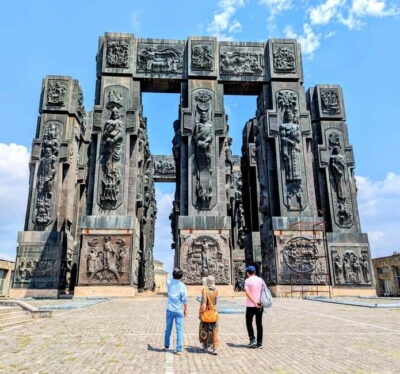
Brutalist Tbilisi: Urban exploration and untold stories
Read our review →
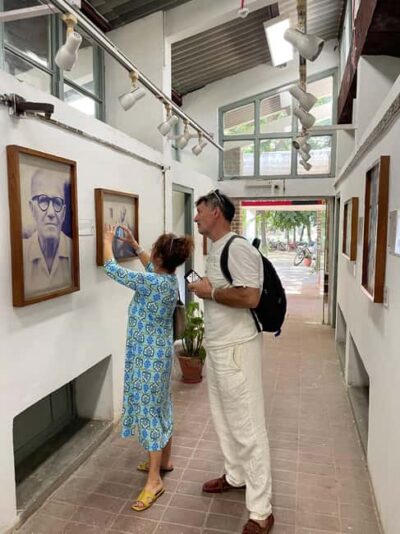
Le Corbusier’s Chandigarh : A Complete Architecture Tour
Read our review →
Architecture of New Belgrade – Brutalism Decoded
Read our review →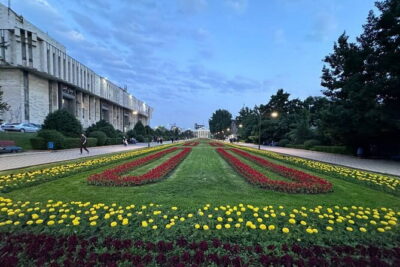
USSR History, Soviet Architects ,Statues & Mosaics
Read our review →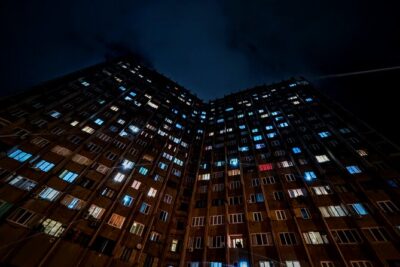
Brutal Tbilisi — Night Edition: Dark Side of Soviet Architecture
Read our review →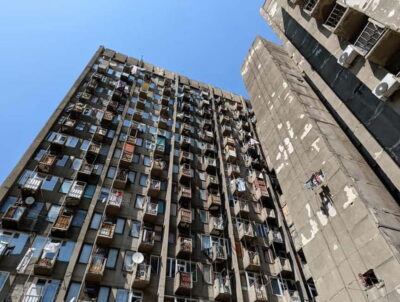
Browse the lists this tour appears in