
Review · WALKING TOURS
Financial District NYC Architecture Walking Tour
Lower Manhattan compresses centuries of New York into a walk of roughly two hours. You begin at Battery Park with colonial-era landmarks nearby, then move through Wall Street, modern office towers, Ground Zero, and the striking World Trade Center complex. The real subject is not just architecture. It is how New York keeps rebuilding, adapting, and arguing with its own past.
I like the small group limit of 15, which gives you a better chance to hear the guide and ask questions. I also like the route’s clear visual contrast, from Trinity Church and Federal Hall to the futuristic Oculus and the new World Trade Center. The main drawback is the pace: with so many major buildings packed into two hours, several stops are brief, and this is not a good choice if walking is difficult.
Key points before you book
- Battery Park to the Oculus: The route crosses a useful slice of Lower Manhattan and ends inside the World Trade Center PATH station.
- Architecture across several eras: You see 19th-century churches and civic buildings, Art Deco and mid-century modern work, and bold 21st-century designs.
- Ground Zero is part of the walk: The route includes the 9/11 Memorial, the museum exterior and design context, Liberty Park, and nearby memorial architecture.
- A maximum of 15 people: The group size suits anyone who wants to ask questions without shouting across a crowd.
- Headsets and a photo are included: Individual audio headsets help with city noise, and a professional photo gives you a simple souvenir.
- Two hours means a brisk overview: Most stops last between five and ten minutes, so expect orientation and explanation rather than long interior visits.
From Battery Park to the story of New York
The tour begins at the Glass Carousel in Battery Park, near Castle Clinton National Monument. This is a sensible meeting point. You are at the southern tip of Manhattan, close to the harbor, with the city’s oldest civic layers behind you and the financial district only a short walk away.
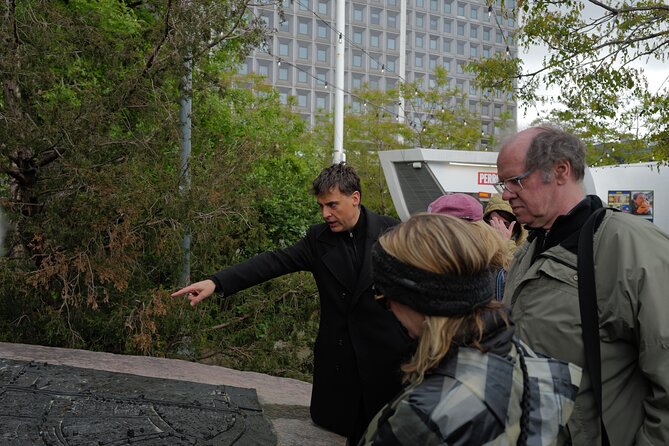
Dr. Ivan Shumkov is listed as the licensed guide for the departure. A guide named William also received special praise for explaining the route clearly and helping with a lunch reservation afterward. Since guides can vary by date, the useful point is that the experience is built around a live guide, not a recorded audio walk.
You receive an individual headset. That matters in Lower Manhattan, where traffic, construction, sirens, and large crowds can make ordinary conversation hard. The headsets should let you keep walking while still hearing the explanation, though you will want to stay close enough to follow the group’s movement.
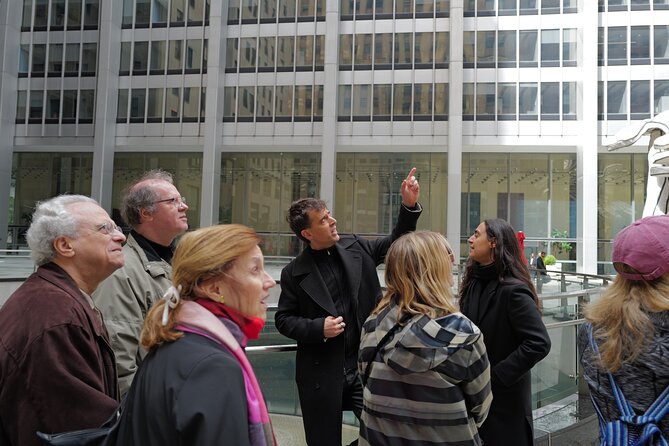
This is an architecture walk, but it is also a lesson in changing civic priorities. You move from churches and government buildings to banks, transit hubs, memorials, and performance spaces. The route works best when you pay attention to the conversation between old and new buildings, not just to each landmark as an isolated object.
More Walking Tours in New York City
- Tribeca Architecture And History Walking Tour
★ 5.0 · 141 reviews - TriBeCa Architecture & History Walking Tour
★ 5.0 · 37 reviews - Midtown Manhattan Art and Architecture Walking Tour
★ 5.0 · 32 reviews
Trinity Church and Federal Hall: New York’s older public face
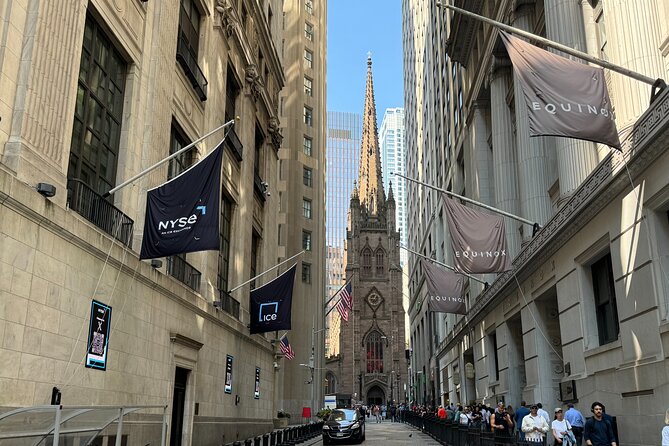
Trinity Church receives only about five minutes on the planned route, but it gives you an immediate sense of how old Lower Manhattan can feel. The church dates from 1846 and sits among the financial district’s taller commercial buildings. That contrast is part of the appeal: a historic religious building remains surrounded by a district better known for money and office towers.
Do not expect a long church visit at this point. The short stop is designed to place Trinity in the larger story of the neighborhood. Your guide can connect the church to the streets around it and explain why older structures still matter in a district that has been rebuilt many times.
Federal Hall, designed by Town and Davis and dating from 1842, continues that civic theme. Its location makes it an important stop even if you are mainly interested in design. The building represents the government and public institutions that helped shape the district before the modern banking towers arrived.
The Federal Reserve appears between these early stops, with its 1924 building by York and Sawyer. The tour points out its role as a place associated with the storage of much of the world’s gold. That detail adds some drama, but the building itself also helps show how financial power became physically expressed in Lower Manhattan.
These early stops are best for context. If you want to go inside every building or spend time studying architectural details, two hours will feel short. If you want a smart introduction before exploring on your own, the quick treatment makes sense.
Woolworth, Chase Manhattan, and the rise of the office tower
The Woolworth Building is one of the route’s visual highlights. Cass Gilbert designed it, and it dates from 1912. The tour lets you see how an earlier generation used height, ornament, and a strong silhouette to announce commercial power.
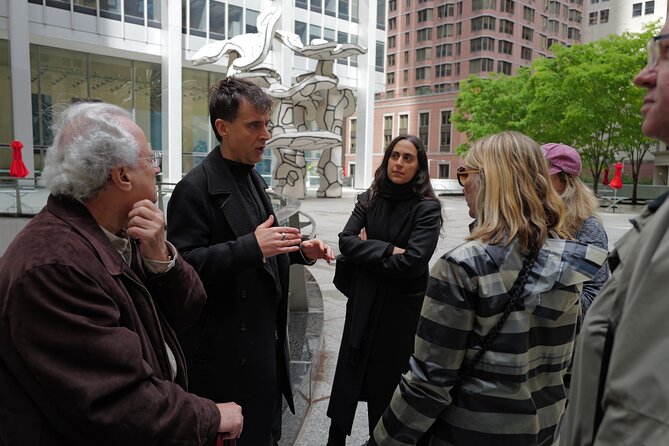
The Woolworth stop is especially useful beside the later Chase Manhattan Bank. At One Chase Manhattan Plaza, you see Gordon Bunshaft’s work for Skidmore, Owings and Merrill, completed in 1960. The design belongs to a different period, with a more restrained modern approach than the Woolworth Building.
The Chase Manhattan stop lasts about ten minutes and includes the building’s public art and architecture. That extra focus is welcome. Mid-century office design can be easy to overlook when a city is full of decorated older buildings and dramatic new structures, yet this kind of plain-spoken modernism shaped much of the financial district.
I would pay attention here to the shift in attitude. The Woolworth Building reaches upward with visual decoration. Chase Manhattan presents a cleaner corporate image, with public space and large-scale modern design doing the work. Seeing both during one walk makes the changes easier to understand than seeing either one alone.
Fulton Center and 8 Spruce Street: transit and sculpture
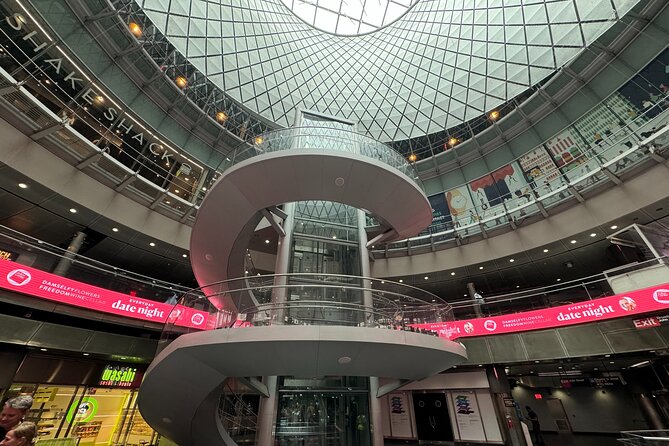
Fulton Center represents a more recent chapter. The Grimshaw-designed station opened in 2015, and the stop lasts about five minutes. It is a practical place to discuss how transportation projects can become architectural statements rather than merely functional underground spaces.
The building also gives you a sense of how Lower Manhattan serves several roles at once. People come here for work, tourism, memorials, shopping, transit, and public events. Fulton Center sits within that mix, so the guide’s explanation can help you notice the relationship between the station and the surrounding streets.
Nearby, the route points out 8 Spruce Street, known as New York by Frank Gehry, completed in 2010. Its rippling exterior looks very different from the rigid glass boxes associated with many office towers. Even from street level, it gives the walk a welcome change in texture and shape.
You will not get a full building tour at either stop. The value is in seeing them in sequence, with the guide explaining how a transit building and a residential skyscraper respond to the same crowded downtown setting.
More Walking Tours in the USA
- Holdouts: A NYC Architecture Walking Tour
★ 5.0 · 31 reviews - Midtown North NYC Architecture Walking Tour
★ 5.0 · 28 reviews - The Official Art Deco Walking Tour by The Miami Design Preservation League
★ 5.0 · 1,580 reviews - Chicago in a Day: Food, History & Architecture Walking Tour
★ 5.0 · 1,153 reviews
Ground Zero and the 9/11 Memorial area
The 9/11 Memorial and Museum is one of the most serious sections of the walk. The tour identifies the work of Snohetta, Michael Arad, and Peter Walker, with the memorial dating from 2011. The design requires a slower, more respectful kind of attention than the financial district’s towers and plazas.
The scheduled stop is about ten minutes. That is enough to orient you to the memorial and its architectural approach, but not enough for a full museum visit. Admission to the museum itself is not included as a separate visit, and the tour should not be treated as a substitute for spending time inside.
This limitation is worth knowing before booking. If your main goal is the 9/11 Museum’s exhibits, artifacts, and personal stories, plan a separate visit. If you want to understand how the memorial fits into the rebuilt World Trade Center, this walking stop provides a useful framework.
A professional photo is also included in the experience. The information does not specify exactly when or where it is taken, so consider it an added keepsake rather than the main reason to book. The strongest part of this section remains the chance to pause and consider how memorial design works in a place with such intense public meaning.
St. Nicholas and the Perelman Performing Arts Center
The rebuilt St. Nicholas Greek Orthodox Church and National Shrine offers another important contrast. Santiago Calatrava designed the church, completed in 2020. Its presence near the World Trade Center shows that the new district is not only about offices, transport, and memorials. It also includes a place of worship with a distinct architectural identity.
The planned stop lasts about five minutes. That makes it a viewing and explanation stop, not a full church visit. You should be prepared to admire the exterior and hear the building’s place in the area’s rebuilding story rather than linger for a long examination.
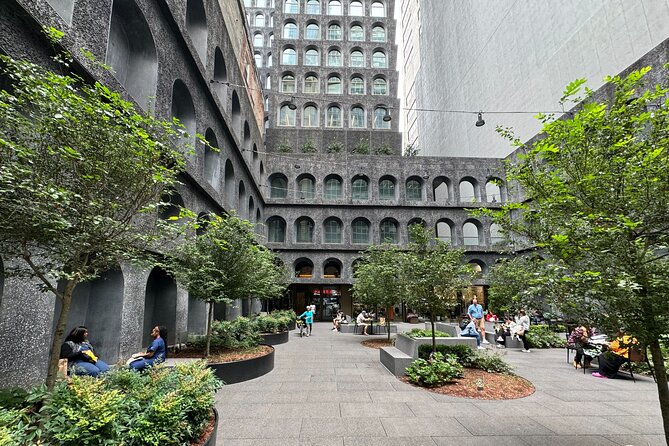
The route then includes the Perelman Performing Arts Center, designed by REX and completed in 2023. Its inclusion keeps the tour current. Lower Manhattan’s rebuilding is still an active process, and the arts center gives the area a civic use beyond business and remembrance.
These two buildings also make the route more personal. A church and a performing arts center serve different needs, yet both help create a district that people can use for community life. That is a more useful way to look at new architecture than judging buildings only by their shape.
Liberty Park and the World Trade Center towers
At World Trade Center Liberty Park, the tour turns toward the larger complex of towers. You see One World Trade Center by David Childs and SOM, completed in 2015, along with 3 World Trade Center by Richard Rogers, completed in 2018, and 4 World Trade Center by Fumihiko Maki, completed in 2015.
The route also points out 7 World Trade Center, another David Childs and SOM project, completed in 2015. Two additional towers, 2 World Trade Center and 5 World Trade Center, are identified as still in process. That detail matters because the site remains unfinished in a literal sense. You are looking at a district that continues to change rather than a project with a final, settled form.
The stop lasts about ten minutes. From Liberty Park, the guide can help you sort out the towers and their different designers. Without explanation, a visitor can easily remember only a forest of glass and steel. With the architectural names and dates, the area becomes a record of distinct design choices.
This is also where the tour’s compact format has both strength and weakness. The strength is efficiency. You see a large portion of the World Trade Center site without spending a full day walking between separate attractions. The weakness is that each building gets only a short introduction.
Ending inside Calatrava’s Oculus
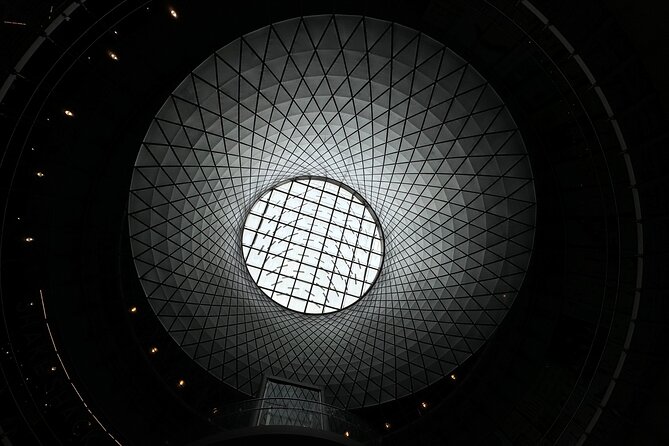
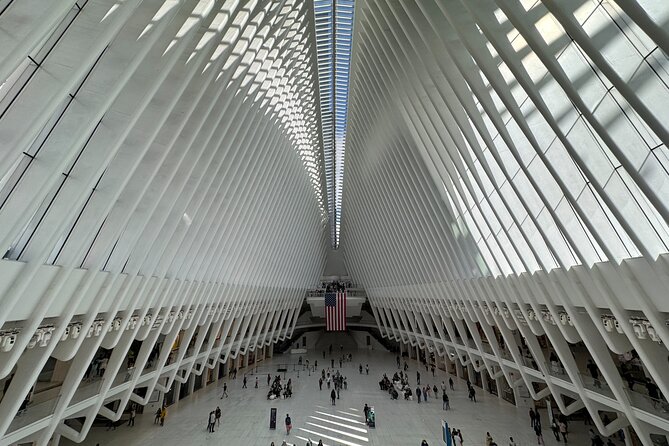
The final stop is the Oculus PATH station, designed by Santiago Calatrava and completed in 2015. The interior is the tour’s most dramatic finish, with a bright, sweeping structure that looks unlike the more conventional office towers nearby.
Ending here is practical as well as visual. The tour finishes inside the World Trade Center PATH station at 185 Greenwich Street, so you can continue by public transportation or explore the surrounding complex on your own. Since the start is at Battery Park and the end is downtown near the World Trade Center, the route has a clear direction rather than sending you back to the beginning.
Allow yourself a little time to look around before leaving. The ten-minute stop is enough for an introduction, but you may want to linger if modern structural design interests you. The Oculus is also a useful place to finish because it brings together the tour’s main themes: transportation, rebuilding, public space, and ambitious contemporary architecture.
Is $59 a fair price for two hours?
The price is $59 per person. I see reasonable value if you want a guide to organize the district’s major buildings and explain the links between them. You are paying for a small-group experience, a licensed guide, individual headsets, and a professional photo, with fees and taxes included.
The value is less clear if you only want to look at the buildings from the street. Lower Manhattan is easy to walk through independently, and you can see many of these exteriors without paying an admission fee. The tour earns its price through interpretation, route planning, and the chance to ask questions.
The maximum of 15 people helps. A large group would be awkward on narrow sidewalks and around memorial spaces. This size also gives you a better chance to hear the guide and ask about a building that catches your eye.
The tour is booked an average of 27 days ahead, so advance planning is sensible. Confirmation arrives at booking. Free cancellation is available up to 24 hours before the start time, while cancellations or changes within 24 hours are not refunded. Poor weather or failure to meet the minimum group size can lead to a new date or a full refund.
Who will enjoy this walk most?
I would recommend it to a first-time New York visitor who wants a well-shaped introduction to Lower Manhattan. It also suits families and teenagers because the route keeps changing subjects, from churches and gold reserves to towers, memorials, and a striking transit station. One family outing included teenagers who enjoyed the information, and the guide helped the group reach a lunch reservation afterward.
It is a good fit for anyone who likes buildings but does not want a technical architecture lecture. The live explanations and question time make the subject more approachable.
You should think twice if walking is a problem. The tour requires movement through a dense downtown area, and the supplied guidance specifically says it is not recommended for people with walking difficulties. Service animals are allowed, and the route is near public transportation.
Also keep your expectations clear. This is not a museum tour, a tower admission, or a long interior visit. It is a guided outdoor overview, with brief stops and a steady pace.
Should you book the Financial District architecture walk?
Book it if you want one efficient route through several centuries of Lower Manhattan design, especially if you value explanation more than independent wandering. The combination of Federal Hall, Trinity Church, Chase Manhattan, 8 Spruce Street, the 9/11 Memorial area, Liberty Park, and the Oculus gives you a broad view of how the district has changed.
Skip it if you prefer to spend a long time inside each site or if a two-hour walk would be tiring. You can see many of the exteriors yourself, and the 9/11 Museum still deserves separate time.
For most visitors who want structure, context, and a manageable group, $59 is a fair price. The best reason to book is not simply the number of landmarks. It is the chance to see old civic buildings, financial power, memorial architecture, and new public spaces as parts of one connected New York story.
FAQ
Where does the tour begin?
It begins at the Glass Carousel in Battery Park, near Castle Clinton National Monument, New York, NY 10004.
Where does the tour end?
It ends inside the Oculus PATH station at the World Trade Center, at 185 Greenwich Street, New York, NY 10006.
How long does the tour last?
The walking tour lasts approximately two hours.
How large is the group?
The tour has a maximum of 15 participants.
Are headsets included?
Yes. Each participant receives a professional individual headset.
What happens if I need to cancel?
You can cancel at least 24 hours before the start time for a full refund. Cancellations or changes made less than 24 hours before the start time are not refunded.
Newly added in New York City
- Manhattan Architecture Photography Tour★ 5.0 · 24 reviews
- Midtown North NYC Architecture Walking Tour★ 5.0 · 28 reviews
- Holdouts: A NYC Architecture Walking Tour★ 5.0 · 31 reviews
- Midtown Manhattan Art and Architecture Walking Tour★ 5.0 · 32 reviews
- TriBeCa Architecture & History Walking Tour★ 5.0 · 37 reviews
- New York City: Flatiron Food, History, and Architecture Tour★ 4.8 · 43 reviews
- New York City: Art Deco and Architecture Landmarks Tour★ 5.0 · 76 reviews
- 3 Hour Midtown Manhattan Architectural Tour★ 5.0 · 81 reviews
Walking Tours, compared.
The Official Art Deco Walking Tour by The Miami Design Preservation League
Read our review →
Baroque Architecture and Underground Walking Tour
Read our review →
Chicago in a Day: Food, History & Architecture Walking Tour
Read our review →

Ramblas, Old Town, Gothic and Gaudi Architecture Walking Tour
Read our review →
Chicago’s Secret Interiors Architectural Walking Tour
Read our review →
Browse the lists this tour appears in